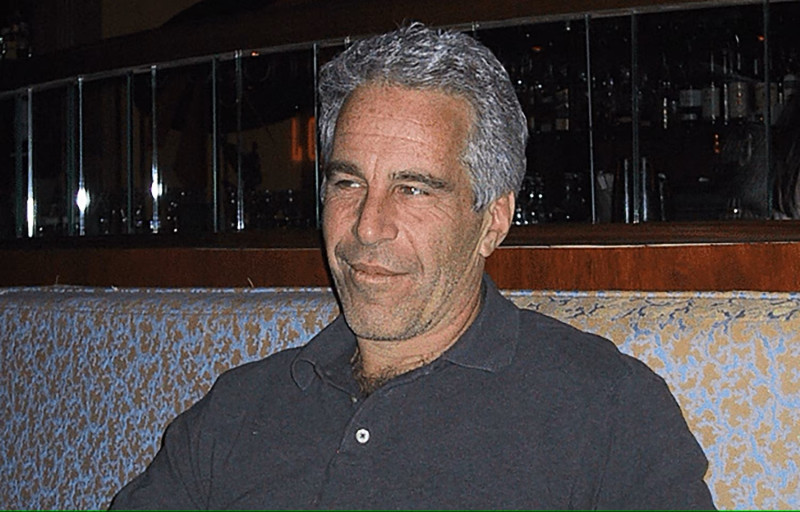
YEARS after escaping the grip of Jeffrey Epstein, a former assistant has revealed how the convicted sex offender allegedly created a network of control that left women dependent on him, isolated from support systems and fearful of leaving.
The woman, identified by the BBC under the pseudonym Anya, said her ordeal began when she was introduced to Epstein through a modelling contact in Paris and gradually drawn into what she described as a carefully constructed trap built on promises of career opportunities, wealth and access to influential circles.
She said the abuse was not enforced through physical imprisonment but through psychological manipulation and dependency.
"I'm still struggling to reconcile with the fact that I was abused for years," Anya said.
"You were not chained to a door or something, right? You were not locked up in a basement. The chains were less obvious, but they were there."
Epstein, who died in 2019 while awaiting trial on federal sex-trafficking charges involving minors, had previously described his own operation as "like a cult, and he was the cult leader", according to Anya.
She told the BBC that Epstein maintained control over a group of female assistants — estimated to number around a dozen at certain periods — who lived in properties connected to him, worked at his direction around the clock and were repeatedly subjected to sexual abuse.
Anya said the women were recruited through deception and promises of employment before Epstein gradually took control of their finances, personal relationships and decisions.
"He built this whole ecosystem of abuse that was serving him," she said.
She said Epstein exploited personal vulnerabilities, monitored their lives closely and used humiliation and fear to maintain authority over them.
Another former assistant, Sarah Kellen, described similar experiences during testimony to the US House Oversight Committee, saying Epstein presented himself as a protector while weakening the women's independence.
"He was very good at just decimating your ability to make your own decisions and have your own autonomy. And it made you more and more dependent on him," Kellen said.
Clinical psychologist Dr Tara Quinn-Cirillo, who has worked with victims of coercive control, said abuse of this nature was not limited to children.
"There is a bias which tends to make people think that only children are susceptible to this type of coercion, but you can be groomed as an adult," she said.
"You can be vulnerable to this."
Anya said she initially believed Epstein could help advance her modelling career, having already worked with luxury brands including Fendi and Chanel after leaving Russia in search of better opportunities.
She said modelling scout Daniel Siad introduced her to Epstein, describing the meeting as a deliberate attempt to target her.
"It was a complete set-up," she said, accusing Siad of being "essentially a professional trafficker".
Siad’s name appears thousands of times in documents linked to the Epstein investigation, although his lawyer has previously denied any knowledge of Epstein’s criminal activities.
Anya said her first meeting with Epstein took place at his Paris apartment, where she felt reassured because other women were present.
She said Epstein asked her to undress so he could assess her suitability for modelling, then criticised her appearance and told her she needed to improve her body.
She said his comments appeared believable because they resembled criticism common within the modelling industry.
Anya recalled that Epstein gained her trust by asking about her ambitions, family and personal goals.
"You don't get asked those questions in fashion," she said.
She said Epstein also attempted to address her suspicions directly.
"I see that you're smart and you're suspicious," she recalled him telling her. "I don't want to sleep with you."
Anya said the comment made her trust him further.
"I was telling myself, gosh, this guy is just incredible. He can see right through me," she said.
Over the following months, she said Epstein intensified his control through what she described as a lengthy grooming process.
She claimed Epstein pressured her to send photographs of her body, while his executive assistant Lesley Groff monitored her progress through emails.
Anya said Epstein eventually arranged what appeared to be a meeting with Faith Kates, co-founder of modelling agency Next Management, but she later discovered documents suggesting the agency had rejected her before the meeting took place.
She said the revelation showed she had been deliberately kept hopeful and dependent.
"It was a very elaborate grooming," she said.
Faith Kates’ lawyer rejected any suggestion that she was involved in Epstein’s alleged trafficking activities, describing such claims as false and defamatory. Next Management also said it had no relationship with Epstein and that any alleged actions by Kates were her own.
After modelling opportunities failed to materialise, Anya said Epstein encouraged her to work as his assistant.
"Come work for me, I'll teach you a real business. You'll travel, you meet important people all over the world," she recalled him saying.
Instead, she said the role involved waiting for instructions, carrying out minor tasks and remaining available at all times.
She said Epstein controlled her access to money, healthcare and housing, leaving her unable to live independently.
"If I got sick and needed healthcare, he would tell me: 'I'm your medical insurance,'" she said.
Anya said Epstein repeatedly reminded her that he could remove her housing at any time, increasing her dependence on him.
She said one incident involving another assistant who attempted to escape reinforced the fear surrounding leaving.
According to Anya, Epstein hired a private investigator to track down the woman and showed her an email calculating that the missing assistant allegedly owed him US$700,000.
She said the message was clear: leaving would come with consequences.
Anya also alleged that Epstein collected compromising material to discourage women from speaking out.
She recalled an incident where assistants were encouraged to participate in a topless photoshoot that was filmed.
"This way I know you'll never go against me," she recalled Epstein saying.
"That's his library of evidence," she said.
She said Epstein also forced assistants to write what they called "gratitude letters" thanking him.
"I was so terrified of not saying 'thank you' enough to him," Anya said.
"I think partially maybe those gratitude letters were another mechanism of him saying, how can you go against me if you are thanking me all the time?"
She said Epstein deliberately created conflict between the women by telling them others were criticising them while presenting himself as their supporter.
Anya also described undergoing surgery that she said Epstein demanded after objecting to a small tattoo she had.
She said he rejected laser removal because it would take too long and instead suggested cutting away the tattooed skin.
"Only I could come up with that," she recalled him saying.
She said the procedure left permanent scars and was repeated a year later because Epstein was dissatisfied with the result.
One of the most painful memories, Anya said, was being forced to recruit other women into Epstein’s circle.
Each assistant, she claimed, was expected to bring in another woman, creating a continuing cycle of recruitment.
"It's one or 10, like, you're already complicit," she said.
Anya said she decided to speak publicly to help others understand how adults as well as children could become victims of trafficking and coercive abuse.
She said Epstein’s association with wealthy and powerful figures made it harder for victims to challenge him.
"When you have people like Bill Gates come to his house for dinner and shake his hand, you think, who am I to question it? Who am I to speak up here? It legitimised the abuse," she said.
Both Anya and Kellen later received compensation from the Epstein Victims' Compensation Fund after providing evidence supporting their claims.
Anya said she never spoke openly about the abuse while Epstein was alive but now hopes her story can encourage others facing similar situations to seek help.
"I'm not in any way special," she said.
"I just somehow managed to find this strength in me to persevere and to survive. If I can do it, you can do it." - July 18, 2026