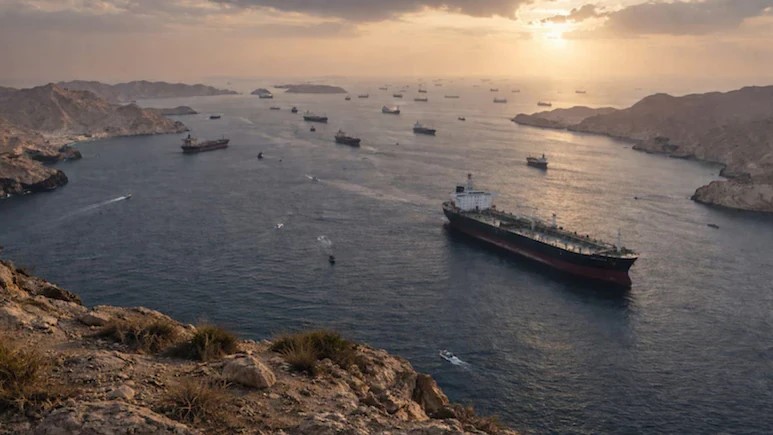
THE European Union and Gulf Cooperation Council have reaffirmed that the Strait of Hormuz must remain open for international navigation, rejecting any attempt by individual countries to impose control, restrictions or financial charges on vessels using the strategic waterway.
In a joint statement issued after the High-Level Forum on Regional Security and Cooperation held in Brussels on July 13, both blocs said no bilateral agreement, arrangement or memorandum between countries could be used unlawfully to regulate or restrict the right of passage through an international strait.
"No arrangement, understanding or bilateral memorandum between states may be unlawfully used to regulate or restrict rights of passage through an international strait," TRT World cited the statement saying today.
The EU and GCC stressed that freedom of navigation is guaranteed to all countries under international law and cannot be subjected to the control or approval of any single nation.
The forum was co-chaired by EU foreign policy chief Kaja Kallas and Bahrain Foreign Minister Abdullatif bin Rashid Al-Zayani, in his capacity as Chairman of the GCC Ministerial Council.
Both sides reiterated that freedom of navigation, including passage through the Strait of Hormuz as a route used for international shipping, is protected under international law as established by the United Nations Convention on the Law of the Sea.
"Ships from all countries enjoy these rights and no country may suspend, obstruct or impose any conditions on them," the statement said.
The EU and GCC also strongly condemned attacks by Iran against commercial vessels travelling through the strait and against the sovereign territories of several countries in the region.
"These attacks endanger the lives of civilians and seafarers, violate international law and United Nations Security Council Resolution 2817, and cannot be justified under any circumstances," the two blocs said.
They called on Iran to "immediately and unconditionally halt all attacks and all forms of interference with maritime navigation" and ensure that the Strait of Hormuz remains open without restrictions, transit fees or service charges.
"Any attack on the security of a country becomes a concern for all parties that depend on the security of this vital waterway," the statement added.
The EU and GCC pledged to continue close coordination to protect freedom of navigation, international shipping and the safety of seafarers.
They also urged all parties to exercise restraint and reaffirmed their commitment to dialogue and diplomacy as the pathway to resolving tensions and safeguarding maritime freedom through the strait.
Tensions in West Asia have continued to escalate as the United States and Iran remain locked in a cycle of retaliatory strikes, raising concerns over the security of one of the world’s most important energy shipping routes. - July 19, 2026