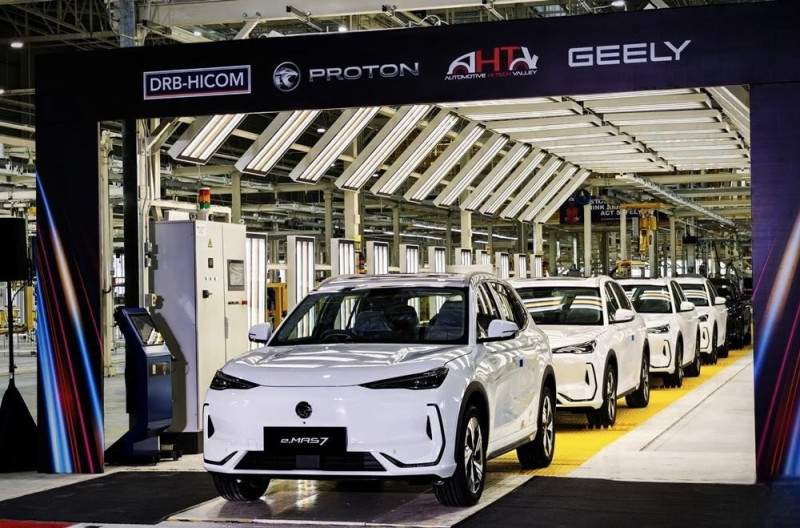
SOUTHEAST Asia’s transition to electric vehicles (EVs) risks undermining its established automotive supply base, with smaller component manufacturers struggling to secure a place in supply chains dominated by Chinese carmakers.
The region’s suppliers face mounting pressure as demand for parts used in internal combustion engine (ICE) vehicles weakens, while high financing and technology costs, coupled with limited access to manufacturers, make it difficult for them to move into EV production.
The challenge is particularly significant in Malaysia, Thailand and Indonesia, where smaller companies have long supplied parts to conventional vehicle manufacturers but have yet to benefit substantially from Chinese EV investments.
SCMP cited Indonesian economist Bhima Yudhistira Adhinegara saying Chinese EV investments had generated limited business for established local component makers because the supply chains differed significantly from those of Japanese automakers.
“The supply chain is very different between Japanese autos and Chinese EVs,” said Bhima, executive director of the Centre of Economic and Law Studies in Jakarta.
“The biggest barriers are financing, technology and access to manufacturers.”
In Thailand, Krungsri Research, the research arm of Bank of Ayudhya, found that local suppliers were struggling to enter Chinese EV supply chains, as manufacturers either imported major components or relied on existing Chinese suppliers.
Thai vendors were consequently at a disadvantage in terms of cost and access to proprietary technology.
Hybrid and aftermarket opportunities
Continued demand for conventional vehicles and hybrids could provide smaller suppliers with revenue to finance their transition to EV production.
In Thailand, hybrid vehicle manufacturing supports demand for both conventional engine components and electrical systems, with Japanese hybrid manufacturers sourcing substantial volumes of parts locally.
An automotive master plan published by the Economic Research Institute for Asean and East Asia on Oct 13 also advocated supporting lower-emission vehicles and hybrids in the near term while preparing for wider electrification.
However, Bhima said smaller Indonesian manufacturers were already under financial pressure from sluggish consumer spending and rising fuel costs, forcing some to downsize, reduce product quality or seek credit restructuring.
“There are no transitional incentives from the government for small ICE suppliers,” SCMP quoted him saying.
He urged the Indonesian government to help smaller manufacturers connect with EV brands and assembly plants, while using local-content requirements to ensure domestic suppliers benefited from investments in the sector.
In Thailand, replacement parts for older ICE vehicles could also provide a source of business as motorists continue using conventional cars despite the shift towards electrification.
Some manufacturers are exploring opportunities beyond the automotive industry, including supplying components for rail, medical equipment, aviation and agricultural machinery.
In Malaysia, the challenge of integrating domestic suppliers into Chinese EV supply chains has come into focus following changes to BYD's local manufacturing plans.
The Chinese automaker dropped its proposed assembly plant in Tanjung Malim following a dispute over export quotas and pricing conditions imposed by the Investment, Trade and Industry Ministry, which defended the requirements as non-discriminatory.
BYD subsequently partnered local contract assembler Inokom to assemble passenger vehicles at an existing facility in Kulim, Kedah.
However, local value-added remains limited. Malaysian media reported in March that locally assembled EVs contained only 20 to 30 per cent domestic content, compared with as much as 70 per cent for foreign-branded ICE vehicles.
Malaysia has also sought to connect domestic suppliers with Chinese manufacturers. In May last year, the Malaysian Investment Development Authority brought together 23 local parts suppliers and 12 technology suppliers with Chery, resulting in four commercial agreements covering components, technology transfer and joint investment.
Aiman Abdullah, managing editor of Motoring Malaysia and a long-time industry observer, said domestic automakers' electrification programmes were gradually building local engineering and manufacturing expertise.
Experience with high-voltage systems in hybrid vehicles could also help suppliers develop the capabilities needed to produce EV components.
However, he said manufacturers needed clearer and more consistent plans from the government and automakers, noting that suppliers typically required six to 18 months to prepare for full-scale production, while investments could take about a decade to generate returns.
“Investors need to see stability and focus in terms of policy before they take out their chequebooks,” he said.
Aiman proposed establishing a fund to help smaller businesses expand production and overcome financial barriers to entering the EV supply chain.
Aftermarket services offer another route
Vehicle servicing, inspection and reconditioning could provide another opportunity for local businesses to participate in the growing EV market.
Carsome co-founder and Carsome Academy chief executive officer Teoh Jiun Ee said Malaysia already had an established ecosystem for conventional automotive services, including body repairs, tyres and suspension.
However, work involving high-voltage systems, battery assessments and model-specific components required more specialised expertise and access to manufacturer-controlled parts and diagnostic systems.
“The key distinction is between work we can carry out here and the parts, data and specialist systems we can access to carry it out,” he said.
Carsome can inspect EVs at its facilities but refers cases involving the repair or replacement of individual battery modules to manufacturers, particularly when vehicles remain under warranty.
Teoh said technicians could build on their existing automotive knowledge by acquiring skills in electrical systems, high-voltage safety and EV diagnostics.
However, he warned that the cost of retraining could prevent some workers from upgrading their skills unless employers, the government and industry partners shared the burden.
“If the cost falls entirely on individual technicians, there is a risk that the people who most need to upgrade their skills may be the least able to access it [training],” he said.
He said developing a more mature used-EV ecosystem would also help ensure vehicles were assessed consistently and safely, giving buyers greater confidence in their condition.
“For us, the broader opportunity is to develop a more mature used-EV ecosystem here, where vehicles can be assessed consistently and safely, and buyers have greater confidence in the condition of the cars they purchase.” - November 1, 2026