PARIS – The Arctic Ocean's floating ice cover has shrivelled to its second lowest extent since satellite records began in 1979, according to United States government scientists yesterday.
Until this month, only once in the last 42 years has Earth's frozen skull cap covered less than four million square kilometres.
The trend line is clear: sea ice extent has diminished 14 per cent per decade over that period. The Arctic could see it's first ice-free summer as early as 2035, researchers reported in Nature Climate Change last month.
But all that melting ice and snow does not directly boost sea levels any more than melted ice cubes make a glass of water overflow, which gives rise to an awkward question: who cares?
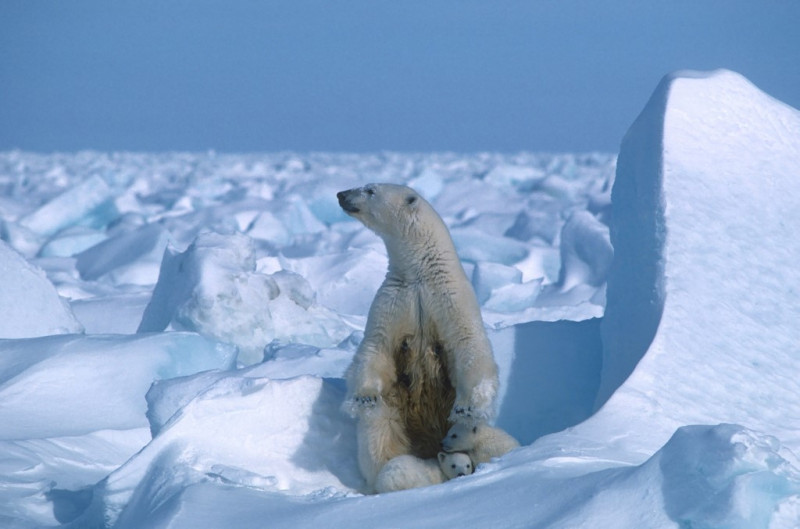
Granted, this would be bad news for polar bears, which are already on a glide path towards extinction, according to a recent study.
And yes, it would certainly mean a profound shift in the region's marine ecosystems, from phytoplankton to whales.
But if our bottom-line concern is the impact on humanity, one might legitimately ask, "So what?".
As it turns out, there are several reasons to be worried about the knock-on consequences of dwindling Arctic sea ice.
'Feedback loops'
Perhaps the most basic point to make, scientists say, is that a shrinking ice cap is not just a symptom of global warming, but a driver as well.
"Sea ice removal exposes dark ocean, which creates a powerful feedback mechanism," Marco Tedesco, a geophysicist at Columbia University's Earth Institute, told AFP.
Freshly fallen snow reflects 80 per cent of the Sun's radiative force back into space.
But when that mirror-like surface is replaced by deep blue water, about the same percentage of Earth-heating energy is absorbed instead.
And we're not talking about a postage stamp area here: the difference between the average ice cap minimum from 1979 to 1990 and the low point reported today more than 3 million km2 -- is twice the size of France, Germany and Spain combined.
The oceans have already soaked up 90 percent of the excess heat generated by manmade greenhouse gases, but at a terrible cost, including altered chemistry, massive marine heatwaves and dying coral reefs.
And at some point, scientists warn, that liquid heat sponge may simply become saturated.
'Altering ocean currents'
Earth's complex climate system includes interlocking ocean currents driven by wind, tides and something called the thermohaline circulation, which is itself powered by changes in temperature ("thermo") and salt concentration ("haline").
Even small changes in this Great Ocean Conveyor Belt -- which moves between poles and across all three major oceans – can have devastating climate impacts.
Nearly 13,000 years ago, for example, as Earth was transitioning out of an ice age into the interglacial period that allowed our species to thrive, global temperatures abruptly plunged several degrees Celsius. They jumped back up again about 1,000 years later.
Geological evidence suggests a slowdown in the thermohaline circulation caused by a massive and rapid influx of cold, fresh water from the Artic region was partly to blame.
"The fresh water from melting sea ice and grounded ice in Greenland perturbs and weakens the Gulf Stream," part of the conveyor belt flowing in the Atlantic, said Xavier Fettweis, a research associate at the University of Liege in Belgium.
"This is what allows western Europe to have a temperate climate compared to the same latitude in North America."
The massive ice sheet atop Greenland's land mass saw a net loss of more than half-a-trillion tonnes last year, all of it flowing into the sea.
Unlike sea ice, which doesn't increase sea levels when it melts, runoff from Greenland does.
That record amount was due in part to warmer air temperatures, which have risen twice as fast in the Arctic as for the planet as a whole.
But it was also caused by a change in weather patterns, notably an increase in sunny summer days.
"Some studies suggest that this increase in anticyclonic conditions in the Arctic in summer results in part from the minimum sea ice extent," Fettweis told AFP.
'Bears nearing extinction'
The current trajectory of climate change and the advent of ice-free summers – defined by the UN's IPCC climate science panel as under one million km2 – would indeed starve polar bears into extinction by century's end, according to a July study in Nature.
"Human-caused global warming means that polar bears have less and less sea ice to hunt on in the summer months," Steven Amstrup, lead author of the study and chief scientist of Polar Bears International, told AFP.
"With unabated greenhouse gas emissions, the ultimate trajectory of polar bears is disappearance." – AFP, September 22, 2020



.jpeg)