_Anthony_Albanese__Joe_Biden__Fumio_Kishida__Narendra_Modi-Tokyo-AFP_pic.jpg)
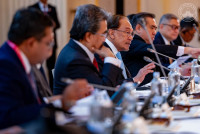
TOKYO – Leaders of Japan, India, Australia and the United States warned today against attempts to “change the status quo by force” as concerns grow about whether China could invade self-ruled Taiwan.
A joint statement by the so-called Quad bloc avoided any direct mention of China’s growing military power in the region, but left little doubt about where its concerns lie.
The carefully worded document also made reference to the conflict in Ukraine, but without offering any joint position on an invasion that India has pointedly declined to condemn.
The Quad’s other members have been less coy about their view that a strong response to Russia’s war is needed and sends a message that will deter other countries, including China.
“As Russia’s invasion of Ukraine is shaking the fundamental principles of the international order... (we) confirmed that unilateral attempts to change the status quo by force will never be tolerated anywhere, particularly in the Indo-Pacific region,” Japan’s Prime Minister Fumio Kishida said.
The group’s joint statement made no mention of Russia, or China, but listed a range of activities that Beijing has regularly been accused of in the region.
“We strongly oppose any coercive, provocative or unilateral actions that seek to change the status quo and increase tensions in the area, such as the militarisation of disputed features, the dangerous use of coast guard vessels and maritime militia and efforts to disrupt other countries’ offshore resource exploitation activities,” it said.
The four nations are attempting to build their loose grouping into a more substantive counterweight to China’s rising military and economic power, despite their differences.
They unveiled plans to invest at least US$50 billion (RM219.6 billion) into infrastructure projects in the region over the next five years and a maritime monitoring initiative seen as intended to bolster surveillance of Chinese activities.
The moves come with worries over recent efforts by China to build ties with Pacific nations including the Solomon Islands, which sealed a security pact with Beijing last month.
China’s foreign minister will visit the Solomon Islands this week, with reports suggesting he could add other countries including Vanuatu, Samoa, Tonga and Kiribati.
‘Democracies versus autocracies’
In a nod to those concerns, Kishida earlier urged Quad members to “listen carefully” to regional neighbours, including the Pacific islands.
“Without walking together with countries in the region, the Quad cannot be successful,” he said.
Australia’s newly elected Prime Minister Anthony Albanese also said the bloc needed to “push our shared values in the region at a time when China was clearly seeking to exert more influence”.
The Quad met a day after US President Joe Biden raised eyebrows and the regional temperature by saying Washington was ready to intervene militarily to defend Taiwan against any Chinese attack.
He insisted today that his comments did not mean a change to Washington’s longstanding “strategic ambiguity” on how it might respond to a Chinese invasion, but Beijing reacted angrily nonetheless.
And if Biden was keen to avoid being seen as changing policy, he left little doubt about where the Quad’s focus lies.
“This is about democracies versus autocracies, and we have to make sure we deliver,” he said as the Quad summit began.
US strategy is for a “free, open, connected, secure and resilient Indo-Pacific. Russia’s assault on Ukraine only heightens the importance of those goals.”
There is growing regional discomfort with Chinese military activity including sorties, naval exercises and encroachments by fishing vessels that are viewed as probing regional defences and red lines.
The bloc said its new maritime monitoring programme would “promote stability and prosperity in our seas and oceans”, again avoiding pointing the finger at Beijing while referencing illegal fishing – an accusation frequently levelled at China.
The leaders are set to meet again in person next year, in Australia. – AFP, May 24, 2022