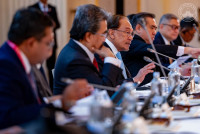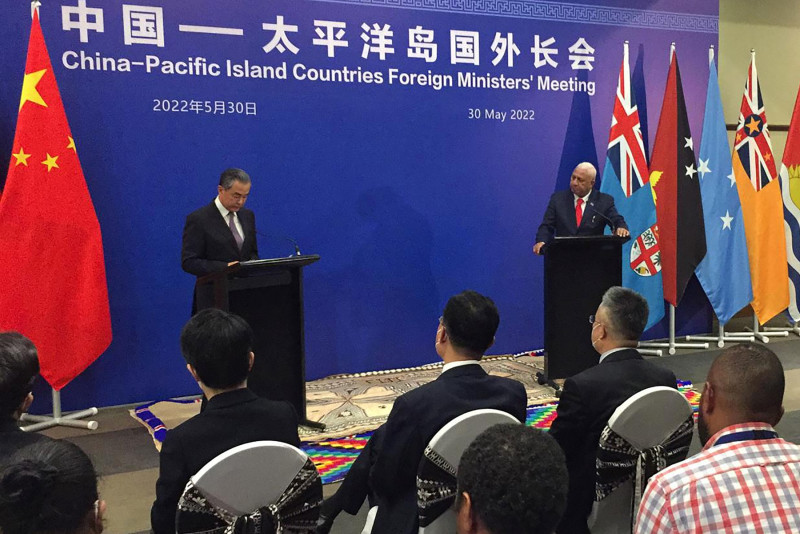
SUVA – Talks between Chinese Foreign Minister Wang Yi and 10 Pacific Island nations failed to reach an agreement on a wide-ranging security deal today after sharp warnings the proposal would push the region into “Beijing’s orbit”.
A virtual summit of leaders and foreign ministers was expected to discuss proposals to radically increase China’s involvement in the security, economy and politics of the South Pacific.
But the effort appeared to have fallen short after some regional leaders voiced deep concern.
“As always, we put consensus first,” co-host and Fijian Prime Minister Frank Bainimarama said after the meeting, indicating that broad agreement would be needed before inking any “new regional agreements”.
Wang is in the Fijian capital Suva as part of a 10-day diplomatic blitz, as Beijing jostles with Washington and its allies over influence in the strategically vital Pacific.
Ahead of his visit, China proposed a pact that would see Beijing train Pacific Island police, become involved in cybersecurity, expand political ties, conduct sensitive marine mapping and gain greater access to natural resources on land and in the water.
As an enticement, Beijing offered millions of dollars in financial assistance, the prospect of a China-Pacific Islands free trade agreement and access to China’s vast market of 1.4 billion people.
China has pitched itself to the South Pacific as a “major developing country” that stands shoulder to shoulder with small and medium-sized nations.
Before the meeting, President Xi Jinping sent a message that China would be “a good brother” to the region and that they shared a “common destiny”, according to state broadcaster CCTV.
But in a letter to other regional leaders, President of the Federated States of Micronesia David Panuelo warned the proposed agreement was “disingenuous” and would “ensure Chinese influence in government” and “economic control” of key industries.
Following today’s closed-door meeting, Wang did not cite the proposed “Common Development Vision” document directly, but said the two sides would “continue to have ongoing and in-depth discussions and consultations to shape more consensus on cooperation”.
He added: “China will release its own position paper” highlighting “our own positions and propositions and cooperation proposals with Pacific Island countries”.
Wang instead announced that 10 Pacific Island nations had agreed on memorandums of understanding on China’s “Belt and Road” infrastructure initiative and urged those worried by Beijing’s intentions not to be “too anxious and don't be too nervous”.
Balancing act
Western powers have bristled against China’s move into the region, with the US State Department warning South Pacific nations to be wary of “shadowy, vague deals with little transparency”.
Australia joined the United States in urging a spurning of China’s attempts to expand its security reach deep into the region, with the country's new foreign minister warning of the “consequences” of such deals.
Many in the Pacific are keen to maintain amicable ties with China, balancing relations between Beijing and Washington while focusing on the more urgent threat of climate change and day-to-day economic issues.
During a joint appearance with Wang, Bainimarama hit out at those engaged in “geopolitical point-scoring” that “means less than little to anyone whose community is slipping beneath the rising seas, whose job has been lost to a pandemic or whose family is impacted by the rapid rise in the price of commodities”.
All but a few of the Pacific Islands are low-lying and deeply vulnerable to sea-level rises caused by climate change. – AFP, May 30, 2022