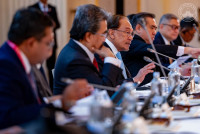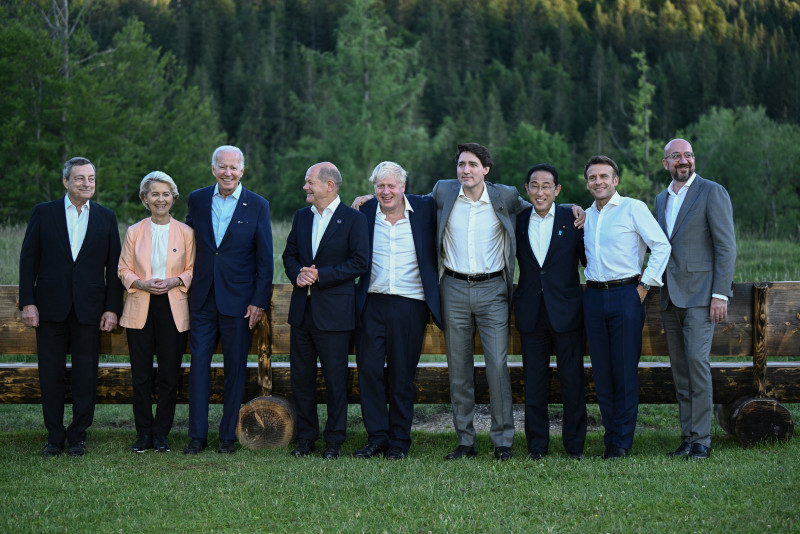
ELMAU CASTLE – The G7 group of rich democracies yesterday announced an attempt to compete with China’s formidable Belt and Road Initiative by raising some US$600 billion (RM2.6 trillion) for global infrastructure programmes in poor countries.
The Partnership for Global Infrastructure and Investment, unveiled with fanfare by US President Joe Biden and G7 allies from Canada, Germany, Italy, Japan and the European Union, aims to fill a huge gap left as communist China uses its economic clout to stretch diplomatic tentacles into the furthest reaches of the world.
Biden said the target was for the United States to bring US$200 billion to the table, with the rest of the G7 another US$400 billion by 2027.
Funding the kinds of projects that China currently dominates – everything from roads to harbours in far-flung corners of the world – is not “aid or charity,” Biden said.
Highlighting the geostrategic thinking behind the plan, Biden said such projects “deliver returns for everyone, including the American people and the people of all our nations.”
Around the world, the role of China’s democratic rivals is “a chance for us to share our positive vision for the future” and for other countries to “see for themselves the concrete benefits of partnering with democracies,” he said.
European Commission chief Ursula von der Leyen echoed this, saying “it is up to us to give a positive, powerful investment impulse to the world, to show our partners in the developing world that they have a choice.”
Although China was not referred to by name, the rivalry loomed large over the leaders’ presentation, a relaunch of a first attempt at a Western infrastructure fund that Biden laid out during last year’s G7 summit in Britain.
Unlike China’s state-run BRI initiative, the proposed G7 funding would depend largely on private companies being willing to commit to massive investments and is therefore not guaranteed.
According to US officials, however, that is a good thing.
In this capitalist vs communist scenario, US officials say, recipient countries will be able to avoid the debt traps and other strongarm tactics allegedly used by the Chinese.
‘Not too late’
Between now and 2027, the US government and allies will shoot for the US$600-billion figure “through grants, federal financing, and leveraging private sector investments,” the White House said.
“This will only be the beginning: the United States and its G7 partners will also seek to mobilise hundreds of billions in additional capital from other like-minded partners, multilateral development banks, development finance institutions, sovereign wealth funds, and more.”
With the investment target largely aspirational, a senior US official acknowledged that the West is currently in second place behind China.
“There’s no doubt that the Belt and Road Initiative has been around for several years and it’s made a lot of cash disbursements and investments – and that we’re coming to this after years of their investments,” the official said.
“But I would argue that it is definitely not too late. And I’m not even sure that it is late.”
The official, briefing reporters on condition of anonymity, said that “many countries” which partnered with China were suffering buyer’s remorse, concluding that Beijing was more interested in establishing economic and geostrategic footholds than benefiting locals.
By contrast, “we’re coming to you with an offer to make investments to actually improve your country, to improve the economy and to have lasting effects on GDP and your populations,” the official said.
“I think that is the deal that is being offered.”
While the obvious targets for the US-led initiative are in Africa, South America and much of Asia are also on the radar. Fallout from Russia’s devastating invasion of Ukraine means that “even places in eastern Europe” could be brought into the fold, the official said. – AFP, June 27, 2022