Business

Thorny problem as durian trade battered by lockdown

Local sales of king of fruits not as good as last year, may lead to collapse of whole industry, say traders

Updated 5 years ago · Published on 17 Feb 2021 4:20PM

Thorny problem as durian trade battered by lockdown
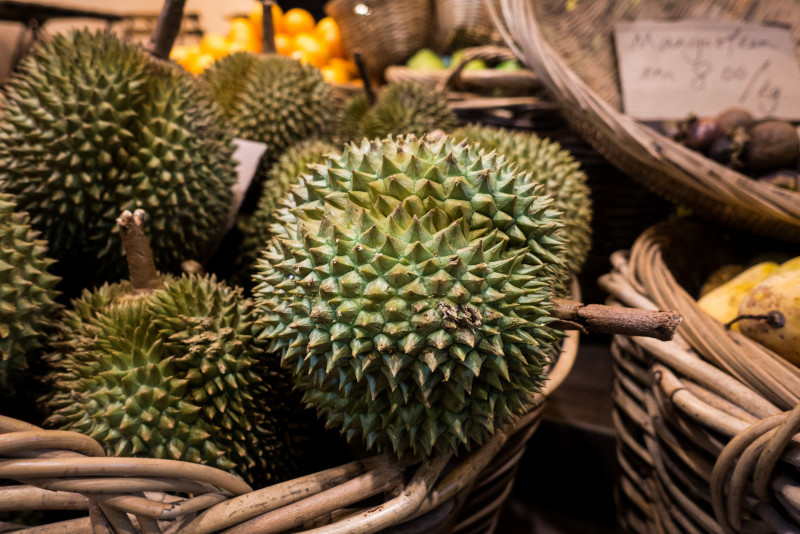
The trade explosion in durians over the past decade is largely driven by China’s growing appetite, with prices of the once-cheap fruit selling for RM60 or more a kilo. – foodiesfeed pic, February 17, 2021

RAUB – Durians falling from trees are collected in nets on a farm in Malaysia, where a long lockdown has slowed domestic demand and left traders more reliant on China’s appetite for the world’s smelliest fruit.

Grown across tropical Southeast Asia, fans love the “king of fruits” for its bittersweet flavours and creamy texture although critics compare its odour to rotting garbage, and it is banned from many hotels and on public transport.

A first lockdown in Malaysia did not do too much damage to demand but a serious Covid-19 resurgence has prompted authorities to re-impose curbs for a longer period, hitting the economy again and hammering the durian industry.

With the roadside stalls where people usually eat the fruits largely empty of customers, sales have plummeted.

“Compared to last year, the local sales are not as good,” Eric Chan, a trader and managing director of Dulai Fruits Enterprise, told AFP.

On the farm in Raub, outside Kuala Lumpur, some of the precious fruits are caught in nets stretched out under trees to ensure they don’t suffer any damage.

Many are destined for China, where the virus emerged but which has largely tamed its outbreak and is once again recording economic growth.

“If there are no exports, or when there is no stock for the export, I think (such a scenario) will collapse the whole industry,” said Top Fruits managing director Tan Sue Sian.

The trade in durians has exploded over the past decade, largely driven by China’s growing appetite, with prices of the once-cheap fruit selling for RM60 or more a kilo.

The fruit was once exported to China only as pulp and paste – but in 2019, officials there allowed the shipment of frozen whole fruits, in a further boost to the industry.

Durians can be found in Malaysia at all times of the year, though the fruit has bumper harvests at certain times. – AFP, February 17, 2021

Related News

Malaysia / 1d

Malaysia's July exports increase by 38.2 per cent

Malaysia / 1d

Alumni calls on Malaysia to increase intake of Thai uni students

Malaysia / 2d

Violence in Thailand: Visitors drop by almost 50 per cent

Malaysia / 6d

Billionaire numbers reach record high as wealth remains concentrated

Malaysia / 1w

Malaysia records 6% GDP growth in Q2 despite global headwinds, says Sim

Malaysia / 1w

Anwar backs One China policy, says Beijing can pursue reunification

Spotlight

Malaysia

Desa ParkCity deaths: Netizens voice concern, call for increased enforcement, crackdowns on scammers

Malaysia

Seven Yemenis arrested over dangerous stunt on KL road

Malaysia

UMNO gives state leaders mandate to negotiate electoral pacts

Malaysia

Sultan Selangor warns against greed, abuse of trust

By Alfian Z.M. Tahir

Malaysia

Form Six students to get allowance from 2027

Malaysia

Desa ParkCity deaths: Wife believed to be victim of love scam, say cops

Malaysia

Saravanan's letter will be referred to MACC, relevant authorities - PM Anwar

Malaysia

Thirteen arrested after teen girl dies in suspected gang-related road attack in Kulai

You may be interested

Business

Property developer, Matrix Concepts sets RM1.8b FY2027 sales target

Business

Malaysia’s international reserves stand at US$132.07b in July

Business

Robo.ai swings to positive equity after US$46.7m first-half profit

By Alfian Z.M. Tahir

Business

ASM 2 Wawasan declares seven-year high payout of 5 sen a unit

Business

Oil prices fall as Hormuz reopening hopes offset Iran tensions

Business

Petronas revenue jumps 15% to RM152.4b as energy investments lift first-half earnings

Business

Questions over traceability of nearly 77,000 tonnes of K8 cargo at Tanjung Langsat