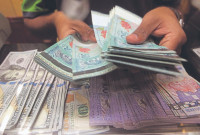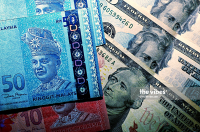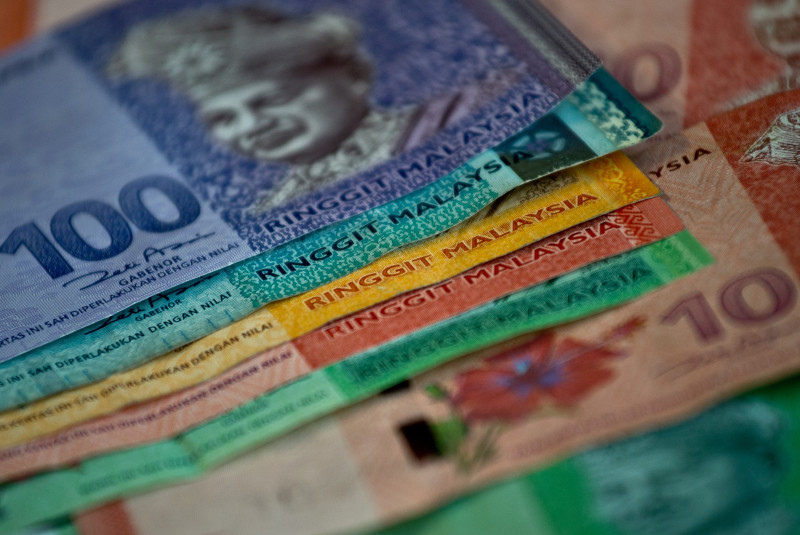
KUALA LUMPUR – The ringgit is anticipated to trade range-bound at between 4.0 and 4.20 against the US dollar in the next six to 12 months, with investors keeping a close eye on the interest rate differential between Malaysia and the United States.
Standard Chartered (StanChart) head of managed investments and product management Danny Chang said the current Malaysia 10-year government bond has a 3.216% yield as compared with the US 10-year bond yield, which stood at 1.42%, which is deemed more favourable for the ringgit.
“It is one of the factors that support the ringgit, apart from firm commodity prices, with both oil prices and crude palm oil prices lending further support to the local currency.
“On the other hand, there are the country’s lockdown measures, which have adverse impact on the economy and will pull the ringgit down, at least in the short term. They act as a counterbalance to the good aspects. Following this, Malaysia’s gross domestic product growth has been reduced downwards,” he said during the Standard Global Market Outlook for the second half (H2) of 2021 virtual press conference today.
For the local equities market, Chang said Malaysia had favourable returns for the past three years, but that the market is facing structural issues due to the country’s lack of technology exposure in the Bursa Malaysia composite index.
“Malaysia would benefit if the country has more exposure to the technology sector because the runners in the equity market are led by technology, and the lack of technology (stocks) has resulted in the under performance of the benchmark FTSE Bursa Malaysia KLCI (FBM KLCI),” he said.
Citing the roll-out of the 5G network as an example, he said that Digital Nasional Bhd has selected Ericsson as the provider of Malaysia’s statewide 5G network deployment and that the RM11 billion project would have benefited local contractors, but none of them would likely be listed on the local exchange.
“As a result, that money will not flow into the FBM KLCI, and Malaysia will not benefit from the equity market perspective,” he said, adding the key index’s composition mostly comprised stocks in the financial services industry, particularly the banking sector, which makes up a third of the FBM KLCI.
On the macroeconomics perspective, StanChart head of fixed income, currencies, and commodities Manpreet Gill said the strong burst of stimulus-led equity market performance was likely to give way to a more sustainable pace of gains in H2 2021 and beyond as the US economic recovery wave radiates to other parts of the global economy.
“Equities remain preferred, led by Europe and the US, while US dollar-denominated bonds across emerging markets (EM), Asia and high yield (HY) segments remain preferred, supporting yields across income allocations,” he said.
The global economy continues to rebound as aggressive vaccination campaigns in the US, Europe, and China have helped economic activities, especially in the services sector, return to normal, with the US economy returning to pre-pandemic trend growth in H2 and the Euro area to follow in early 2022, while China has returned to a growth trend earlier this year.
“Economic growth is set to extend as Covid-19 vaccinations enable most developed markets (DM) to approach herd immunity by H2, with some EMs following by early next year.”
However, Manpreet said StanChart had maintained its preferences for high-yielding credit assets, such as DM HY bonds, global leveraged loans, and EM US dollar government bonds. – Bernama, July 7, 2021