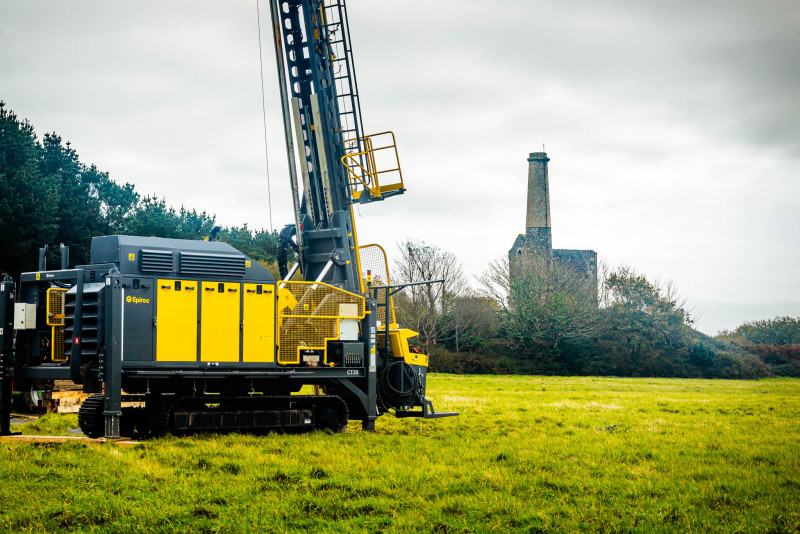
LONDON – As the global auto sector accelerates the production of electric cars, one British company is hoping to cash in from mining lithium, which is needed to make rechargeable batteries that power these vehicles.
It is five years since former investment banker Jeremy Wrathall launched Cornish Lithium, a company operating in Cornwall, southwest England, which recently hosted the G7 summit.
And while it may be another four years until it begins commercial production of the metal, Wrathall is optimistic that his punt will pay dividends.
“In 2016, I started to think about the electric vehicle revolution and what that would mean for metal demand, and I started to think about lithium,” he told AFP.
“A friend of mine mentioned lithium being identified in Cornwall, and I just wondered if that was a sort of unrecognised thing in the UK.”
In fact, lithium was discovered in Cornwall in 1864, while the area is known for its historic copper and tin mining that dates back 4,000 years and ended at the turn of the century.
“Of course, I would like to revive mining in Cornwall, but this is a commercial project,” said Wrathall.
“It’s not a mission that drives me to the point of being emotional or romantic.”
‘Encouraging results’
Cornish Lithium is at a testing stage to see if the metal can be produced commercially.
“The initial results are encouraging. I’m excited about it,” said Wrathall, whose company has revived a former mine situated away from the area’s picturesque villages and beaches.
The firm is looking to extract enough lithium from hot water underground to meet at least a “significant proportion” of UK demand, while at the same time respecting the environment.
It is mulling the capture of heat from underground to generate clean power, or geothermal energy, that can be used to extract lithium.
Wrathall said Cornwall benefits from having very clean water.
“It has a lot of lithium and very little of anything else.
“When you’re looking for needles in a haystack, you want as little hay as possible and more needles, and that’s what we’ve got.”
Long journey
The project has been far from easy, from securing drilling rights from landowners to finding the technology to bring water containing lithium to the surface.
And, the company is facing competition from British Lithium, which is looking to extract the metal from Cornwall’s granite.
British demand for lithium is set to reach 75,000 tonnes by 2035, five years ahead of a UK ban on the sale of high-polluting diesel and petrol vehicles.
Lithium is mined mostly in Australia and South America, while China controls the supply chain.
And while automakers insist on the environmental benefits of electric vehicles, the bulk of current lithium extraction relies on power from polluting fossil fuels.
In Europe, projects are ongoing for cleaner extraction of the metal in France and Germany.
“It’s vitally important that we do get this technology, otherwise, Europe has got no lithium supply,” said Wrathall.
This comes as car giants Nissan and Renault announced plans for huge plants in England and France to make electric batteries.
The European Commission, meanwhile, wants to end the sale of new petrol and diesel cars by 2035, under a massive plan to fight climate change unveiled last week.
“Europe, from a strategic point of view, should be looking at securing its own supply of lithium,” said Alex Keynes from Brussels-based lobby group Transport & Environment.
“Our view is that for the medium to long term, the majority of materials, including lithium, should come from efficient and clean recycling.” – AFP, July 18, 2021