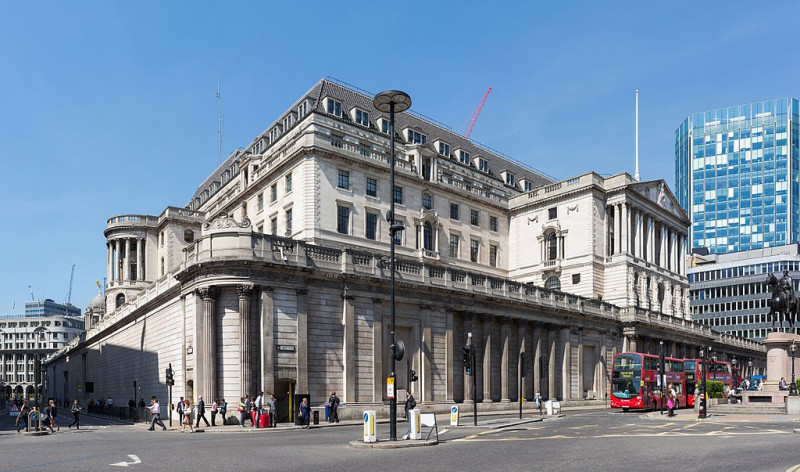
LONDON – The Bank of England (BoE) today unveiled an extra £150 billion (RM812.83 billion) in cash stimulus and forecast a deeper coronavirus-induced recession for Britain as the country begins a second lockdown.
BoE, which held its benchmark interest rate at a record-low 0.1%, lifted its quantitative easing (QE) stimulus as it seeks to boost lending by retail banks, and consequently, economic growth.
The bank’s monetary policy committee voted “for the Bank of England to increase the target stock of purchased UK government bonds by an additional £150 billion, financed by the issuance of central bank reserves”, it said in a statement.
Today’s announcement took the bank’s total QE coronavirus stimulus to £895 billion.
It has now pumped out £450 billion under its QE programme since March, when Covid-19 prompted Britain’s first virus lockdown.
Prior to this, it had pumped hundreds of billions of pounds into the UK economy over the past decade in the wake of the 2008-9 global financial crisis and Brexit.
‘New lockdown’
The decisions today come as the UK begins a minimum four weeks of stay-home restrictions, as the government seeks to stem a second wave of Covid-19 after similar actions elsewhere in Europe.
The initial lockdown, which lasted around three months until mid-June, sparked Britain’s deepest recession on record.
“Since the committee’s previous meeting (in September), there has been a rapid rise in rates of Covid-19 infection,” said BoE in a statement announcing the outcome of yesterday’s regular policy meeting.
“The outlook for the economy remains unusually uncertain.
“It depends on the evolution of the pandemic and measures taken to protect public health, as well as the nature of, and transition to, the new trading arrangements between the European Union and the UK” post-Brexit.
“It also depends on the responses of households, businesses and financial markets to these developments.”
It forecast the economy to shrink by 11% this year, worse than prior guidance of a 9.5% contraction.
The gross domestic product was then set to rebound by 7.25% next year – but this was down from the 9% increase given previously.
Under QE, BoE creates cash that is then used to purchase assets such as government and corporate bonds, with the aim of boosting lending and stimulating economic activity.
The bank first embarked upon what was at the time a very unusual policy measure in the wake of the global financial crisis. – AFP, November 5, 2020