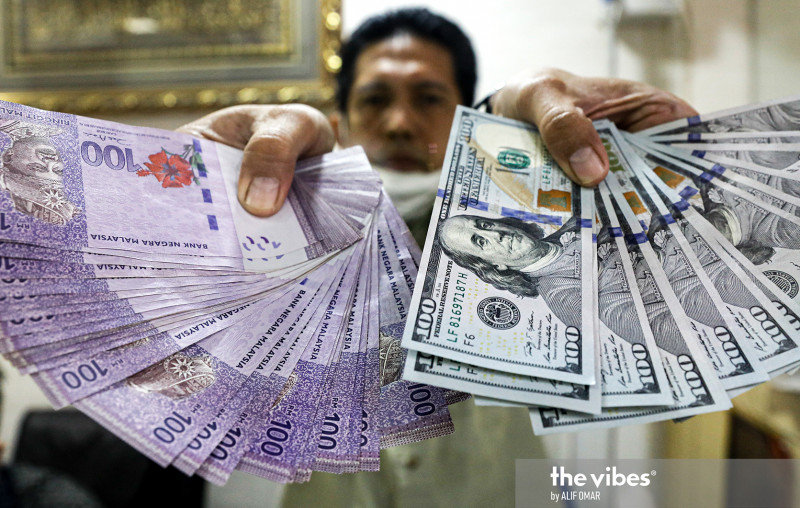
KUALA LUMPUR – HSBC expects the ringgit to stabilise against the US dollar in the second half of 2022 (H2 2022), strengthening to 4.28 by the end of the year.
HSBC’s global private banking and wealth chief investment officer for Southeast Asia, James Cheo, said the ringgit will strengthen when global market sentiment improves.
“The beginning of the first half of this year has been volatile and we believe the ringgit will stabilise to move towards 4.28 by the end of the year when the market sentiment globally improves,” he said during the HSBC H2 2022 Investment Outlook online press conference today.
Today, the ringgit opened at 4.39 versus the US dollar and it had hit 4.40 against the US dollar on May 19, 2022, marking its lowest rate since March 2020.
Cheo said HSBC observed that equity inflows from foreign investors have continued to trickle in year-to-date, in view of Malaysia’s growth recovery and reopening for tourism.
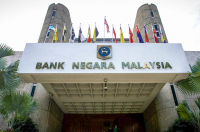
In another note, Cheo said he expects Bank Negara Malaysia to increase the policy rate by another 50 basis points (bp), ending the year at a 2.5% overnight policy rate after lifting its policy rate by 25bp recently.
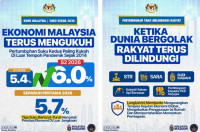
He also said that Malaysia is on a solid growth path and expects the country’s gross domestic product (GDP) growth to be at 5.5% this year, thanks to strong manufacturing and higher commodity prices.
Cheo said the Malaysian economy expanded by 5% year-on-year in the first quarter of 2022 to pre-pandemic levels and with the impact of pandemic restrictions receding, private consumption bounced back and investment stabilised, though this led to import growth outpacing exports.
“Domestic demand should accelerate further this quarter and next, supported by a tightening labour market,” he added.
Meanwhile, HSBC’s global private banking chief investment officer for Asia, Fan Cheuk Wan, expects the global economic cycle to continue but at a slower rate while inflation eases gradually.
The United States rate hike expectations will be moderating in H2 2022 despite the lingering energy shock and supply chain disruptions, she said.
“We forecast global GDP growth to decelerate to 3.4% in 2022 and 2.9% in 2023, down from 5.8% in 2021.
“We expect global energy shock and supply chain challenges to push up global inflation to 7.5% in 2022 before moderating to 5.1% in 2023,” Fan said.
She added that the world has faced several structural shocks and investors need to reposition their portfolios to adapt to these challenges.
“The Covid-19 crisis, Russia-Ukraine war and sustainability revolution are disrupting supply chains, labour markets, energy sources and infrastructure.
“These structural changes will require significant investments that will ultimately help boost growth, but this will also push up costs and cause inflation to become stickier than witnessed in the past decade.
“Therefore, we expect the investment outlook for risk assets to gradually improve in H2 2022 with support of a soft landing for the global economy and easing stagflation fears,” she added. – Bernama, June 7, 2022