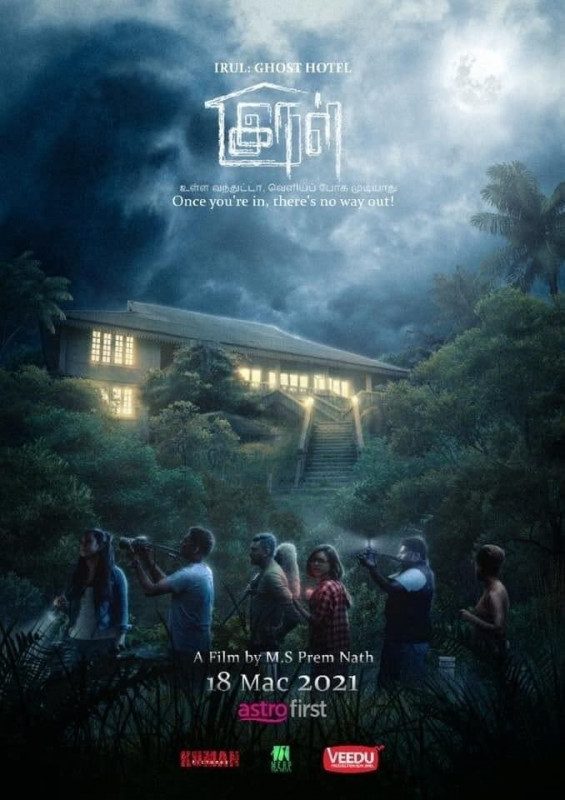

“INITIALLY I wanted to do in Mimaland, not Crag Hotel, the storyline will be totally different,” said Prem Nath - the director of the latest Kuman Pictures horror offering in ‘Irul: Ghost Hotel’ - revealed to me this fun trivia while we were in a Zoom call last Sunday.
“Then we approached the property owners, they said there’s almost 200 companies waiting to make a movie there.”
It was a normal Sunday night. I was setting up the Zoom call trying to make sure the hanging and upside down Zoom Hn1 recorder that I’m using as a mic is aligned correctly to capture more of my voice and not the room’s ambience. Although no cheap coffee this time to scare away the coffee snobs.
I have always loved the idea of found footage because it is one of the storytelling tropes that blurs the line between the real and false, fiction and non-fiction, truth and lies, and so on.
In fact, my whole shtick here at The Vibes has been that, blurring the line of literature and essay ala the New Journalism movement.
For ‘Irul: Ghost Hotel’, I particularly liked the idea of the characters using the actor’s real names (with some of them doing their real jobs in the film industry), something that ‘The Blair Witch Project’ (1999) did, but actually rarely seen after (the first ‘Paranormal Activity’ (2007) also did it, but not the sequels).
“Much more real you know when people calling each other their real name… so off-screen and on-screen they’ll be using the same name.”
“Yeah, that’s true.”
“Most of the scene is not scripted, I just throw them into the scene and record to see what happens. I don’t want them to use accidentally use their real name.”
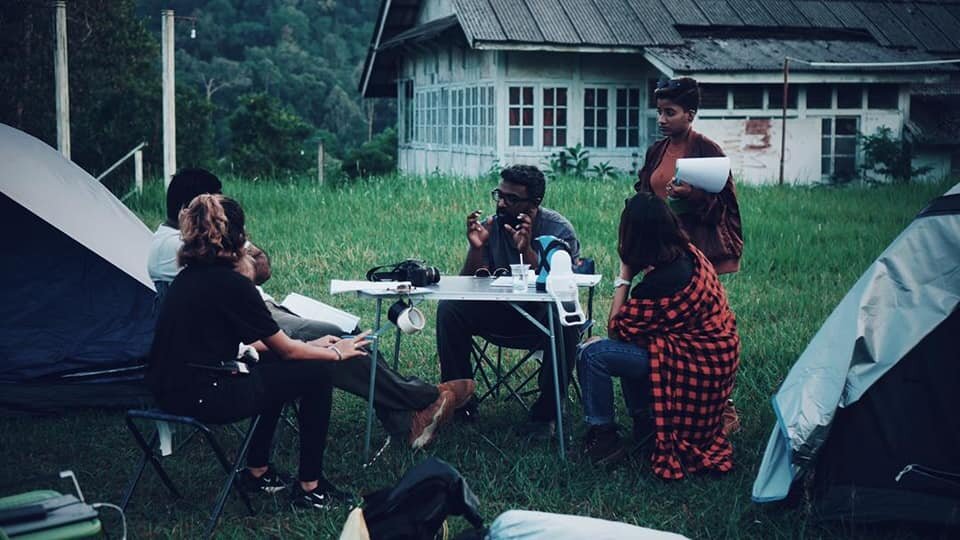
It was interesting to hear the decision to use real names as being more for practical purposes. To allow the actors freedom in interpreting the script and communicate as they would off-screen.
Then our conversation steered into the choosing of Crag Hotel as the setting of the film, as I already revealed above that Prem Nath’s first choice was Mimaland.
“We searched Top 10 haunted place in Malaysia and some of them do not allow filming, but one that did was Crag Hotel,” but it wasn’t just Top 10 Google search that inspired the story, as Prem Nath further revealed, “When we went to Penang, my father used to tell that the train that goes up (to Penang Hill) were built by Indian labourers, prisoners of war. These are the stories I used to hear throughout my childhood.”
This is where the cultural connection solidifies itself in this project. It was not just a random haunted hotel found through Google, but the narrative was built upon the stories the director, and I’m guessing many Malaysians of Indian-descent, have heard about Penang Hill.
Not to spoil the film’s antagonist, but I did mention that the creature in the film looked like Dracula from the 1992 Francis Ford Coppola film.
“No, no, it was not planned to be (like Dracula), we bought the creature from US. The make-up. That thing is scary AF.”
“Oh, so it’s all practical? An actual costume?”
“Yeah, we have a prosthetic make-up artist, the monster designer Wickneswaren, there’s not any CGI in this movie.”
“That’s cool, I mentioned Dracula because I did notice some references to other horror movies such as ‘The Shining’ and ‘The Ring’.”
“Ah, yes, it is my tribute to Stanley Kubrick, it is a small scene. There are a lot of other movies I purposefully gave references to, but I won’t say it lah, up to others to find it.”

There is something about this film that made me think about it from a whole project point-of-view and not just as a released movie. From the trailer, the promotions, the behind-the-scenes stories, how some of the stars are also in the production crew, the film, and even the subtitles (and I haven’t even talked about how quirky and non-DBP the Malay subtitles are), all of them fits in this very independent, low-budget, made by horror film lovers for horror film lovers kind of way.
An artwork is never just the finished product, it is the whole process and the context around it.
While it also triggered the more “film critic” side of me, I’m quite close to writing a long winding thesis of how this movie expands the popular “hero’s journey” in a way that we, the viewers are the one experiencing the journey, not the characters of the film. Maybe one day I would write about this.
As our conversation continued, it went more into the direction of the identity of the film. How does this movie fit into the Malaysian film landscape.

“First of all we must know what kind of audience we are targeting. My main audience is the Indian audience, who (have) never seen found-footage films, they are used to song, action. They’ll be like where’s the song lah. For them I maintain the fast cuts and all that in editing.”
“When you say for the Indian audience, why not actually targeting the bigger Malaysian audience?”
“Oh, okay. For example I worked on ‘Jagat’ (2016) as well. Which also targeted local Indians, focusing on Indian culture. But when other people watch it, they find it interesting to learn more about Indian culture.”
This was definitely an interesting take. Something that I tried to explore in the first article I wrote is there is an opposite effect where when writing a more personal and culturally-slanted story, the appeal is actually more universal.
It is like a unique feature in our human mind that wants to appreciate and learn the story and experiences of someone different from us while finding similarities within them to relate to. Any psycho-neurologists working on this, do hit me up.
This is kind of what I think of the Japanese anime industry when I watch interviews where people in the industry do not realise how big they are worldwide. They were not even thinking about audiences outside of Japan, but it resonated with people outside of Japan.
Even supposedly Western characters in anime are so Japanese in culture it becomes unavoidable to be interested in wanting to learn more about Japan. Is this the key?
When asked about whether there is a new-wave of Indian filmmakers in Malaysia after ‘Jagat’, Prem Nath said, “I noticed every 5 to 10 years, there’s always a new crop of filmmakers and they are doing good. They break away from the South Indian cinema influence, which is what Shanjey (the director of ‘Jagat’) is trying to do also.”
‘Irul: Ghost Hotel’ is currently available to watch through Astro First. Do have fun watching it. - The Vibes, March 27, 2021