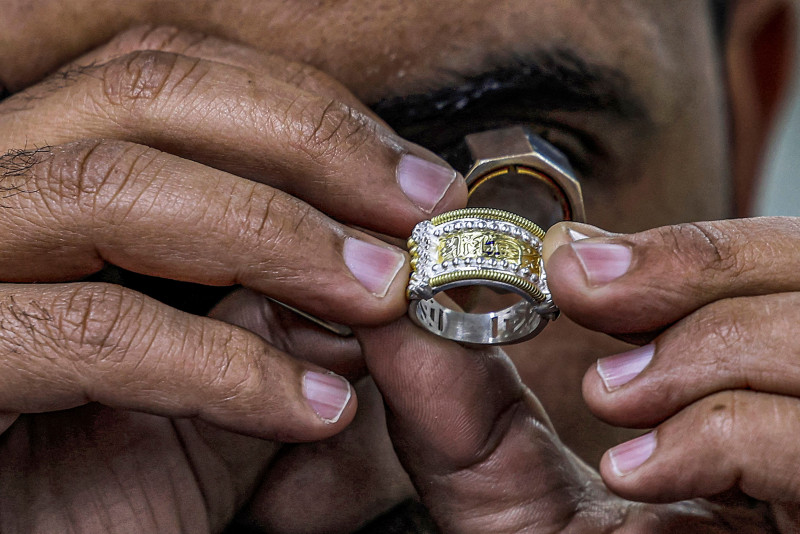
EGYPTIAN luxury brands are harnessing traditional craftsmanship from jewellery design to carpet weaving to bring the country's ancient cultural riches to the world.
Experts in the sector say the global appeal of Arab and Islamic designs from other countries shows Egypt could do more to promote its rich, millennia-old artistic heritage.
One pioneer has been master jeweller Azza Fahmy, whose signature Islamic art-inspired pieces have graced the world's rich and famous including US pop star Rihanna and Jordan's Queen Rania.
Fahmy, who started off in an Old Cairo workshop about 50 years ago, said her focus has been designs that "resonate with Egyptian identity".
Artists and artisans in Egypt, the Arab world's most populous country, draw from a history that spans ancient Pharaonic times, the Mamluk, Ottoman and modern eras.
"We are lucky to be able to draw on 6,000 years of history," said textile designer Goya Gallagher, founder of Cairo-based Malaika Linens, which makes high-end household pieces.
"The main challenge is making sure our pieces are timeless, that they're very well made and always hand-made," she said at the company workshop on the western outskirts of Cairo.
Myriad challenges
But while Egypt boasts some business success stories, many more luxury goods makers say they labour against myriad odds to eke out a market both locally and internationally.
In the era of global mass production, Egypt's once expansive pool of skilled artisans has shrunk, with many young people turning their backs on family skills passed down through the ages.
As businesses struggle to fill the talent gap, they also face the headwinds of a painful economic crisis that has tanked the local currency and restricted raw material imports.
The state's efforts to support the handicrafts sector, meanwhile, have been "limited and sporadic", says the United Nations Industrial Development Organization.
Culture consultant Dina Hafez agreed that Egypt offers little in the way of formalised arts and crafts training.
"The training of artisans is still essentially based on informal education and networks of apprenticeship," said Hafez of Blue Beyond Consulting.
"The sector lacks any structure. We need a real ecosystem. But for the moment, it's all based on personal initiatives."
She said Egypt could learn from Turkey and Morocco, "where the opportunities and obstacles look a lot like Egypt", but which had managed to launch "their designs onto the international scene".
'Soft power'
Still, change is afoot.
Fahmy, the jewellery designer, said there is always space in the market for works made by skilled artisans and "good designers with creative minds and quality education".
Many designers hope to benefit from government initiatives to draw in investment and tourism revenue from its ancient wonders.
At the Grand Egyptian Museum at the foot of the Giza pyramids, Egyptian luxury stores enjoy pride of place.
Although its official opening has been long delayed, the museum offers limited tours and events, and the shops already "showcase the best of Egyptian crafts", said the owner of one, Mohamed al-Kahhal.
In Cairo's historic centre, linen company Malaika trains women from marginalised backgrounds in embroidery and sells the wares to its customers and to other fashion and textile brands.
Carpet maker Hend al-Kahhal works in the same spirit, of bringing Egyptian identity to global frontiers.
Standing on the factory roof, where wool and silk creations hung out to dry, Kahhal said the family business works with designers "to give a contemporary touch to Pharaonic and Mamluk motifs".
The Egyptian Handicrafts Export Council, under the trade and industry ministry, has long been working to showcase such Egyptian creations internationally.
But Hafez, the culture consultant, said she hopes for more progress in future, as often "budget constraints, red tape and customs regulations don't exactly make things easier".
The question, she said, is whether Egyptian "authorities are really aware of the soft power these creators can have". – AFP, May 21, 2023