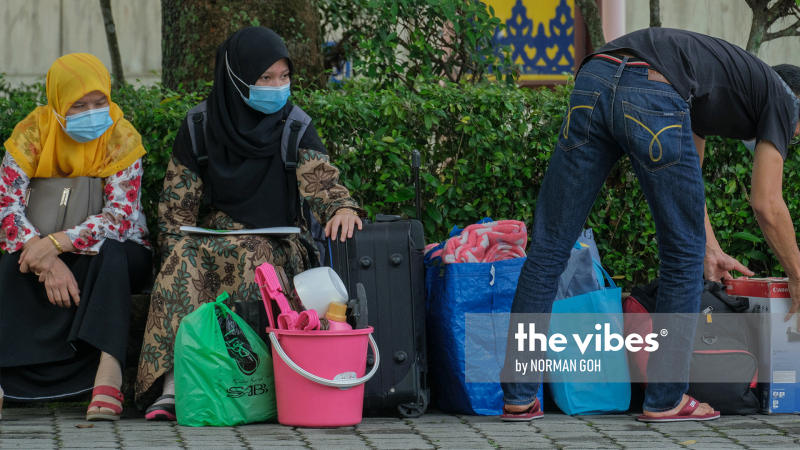

KUALA LUMPUR – Amid the surge in daily Covid-19 cases due to the Omicron variant, tertiary institutions under the purview of the Education Ministry are welcoming students back on campus – with some restrictions in place.
However, not all stakeholders are in agreement, with some arguing that institutions be given autonomy and flexibility to decide on in-person cases should the caseload continue to rise.
Universiti Malaya epidemiology and public health professor Dr Sanjay Rampal said the move is seen as part of Malaysia’s efforts to embrace endemicity of Covid-19, allowing all to live with the virus as sustainably as possible.
“Universities should remain open but as they differ in their infrastructure and IT capabilities, the universities should have the autonomy to perform their own situational analysis.
“The choice (is theirs) whether they prefer to deliver classes using online, face to face or hybrid approaches.
“However, the Health Ministry should continually assess the national health capacity levels and prepare to manage the oncoming Omicron wave over the next two to three months.
“Universities should consider online classes as much as possible when the number of daily Covid-19 cases increases above 50,000. At those higher levels, work from home policies may help keep cases at manageable levels.
“The threshold may also differ based on current assessments and recommendations by the National Covid-19 Rapid Response Task Force,” he told The Vibes.
Allow institutions a degree of flexibility and autonomy

His views were echoed by Malaysia University of Science and Technology’s Institute of Postgraduate Studies dean Geoffrey Williams, who felt the time was right for reopening with caution.
“I am in favour of opening and ending all restrictions but for universities, there remain some special issues, which should be left to the universities themselves.
“At this stage, autonomy is very important, and the government should step aside and allow universities to make their own decisions. For example, students returning from outstation or overseas often bring Covid-19 to campus, more often to hostels””
He said it requires self-testing and self-isolation, and is difficult for universities to monitor.
“Many universities have already implemented and are comfortable with online teaching, and may only want to be on campus for laboratory-based courses. There is still room for improvement for hybrid learning.”

Parent Action Group for Education chairman Datin Noor Azimah Rahim is of the opinion that colleges and universities should decide on what is best for them in consultation with students’ unions.
“Universities may opt to conduct hybrid learning, bearing in mind students may not have the right resources at home.
“Many factors that are unique to colleges/universities come into play such as number of students and space constraints. The government cannot make a unilateral decision and may need to consult colleges/universities from time to time,” said Azimah.
However, retired political economy lecturer Prof Edmund Terence Gomez has questioned the decision process in allowing students on campus.
Was the decision related to economic matters given the falling number of foreign students? And which is more important – the health of students or the economy?
“This is a question the (Defence) Minister (Datuk Seri Hishammuddin Hussein) must answer,”
Gomez said, adding that there should be better coordination between the Health Ministry and the Education Ministry.
Last week, Hishammuddin said according to standard operating procedures set by the Higher Education and Health Ministry, students and staff with either complete or incomplete vaccination status would be allowed to be on campus.
However, those with incomplete vaccination status were required to obtain negative results of RT-PCR tests three days prior to returning to the campus. They also needed to take the RTK-Ag test once a week, he added.
As for existing and new international students, he said only those who had completed their vaccinations were allowed to enter Malaysia, and they must undergo mandatory quarantine for seven or five days if they had received their booster dose. – The Vibes, February 15, 2022