Food

Christmas grub: Zimbabwean beetle makes a seasonal snack

Despite westernised food tastes in the towns and cities, in the countryside, there remains a tradition of eating insects, mopani worms and white ants

Updated 5 years ago · Published on 23 Dec 2020 12:05PM

Christmas grub: Zimbabwean beetle makes a seasonal snack
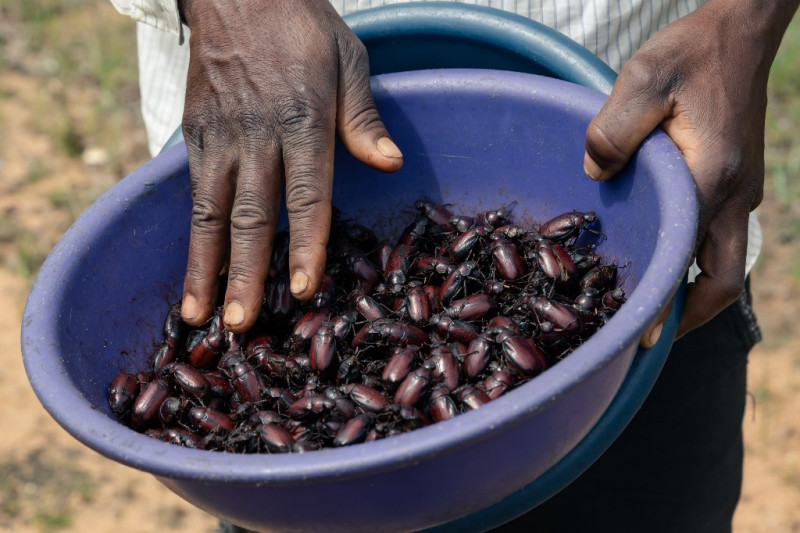
Earnmore Chikavaza, a villager, shows off his bountiful harvest of mandere (chafer beetles, also called Christmas beetles) in a dish after a successful search for the protein-rich edible insects in Mhondoro, Zimbabwe, on December 16. – AFP pic, December 23, 2020

MHONDORO – Earnmore Chikavaza takes a mouthful of fried beetles and munches happily, downing the crunchy snack with a mouthful of water.

He runs out of superlatives to sum up the benefits of a food that is healthy, tasty, organic and – a special advantage in a poor country – absolutely free.

The delicacy is the chafer beetle, also called the Christmas beetle, a dark-red Zimbabwean bug which proliferates in the southern hemisphere country at this time of year.

"You don't spend anything on the beetles. They are free relish," the slender 28-year-old miner told AFP.

"All you have to do is to go out in the bush and shake them off or pluck them from musasa trees and they come in summer when other forms of relish are scarce."

In Zimbabwean towns, food tastes have become westernised, but in the countryside, there remains a time-honoured tradition of eating insects, mopani worms and white ants – the bounty of rich soil and luxuriant vegetation.

Chikavaza lives in Mhondoro, a village about 100 km southwest of the capital Harare.

Three weeks of heavy rain have made it too dangerous to venture into the mining tunnels, so he spends time with a bowl in his hands, shaking beetles out of the trees for food.

Chikavaza takes his harvest to a local lady, Winnie Chikaonda, 72, who helps him cook the insects.

The recipe is simple – the beetles are boiled until soft and then fried until they reach the desired level of crunchiness.

"As children, we used to go out in the bush to harvest them," Chikaonda recalled.

"God created them knowing they were healthy to eat. It’s a pity children from the cities don’t like them. They regard them as creepy creatures that bite." – AFP, December 23, 2020

Related News

Events / 4d

Penang proposes partnership with Medan in the food industry and farming sectors

Places / 3w

Hungary looks towards greater collaboration with Penang

Opinion / 1mth

The Islamic business revolution in Southern Thailand

Health / 2mth

Mesut Ozil plans to ‘tackle’ Penang food during visit to the state

Opinion / 6mth

A message for the season - and for what comes after

Opinion / 6mth

Noise, not reality: Why Malaysia must choose courage over cowardice

Spotlight

Malaysia

Johor state election: MACC receives three reports of alleged corruption

Malaysia

Banks need to do more to help counter rising costs of living – Guan Eng

By Ian McIntyre

Business

BNM holds OPR at 2.75 per cent

Malaysia

MACC: No one off limits in probe into US$13 million luxury property deal

Malaysia

Govt rejects claims Jho Low secretly returned to Malaysia for 1MDB asset talks

Malaysia

School stabbing incident: Suspect claimed she was dissatisfied, allegedly bullied

Places

Four premier hotels in Penang to be restored, open doors soon

By Ian McIntyre

Malaysia

Rosmah demands action against Nga over alleged misleading election poster in Johor polls

Malaysia

Malaysia faces RM51.4b 1MDB burden after recovering RM31.3b in funds and assets

You may be interested

Places

Four premier hotels in Penang to be restored, open doors soon

By Ian McIntyre

Living

Matrix Concepts' home ownership campaign offers over RM30m rewards and prizes