
IN ‘Just Enough Money’, his classic essay on the act (and art) of eating, the American essayist A.J. Liebling, addressed the silly pretensions of high food culture, “Eating is highly subjective, and the man who accepts say-so in youth will end up in bad and overtouted restaurants in middle age, ordering what the maitre d’hotel suggests. He will be guided to them by food-snob publications, and he will fall into the habit of drinking too much before dinner to kill the taste of what he has been told he should like but doesn't.”
Hardly different from the predicament of our times except that we are told, not in flattering terms by “food snob publications” but somewhat severely by highly paid nutritionists and food experts (however well meaning and even accurate on some things they may be) that the point of eating is really to kill whatever taste there is, and, indeed, to like that which we in fact do not.
That this strange obsession with the suppression of taste “because it is good for you” principle rises, not from any ancient culture of deep and pure veneration for suppressing all that is desirous, while respecting all living things, but from what economists might describe as ‘higher values arising from rapid social mobility”; or, as someone leaning towards a more leftist tradition would deride, in jocular fashion, “as bourgeois rubbish rooted in the innate contradictions of the middle class,” is instructive of the economic trap in which food cultures exist in present times.
The transformation of Southeast Asian food cultures from its roots in faith, ritual and the commemorative, has been dramatic. While reflecting deep, diverse interactions within the region, interest in our regional food culture have shifted, increasingly, towards addressing aspects of the popular and the economics of eating.
Great questions still remain unexplored – what was our sense of taste before the coming of chili? When did food cultures in parts of Indo-China and the Philippines, which once embraced baked pygmy crocodile as delicacies emerge as ‘exotic? Why do some delicacies, which are perceived as exotic by some, remain hugely popular with others?
Roasted crickets that line any night market in Thailand, Laos and Cambodia, come into mind? How does the swallowing of that ‘great challenge’ Balut – a fertilized still-forming duck embryo gulped whole, “the more feathers the better” forge the most authentic Filipino “cultural experience?” Why do we still love “durian” with its taste, described so memorably by an American friend, “resembling vomit”.
How ‘Western’ have our attitudes towards food culture become?
Even as a surge of interest in food identities, in recent times, has become celebrated, it has also become somewhere fractious, extending the illusion of modern border disputes over cuisine and making ridiculous the very nature of our food cultures which are in fact diasporic.
This culminated, very recently, in the scramble over who can lay claim to owning perhaps the most pervasive of cultural expressions anywhere in Southeast Asia – street food – according to the dictates of Unesco.
Still, in the 1950’s and 1960’s such questions proved of little bearing against the more pressing exigencies of how, and what, and when, to eat within the pressing concerns of compressed meal schedules, limited money, and food that needed to be bought rather than grown or reared. Then, there was the matter of how to feed exploding populations migrating to cities already bursting at their seams.
During Japan’s industrial revolution of the 1950’s Momofuku Ando of Nissin Foods in Japan introduced the instant noodle brand of Chikin Ramen. It was followed, in the 1970’s by Nissin’s Cup Noodles, the first cup noodle brand ever introduced.
The popularity of instant noodles throughout the Far East and Southeast Asia induced radical changes in food production, concentrating capital into the production of food en masse that could be prepared instantly and, most importantly, without requiring even the most rudimentary of cooking skills.
More importantly, it provided a basic staple for those who struggled, irrespective of class, to put the proverbial ‘meal on the table.’ Over the years the instant noodle, as a result of pure improvisatory genius has gone through countless incarnations, settling as a staple for many in its countless forms.
By 1969 instant noodles were introduced into an Indonesia weary of the austerity period of the Sukarno Orde Lama, and on the threshold of an economic book under the rule of Suharto’s Orde Baru.
In 1972 the Indomie brand was introduced into the Indonesian mass market by the PT Sanmaru Foods Manufacturing Company Indomie Kuah Rasa Kaldu Ayam (Indomie chicken stock flavor). Throughout its emergence as Indonesia’s most popular instant noodle brand it refrained from offering alternative flavours till 1980, when it introduced its Indomie Kuah Rasa Kari Ayam (Inodmie curry chicken flavor).
By 1982, the company was bought by the tycoon Sudono Salim, founder of the Salim Group. It was here that it introduced the variety it has come to be best known for, Indomie Mi Goreng (Indomie Fried Noodles).
In 1988 Indomie went global when it was introduced into Nigeria where it emerged, as Nigerians themselves describe, “as insanely popular.” A Nigerian living in Indonesia, quoted in the Indonesian media just recently, described, “Indomie is so ubiquitous in Nigeria that for many Nigerians, all noodles are Indomie.”
As Indomie raced across the world and was soon to be found everywhere from the lodgings of international students (especially from Southeast Asia) to the budget hotel rooms of sex workers, friendly contests over which flavor was better were frequent though the classic Indomie fried noodles has never failed to triumph in such contestation.
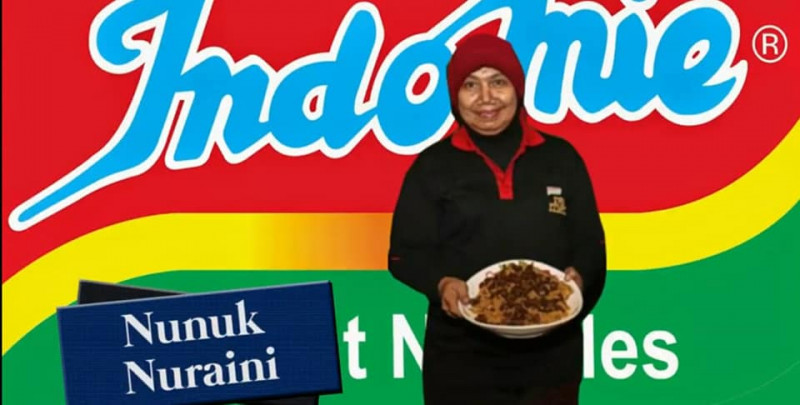
Its creator was Ibu Nunuk Nuraini, a native of West Java, and a graduate of Padjajaran University’s food technology department in Bandung.
For close to three decades she worked as a flavour development manager at Indofood. She counted among her many creations such traditional flavors as soto, rendang, chicken curry, and sambal matah, as well as the Indomie Goreng (fried noodles).
Her recent passing on January 28 was received with an outpouring of messages of sympathy from Indomie devotees all around the world. The Governor of West Java, described her as a “hero for the kos (boarding house) kids” who provided meals for those who struggled.
Expressions of gratitude have come especially from student and former student communities, especially of a great many Southeast Asian nationalities studying abroad who found both satiation and solace in a plate of Indomie.
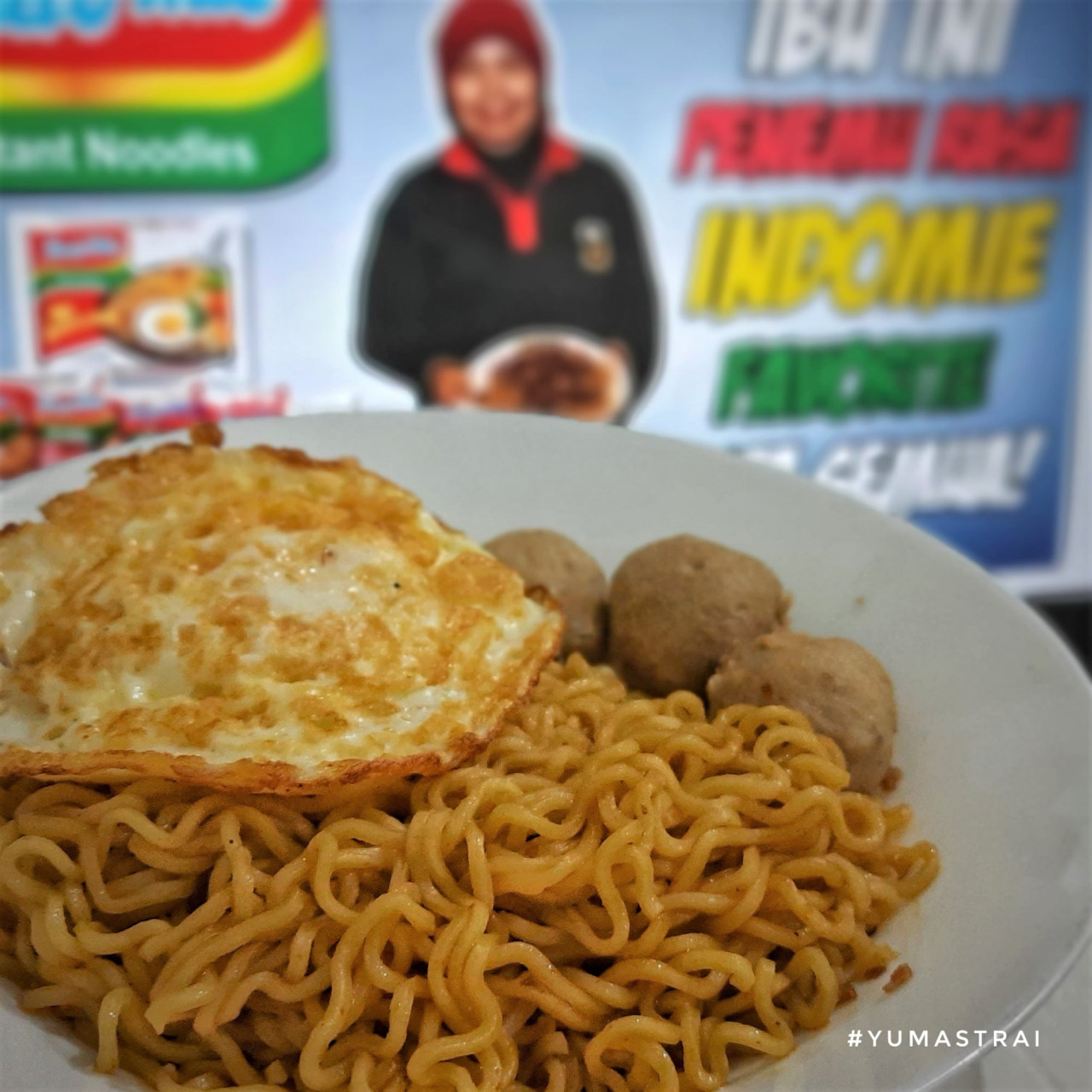
A BBC journalist, Lee Tse Yin, a Malaysian now residing in Britain, describes, “It was a ‘taste of home” – mainly I think because of the fried onion flavoured oil which is so Southeast Asian. Instant taste in a packet – and if you add a fried egg and blanch any green vegetable you can pretend it’s a balanced if not entirely healthy meal.”
For other cultures with instant brand noodles of their own, there is not always such fluid consensus. Novelyn Patac, a Filipina working in Malaysia, explains, “We Filipina’s who work here really like Indomie: but I sent several packets home and they did not like it as much, preferring our own Lucky Me. Perhaps the taste base is different.”
Others were terse in their praise. Haikal Fernandez, a sub-editor here at The Vibes simply said, “I could probably make a packet blindfolded, with one arm tied behind my back.”
Some years ago, a sex worker (not Indonesian) was commissioned for a photo shoot. A quick glance of the budget hotel room she stays in revealed several bundles of Indomie on the teeming floor. When asked why, she replied: “To eat between work, to eat when there is no work, to eat when bored. Indomie is my husband.” And chuckles.
The greatest shift in the food culture of Southeast Asia perhaps: food, once the occasion of feast and commemoration, now the ‘instant’ fulfillment for longing, lament and boredom. – The Vibes, January 30, 2021