WASHINGTON – After seven months in space, NASA's Perseverance rover survived a nail-biting landing phase to touch down gently on the surface of Mars on Thursday, ready to embark on its mission to search for the signs of ancient microbial life.
"Touchdown confirmed," said operations lead Swati Mohan at around 3.55pm Eastern Time (2055 GMT), as mission control at NASA's Jet Propulsion Laboratory in Pasadena erupted in cheers.
The autonomously guided procedure was completed more than 11 minutes earlier, which is how long it takes for radio signals to return to Earth.
"WOW!!" tweeted NASA Associate Administrator Thomas Zurbuchen as he posted Perseverance's first black and white image from the Jezero Crater in Mars' northern hemisphere.
US President Joe Biden hailed Perseverance's "historic" landing.
"Today proved once again that with the power of science and American ingenuity, nothing is beyond the realm of possibility," he tweeted.
Over the course of several years, Perseverance will attempt to collect 30 rock and soil samples in sealed tubes, to be eventually sent back to Earth sometime in the 2030s for lab analysis.
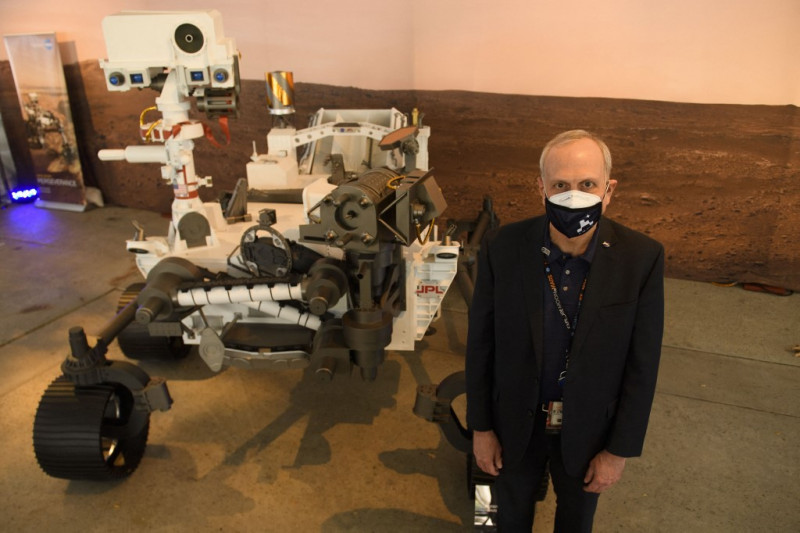
About the size of an SUV, it weighs a ton, is equipped with a seven-foot (two-metre) long robotic arm, has 19 cameras, two microphones, and a suite of cutting-edge instruments to assist in its scientific goals.
Before it could embark on its lofty quest, it first had to overcome the dreaded "seven minutes of terror" – the risky landing procedure that has scuppered nearly 50% of all missions to the planet.
Shortly after 3.30pm Eastern Time (2030 GMT), the Mars 2020 spacecraft careened into the Martian atmosphere at 12,500 miles (20,000 kilometres) per hour, protected by its heat shield.
It then deployed a supersonic parachute the size of a Little League field, before firing up an eight-engined jetpack to slow its descent even further, and then eventually lower the rover carefully to the ground on a set of cables.
Its target site was "absolutely treacherous for landing," Allen Chen, lead engineer for the landing stage said on Thursday.
But the vessel had new landing technologies up its sleeve to help it navigate during descent, including the "Terrain Relative Navigation" that uses a special camera to identify surface features and compare them to an onboard map.
Astrobiology dream
Scientists believe that around 3.5 billion years ago the crater was home to a river that flowed into a lake, depositing sediment in a fan-shaped delta.
"The question of whether there's life beyond Earth is one of the most fundamental and essential questions we can ask," said NASA geologist Katie Stack Morgan.
"Our ability to ask this question and develop the scientific investigations and technology to answer it is one of the things that make us as a species so unique."
It will begin drilling its first samples in summer, and its engineers have planned for it to traverse first the delta, then the ancient lakeshore, and finally the edges of the crater.
Perseverance's top speed of 0.1 miles (0.16km) per hour is sluggish by Earth standards but faster than any of its predecessors, and along the way it will deploy new instruments to scan for organic matter, map chemical composition, and zap rocks with a laser to study the vapour.
"We astrobiologists have been dreaming about this mission for decades," said Mary Voytek, head of NASA's astrobiology programme.
Despite the rover's state-of-the-art technology, bringing samples back to Earth remains crucial because of anticipated ambiguities in the specimens it documents.
For example, fossils that arose from ancient microbes may look suspiciously similar to patterns caused by precipitation.
Flying on another world
Before getting to the main mission, NASA wants to run several eye-catching experiments.
Tucked under Perseverance's belly is a small helicopter drone that will attempt the first powered flight on another planet.
The helicopter, dubbed Ingenuity, will have to achieve lift in an atmosphere that's 1% the density of Earth's, in a demonstration of concept that could revolutionize the way we explore other planets
Another experiment involves an instrument that can convert oxygen from Mars' primarily carbon dioxide atmosphere, much like a plant, using the process of electrolysis to produce 10 grams of oxygen an hour.
The idea is that humans eventually won't need to carry their own oxygen, which is crucial for rocket fuel as well as for breathing.
Perseverance's two microphones will meanwhile attempt to record the Martian soundscape for the very first time after past efforts failed.
The rover is only the fifth ever to set its wheels down on Mars. The feat was first accomplished in 1997 and all of them have been American.
That will probably soon change: China's Tianwen-1 spacecraft entered Martian orbit last week and is expected to touch down with a stationary lander and a rover in May. – AFP, February 19, 2021