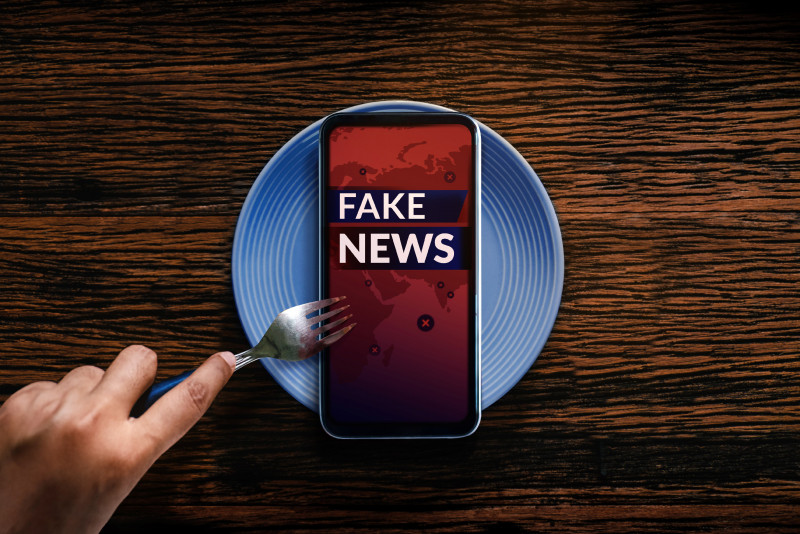
IT is difficult to assess the threat posed by fake news. Does it really have the power to change readers' behavior, as experts fear? A new study has looked at the real effect of misinformation on people. The results suggest that it may not be as dramatic as it seems.
Ciara Greene and Gillian Murphy were interested in studying the power of fake news items, and more particularly on their capacity to influence the behavior of readers. Especially when the stories are related to the covid-19 pandemic. Do they really cause people to shy away from vaccination, as we often hear?
In May 2020, the researchers invited more than 4,500 people to participate in a survey via an article published on the Irish news site TheJournal.ie. They were presented with four true news stories related to the novel coronavirus, and two fake news stories. One was that coffee could potentially protect against covid-19, and the other was that eating chili peppers could lessen the effects of the virus. The other two claimed that pharmaceutical companies were hiding the harmful side effects of a vaccine then in development and that the Irish public health service's next contact-tracking app had been developed by people with links to Cambridge Analytica.
After reading the articles, study participants indicated how likely they were to change their behavior in light of what they had discovered. Would they be tempted to drink more coffee or download the Irish government's contact tracking app? It turns out that they might be, but not as much as you might think.
False memories and behavioral changes
Readers who had found out about the privacy issues of a contact-tracking app were 7% less likely to download it than those who had seen the information but did not remember it. The researchers noted that some people developed "false memories" about the fake news they had encountered. A phenomenon that had an impact on their willingness to modify their behavior based on what they had read.
"We report evidence that even a single exposure to health misinformation may 'nudge behavior.," they write in the study, recently published in the specialized publication Journal of Experimental Psychology: Applied. However, it would seem that this phenomenon does not apply equally to all fake news. The fake news about coffee had a significant effect on the study participants but in a surprising way. Those who saw it were about 5.5% less likely to say they would drink more coffee to mitigate the effects of the new coronavirus.
As Ciara Greene and Gillian Murphy point out, respondents' behavioral intentions do not necessarily result in actual attitude change. "Intentions are however a critical first step for behavior change: if fake news stories have little effect on targeted behavioral intentions, there is relatively little chance of them impacting actual behavior," the researchers write. However, repeated exposure to online misinformation may contribute to this, and may even cause some people to binge on chili peppers to combat covid-19. – ETX Studio, July 6, 2021