Science

NASA to launch delicate stowing of Osiris-Rex asteroid samples

Osiris-Rex is set to come home in September 2023, hopefully with the largest sample returned from space since the Apollo era

Updated 5 years ago · Published on 27 Oct 2020 9:53AM

NASA to launch delicate stowing of Osiris-Rex asteroid samples
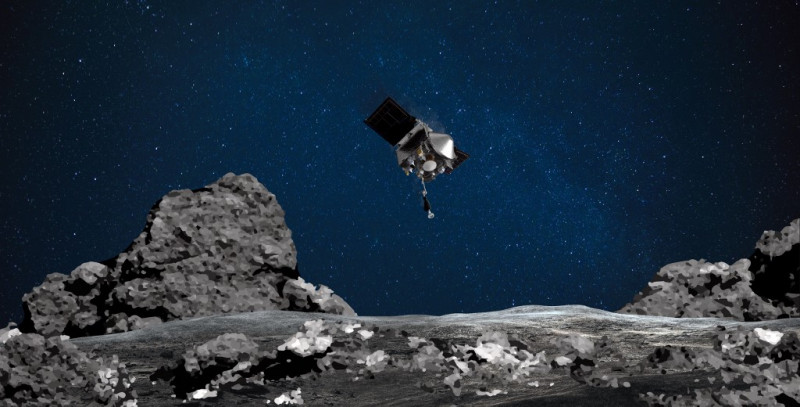
Osiris-Rex is on a mission that scientists hope will unravel the origins of our solar system. – ETX Studio pic, October 27, 2020

NASA'S robotic spacecraft Osiris-Rex is set to begin on Tuesday (October 26) a delicate operation to store the precious particles it scooped up from the asteroid Bennu, but which were leaking into space when a flap got wedged open.

The probe is on a mission to collect fragments that scientists hope will help unravel the origins of our solar system, but that hit a snag after it picked up too big of a sample.

Fragments from the asteroid's surface are in a collector at the end of the probe's three-metre  arm, slowly escaping into space because some rocks have prevented the compartment closing completely.

That arm is what came into contact with Bennu for a few seconds last Tuesday in the culmination of a mission launched from Earth some four years ago.

The probe is thought to have collected some 400 grams of fragments, far more than the minimum of 60 grams needed, NASA said previously.

Scientists need to stow the sample in a capsule that is at the probe's center, and the operation was moved up to Tuesday from the planned November 2 date due to the leak.

"The abundance of material we collected from Bennu made it possible to expedite our decision to stow," said Dante Lauretta, project chief.

Osiris-Rex is set to come home in September 2023, hopefully with the largest sample returned from space since the Apollo era.

The stowing operation will take several days, NASA said, because it requires the team's oversight and input unlike some of Osiris-Rex's other operations that run autonomously.

After each step in the process the spacecraft will send information and images back to Earth so scientists can make sure everything is proceeding correctly.

The probe is so far away that it takes 18.5 minutes for its transmissions to reach Earth, and any signal from the control room requires the same amount of time to reach Osiris-Rex. – ETX Studio, October 27, 2020

Related News

World / 1mth

SpaceX launches its biggest, most beefed-up Starship on test flight (video)

Opinion / 4mth

The 'Age of Apps': Making daily life easier, not harder

Malaysia / 6mth

Part of object suspected to be from space found on Pekan beach

Wellness / 6mth

Penang to ensure room for exercise and social development activities, says CM

Malaysia / 8mth

Supermoon and Taurid meteor shower expected tonight

Culture & Lifestyle / 10mth

'Meniti Cakerawala' dance theatre odyssey set to fascinate Penangites

Spotlight

Malaysia

Jana Wibawa: Muhyiddin's instructions were to consider, not approve the project - Tengku Zafrul

World

Trump declares Iran peace accord 'over'

Malaysia

Rembau Undang’s office ordered to vacate premises within 24 hours amid adat dispute

By Alfian Z.M. Tahir

Malaysia

Don't repeat old mistakes, five ships must be completed according to cost and schedule – PAC

Malaysia

Friends in Putrajaya, rivals in Johor: Election exposes new realities of coalition politics

By Alfian Z.M. Tahir

World

Search intensifies off Karachi after Pakistan cargo jet vanishes following mid-air navigation failure

Malaysia

Salesman gets 10 years jail for slashing motorcyclist with meat cleaver

Malaysia

Thai PM Anutin to make first official visit to Malaysia with border connectivity in focus

Malaysia

Young voters could decide Johor election outcome as parties battle for new electorate

You may be interested

Places

Four premier hotels in Penang to be restored, open doors soon

By Ian McIntyre

Health

Malaysia among top ten medical tourism destinations, with much credit to Penang

By Ian McIntyre

Living

Matrix Concepts' home ownership campaign offers over RM30m rewards and prizes