FOR the first time in more than a century, scientists have found an extinct, rare species of tortoise in the Galápagos islands, a "big deal" for the famed islands' threatened biodiversity.
This animal is the first Chelonoidis phantasticus to be discovered since the explorer Rollo Beck discovered a male specimen during an expedition in 1906, reported The Guardian.
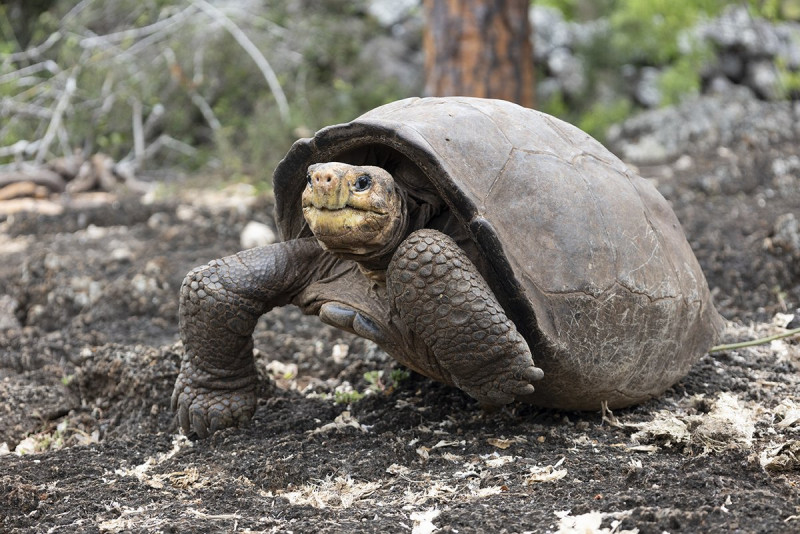
The animal is named Fernanda, after the Fernandina Island where she lives, a relatively uninhabited active volcano in the western Galápagos Archipelago.
“Everything that we knew about this species said it was extinct,” said Stephen Gaughran, an ecology and evolutionary biology researcher at Princeton University and one of the lead authors of the study that announced the finding, published on Thursday in the journal Communications Biology.
“So it’s a big deal for a species that we thought was extinct for a hundred years to suddenly appear here.”
Fernanda had to undergo DNA testing when she was discovered in 2019 on the island. Researchers were delighted that it confirmed that the rare phantasticus species wasn’t extinct after all.
Princeton scientists sequenced the genome of both the 1906 and the 2019 tortoise. They matched as members of the same species of fantastic giant tortoise. This means they are significantly genetically different from the other 13 species of tortoise found in the Galápagos.
With the exception of one species that is already extinct, all giant Galápagos tortoises are listed on the IUCN Red List from vulnerable to critically endangered.
The researchers had initially doubted Fernanda was a native phantasticus species due to her small stature. She appears smaller than the typical giant tortoise, despite being 50 years old or older.
Fernanda also did not have the species' flared shell and saddleback shape. However, the reason for her size could be the lack of vegetation on the arid, volcanic island.
It was also thought that the 1906 specimen was transplanted to the island either via extreme weather or human intervention. Tortoises can't swim, but they can float and be carried during storms.
“It seemed like a more likely explanation that a random tortoise just ended up there from a different island,” he said.
This could mean that Fernanda might not have been alone after all and that the island could have hosted a population of tortoises at one point.
“These findings are extremely exciting from both evolutionary and conservation perspectives,” said Michael Russello, a biodiversity researcher at the University of British Columbia who was not involved in the study.
“Fernandina is a challenging island to traverse, but this finding does suggest a comprehensive survey may be warranted to search for other individuals”, because there’s now “a glimmer of hope that the species may yet survive”.
What does the discovery of Fernanda mean for conservation? According to Danielle Edwards, a Galápagos tortoise expert from University of California Merced, who was not involved in the study, there are wider ramifications, such as whether these Galápagos tortoises are species or subspecies.
“Biology is messy and speciation is a continuum,” said Edwards.
She explained that finding another tortoise genetically similar to Fernanda would be crucial to understanding the mysterious history of these island inhabitants.
Several other tortoise tracks were found by recent expeditions that might belong to the same species. The discovery could motivate local organizations to develop a captive breeding and repatriation programme if confirmed.
“If we only have Fernanda, it’s exciting to have found her. But if she doesn’t have another tortoise to breed with, then there’s nowhere to go,” said Gaughran.
“If there are at least a few of these tortoises still living on that island, then that opens up the possibility of trying to really revive the species.” – Agencies, June 11, 2022