ONE of the American space agency’s most recent probes, named Dart (Double Asteroid Redirection Test), has smashed into an asteroid. The impact resulted in its destruction.
However, the collision was very much intentional. It was designed to test whether threatening space rocks can be redirected safely away from Earth.
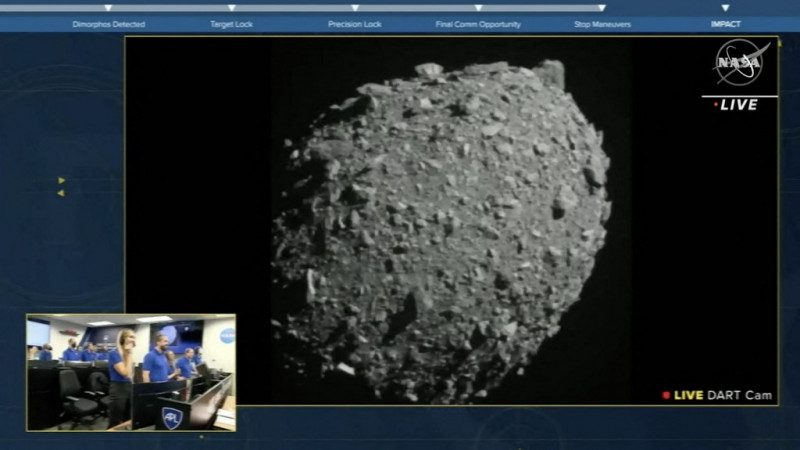
Dart’s camera recorded images per second throughout its task, up until the impact with its target, a 160-metre-wide object called Dimorphos. The consistent image returns were cut out as Dart was destroyed on impact.
Controllers of Dart were based at the John Hopkins University Applied Physics Laboratory (JHU-APL). They all celebrated as Dimorphos filled the view on Dart’s camera in its final moments. Initial calculations show that the impact was only 17m off the exact centre of Dimorphos.
It will be some weeks before scientists on the Nasa-led mission know for sure whether their experiment has worked.
A few weeks are needed before the Nasa scientists can confirm whether their experiment was a success or not. Nonetheless, Nasa’s director of planetary science Dr Lori Glaze was convinced that something remarkable has been achieved.
“We’re embarking on a new era of humankind, an era in which we potentially have the capability to protect ourselves from something like a dangerous hazardous asteroid impact. What an amazing thing; we’ve never had that capability before,” she told reporters.
Dr Elena Adams, a JHU-APL mission systems engineer, said “earthlings should sleep better” knowing they had a planetary defence solution.
The success of the mission will be determined by studying the changes to the orbit of Dimorphos around another asteroid, Didymos. The two-rock system will be precisely measured by telescopes on Earth.
Dimorphos took roughly 11 hours and 55 minutes to circle its 780m-wide partner before the collision.
Moving at about 22,000km/h, the Dart probe first needed to identify the smaller rock from the larger one. Onboard navigation software then adjusted the closing trajectory with thruster firings before going to a head-on collision.
Scientists were fascinated to see the different shapes of the two asteroids, though it was only for a short moment.
As per the scientists' expectations, Didymos had a diamond shape with boulders on its surface and some smooth areas.
Dr Carolyn Ernst, the instrument scientist on Dart’s camera system, was extremely excited to see Dimorphos, saying that it “looks adorable; so cute”.
“It looks in a lot of ways like some of the other small asteroids we’ve seen, and they are also covered in boulders. So we suspect it is likely to be a rubble pile, kind of loosely consolidated,” she added. – The Vibes, September 28, 2022