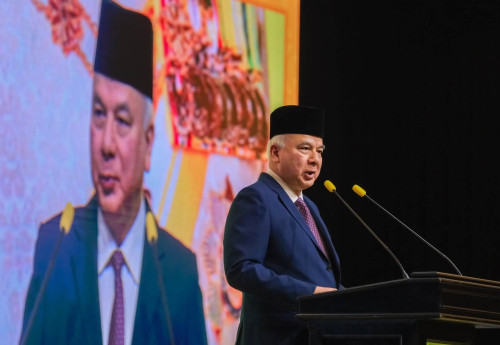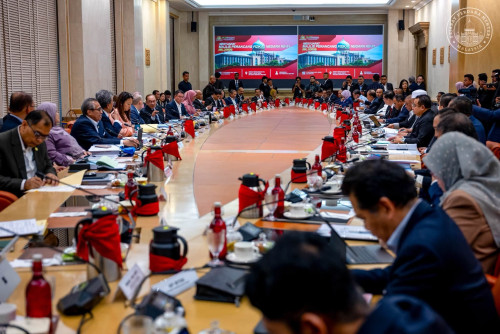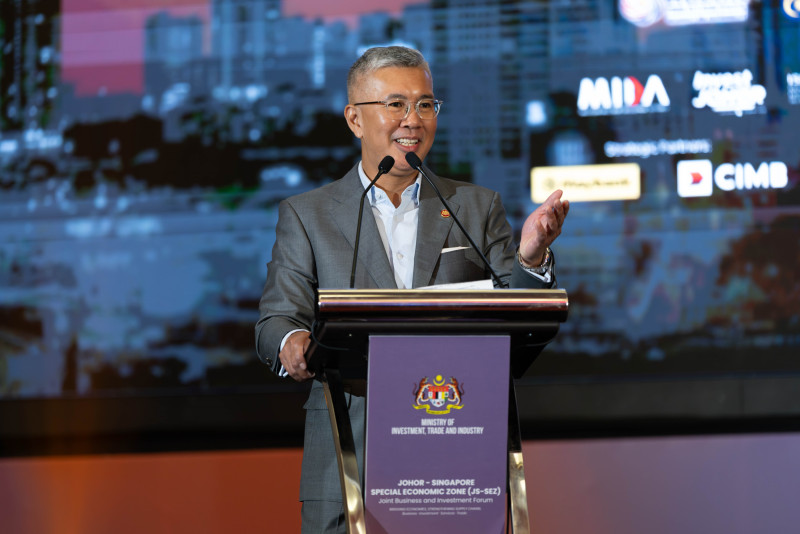
MINISTER of Investment, Trade and Industry (MITI), Tengku Datuk Seri Zafrul Abdul Aziz, reaffirmed the country’s strong commitment to the Johor-Singapore Special Economic Zone (JS-SEZ) at the inaugural JS-SEZ Business and Investment Forum held at the Persada Johor International Convention Centre today.
Tengku Zafrul pointed to the strong investment figures for Q1 2025, crediting agencies such as the Johor State Government, Enterprise Singapore (EnterpriseSG), the Economic Development Board (EDB), MIDA, IRDA, Invest Johor and multiple local councils.
Under the forum’s theme ‘Bridging Economies, Strengthening Supply Chains’, Zafrul described the JS-SEZ as a transformative step forward in regional cooperation, saying: “For many decades, the heart of the Malaysia-Singapore relationship lies in the fact that our two countries are at our best when we work together.”
Malaysia-Singapore trade stood at USD86.69 billion in 2024, led by sectors including electronics, petroleum, machinery, agriculture and optical equipment. The JS-SEZ is expected to elevate this further, with Zafrul calling it “the next milestone in a long, storied and mutually beneficial journey.”
Addressing concerns over the recent US-imposed “Liberation Day” tariffs, Zafrul revealed that he and his team will travel to Washington, DC for discussions with the US Trade Representative and other American stakeholders on April 24.
“Malaysia is fully committed to securing a favourable resolution that preserves vital market access and supply chains, attracts continued foreign investment, and supports the well-being of our workers and businesses,” he said, adding that Malaysia and ASEAN remain against retaliatory tariffs and prefer constructive engagement.
“Many see the tariff issue as a test to ASEAN’s unity and centrality. But the sense of togetherness on this issue I’ve seen from my colleagues has been encouraging,” he noted.
Zafrul also emphasised that the economic challenges of today underscore the urgency and value of the JS-SEZ. “While we are still studying the full impact that the tariffs will have, the need for the JS-SEZ and our countries’ economic interlinkage is greater than ever.”
The JS-SEZ, formalised through a bilateral agreement in January 2025, is expected to roll out 50 projects in its first five years and scale to 100 projects within a decade, creating 20,000 skilled jobs. Key sectors include logistics, manufacturing, financial services, digital economy, tourism, education, health, energy, and the green economy.
Zafrul said there are initiatives which align closely with Malaysia’s New Industrial Masterplan 2030 and the National Energy Transition Roadmap. “The scale of our JS-SEZ ambition is being matched and powered by a whole-of-government approach,” he said.
Welcoming participants from both sides of the Causeway, Zafrul extended his thanks to the governments of Singapore and Johor for their collaboration, and acknowledged the presence of Johor Menteri Besar Dato’ Onn Hafiz and Singapore’s Deputy Prime Minister and Trade Minister, His Excellency Gan Kim Yong.
Zafrul added that MITI leads the Working Group on Ease of Doing Business and supports others focusing on talent, trade, and economic sectors. Zafrul pointed to the recent launch of the Invest Malaysia Facilitation Centre Johor (IMFC-J) as a major milestone in streamlining investment processes.
The JS-SEZ Business Clinic Programme, held in conjunction with the forum, brings together representatives from Customs, Immigration, TNB, the Department of Environment and Ranhill SAJ, alongside business leaders for direct engagement. Companies such as Super Micro Computer Malaysia, ByteDance, Hershey Malaysia, and others are taking part in business matching sessions.
He underscored that beyond financial incentives, the JS-SEZ’s greatest assets include its strategic location, strong connectivity, legal framework, available land, talent pool, and the unity of purpose across governments.
He remarked, “One mountain cannot accommodate two tigers, but the JS-SEZ has proven that two tigers can work together.”
Meanwhile, Deputy Minister Liew Chin Tong said; “Many have asked whether the Johor-Singapore Special Economic Zone (JS-SEZ) will succeed, given it is the third major attempt since 1965 to more deeply integrate the Johor and Singapore economies. But this time, the world has changed—and that makes all the difference.”
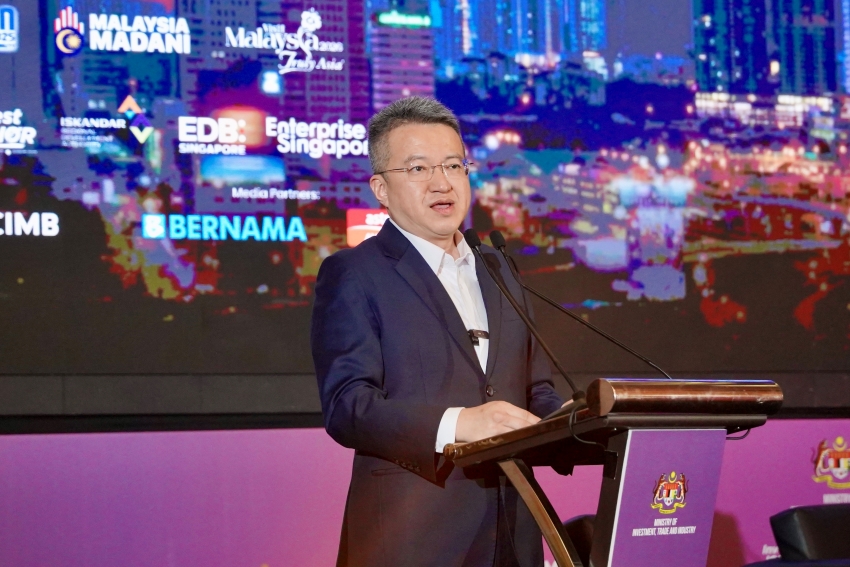
“This time is different,” Liew noted. “It is different because both sides recognise that the world has changed in a way that is not seen in at least a generation. The world has changed from prioritising ‘just-in-time’ efficiency or having just one single global supply chain, to one that is now focusing on ‘just-in-case’ security.”
The shift away from a single, frictionless global trade system—exacerbated by geopolitical tensions—has altered how economies approach integration. “Efficiency is no longer the only priority, as risk is also a very major concern for corporations,” the speaker continues.
“The world is moving away from the idea of a single global supply chain to now thinking of multiple regional supply chains. The idea that you can move container boxes anywhere and everywhere in the world without hindrance, is no longer the case.”
This is not the first time such ambitions have been voiced. In 1989, Singapore’s then-Deputy Prime Minister Goh Chok Tong proposed the SIJORI (Singapore-Johor-Riau) Growth Triangle, aimed at integrating Singapore, Johor and Indonesia’s Riau Islands. However, by 1994 Singapore’s focus had shifted to China, particularly with the launch of the Suzhou Industrial Park, and SIJORI faded from view.
Another attempt came in 2006, when Malaysia launched the Iskandar Development Region under the late Prime Minister Tun Abdullah Badawi. Initially full of promise, the project pivoted toward property and leisure developments targeting Singaporean consumers, and did not realise integration in terms of supply chains or labour.
“This time, if we do it well, if we can successfully integrate the Johor and Singapore economies, we will be able to create something meaningful for both Johor and Singapore, for Malaysia and Singapore, and for ASEAN, which perhaps might add to the global change,” he said.
“We are now entering into a potential third phase. It is about ‘Made by Malaysia’ and ‘Made by Malaysians’, by creating our own intellectual properties and innovation. I think Singapore shares the same aspiration to create its own technology. It is no longer just about being a user but also a creator.”
Liew sees the JS-SEZ as a potential catalyst for this new model of growth: “If we imagine that Johor and Singapore can become a very strong cluster, with the financial capital and financial capabilities of Singapore combined with the capabilities of Johor to create innovation and new technologies here, we will be a very important region.”
The vision extends beyond bilateral economic integration. “We have to shift the way we think. We have always been thinking about exporting to the United States. The US is seen as the consumer of the last resort and in many instances the consumer of the first resort. But it is time for us to think about creating technology for ASEAN, India, Bangladesh, Brazil—for the bottom billions of the world.”
He envisions a model not necessarily dependent on cutting-edge high-tech but rather “middle-tech”—technologies suited to emerging markets, scalable and practical. “We can create technological companies that will provide not necessarily high tech, but middle tech. This will allow us to be in a very interesting position where we occupy the indispensable middle.”
With Malaysia and Singapore working in tandem, the region could help lead ASEAN into a new era. “For Malaysia and Singapore’s economy to succeed in this new era, it is important that we always keep in mind that combined, Malaysia and Singapore can help power transformative growth in ASEAN.”
The ultimate goal is to catalyse a growing middle class throughout ASEAN, which would transform it from a production-focused region into a consumer powerhouse. “We need to see the Indonesians being rich, we need to see the Cambodians being a middle-class society,” Liew added. - April 21, 2025