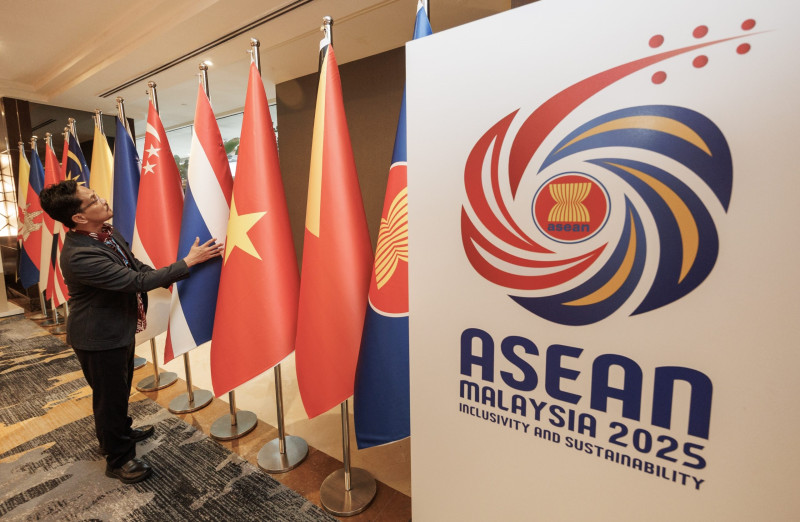
THE 46th ASEAN Summit, which officially began today and spans two days, serves as a vital platform for Southeast Asian leaders to assess the region’s progress across its three foundational pillars: political-security, economic, and socio-cultural cooperation.
Tunku Nashrul Abaidah, Senior Press Secretary to Prime Minister Datuk Seri Anwar Ibrahim, said the summit also addresses a broad spectrum of increasingly complex regional and global issues, including the South China Sea dispute, humanitarian crises in Gaza and Myanmar, unilateral trade actions by global powers, digital economy challenges, and the resilience of supply chains.
“The Prime Minister has consistently emphasised that under this year’s ASEAN Chairmanship, Malaysia bears a significant responsibility in shaping a stronger, and more inclusive and resilient ASEAN Community,” he said.
“Malaysia’s main focus is to ensure that ASEAN remains relevant, responsive and people-centred, in line with the ASEAN 2045 long-term vision that will be launched.”
Tunku Nashrul was speaking during a special Prime Minister’s Office (PMO) briefing held in conjunction with the 46th ASEAN Summit. The session was broadcast live on both the Anwar Ibrahim and PMO Malaysia official Facebook pages.
In addition to the summit with ASEAN member states, Malaysia is also hosting the 2nd ASEAN-Gulf Cooperation Council (GCC) Summit and the inaugural ASEAN-GCC-China Summit, both scheduled for tomorrow and chaired by Malaysia in its capacity as ASEAN Chair for 2025.
The ASEAN-GCC Summit will review the ASEAN-GCC Framework of Cooperation 2024–2028, which outlines joint initiatives in areas including free trade, education, sustainability, and cultural and digital connectivity.
“The second ASEAN-GCC Summit also reaffirms the long-term commitment between the two regions, which have maintained relations since 1990,” Tunku Nashrul noted. “ASEAN and the GCC are two significant economic blocs, with total trade reaching USD130.7 billion and GCC investments in ASEAN amounting to USD390.2 million.”
Regarding today’s summit programme, he said the schedule includes a series of pivotal meetings involving the Prime Minister, ASEAN leaders, and stakeholders from various sectors.
Among the key sessions are the plenary and retreat meetings, which provide space for detailed discussions on current regional challenges and ASEAN’s future agenda.
Engagement sessions are also being held with representatives from the ASEAN Inter-Parliamentary Assembly (AIPA), ASEAN youth delegates, and the ASEAN Business Advisory Council (ASEAN-BAC), reflecting an inclusive approach to regional policy-making.
The Kuala Lumpur Declaration on ASEAN 2045 is also being signed today, with Prime Minister Anwar delivering the opening address. The day concludes with the ASEAN Gala Dinner, a cultural highlight hosted by the Prime Minister and his wife, Datuk Seri Dr Wan Azizah Wan Ismail.
Tunku Nashrul also confirmed that a number of bilateral meetings are scheduled throughout the day with key strategic partners, including Cambodia, Singapore, China, and Kuwait.
“Today marks a significant milestone in Malaysia’s journey as ASEAN Chair for 2025,” he said. “The Prime Minister’s leadership will be central—not only in shaping the summit’s key decisions—but also in showcasing Malaysia’s commitment to inclusion, sustainability, and regional stability.”
He added that the summit provides Malaysia with an opportunity to steer the development of a people-centric ASEAN Community, aligning with the aspirations of the Malaysia MADANI framework.
“Through this chairmanship, Malaysia can further strengthen diplomatic and economic ties in the region, including with key dialogue partners such as the GCC and China,” he said.
“Beyond that, hosting such a large-scale summit also brings tangible economic benefits to the domestic economy, particularly in tourism, hospitality, and small and medium enterprise sectors.”
Malaysia positioned to drive cross-regional trade
Meawhile, the PMO said Malaysia is strategically placed to lead cross-regional trade, bolster regional supply chain resilience and advance sustainable infrastructure development, given the vast combined economic scale of ASEAN, the Gulf Cooperation Council (GCC), and China.
Tunku Nashrul noted that the collective economic value of ASEAN, the GCC and China now stands at nearly USD25 trillion, with a combined population exceeding two billion.
Against this backdrop, he said, tomorrow’s inaugural trilateral summit involving ASEAN, the GCC and China will serve to outline new strategies in trade, investment, sustainable infrastructure, and digitalisation across the region.
“The trilateral summit between ASEAN, the GCC and China is a new initiative introduced by Malaysia under its ASEAN Chairmanship,” said Tunku Nashrul. “It aims to strengthen trilateral economic cooperation between ASEAN, the GCC and China. All sessions are scheduled to take place tomorrow (27 May), with Malaysia presiding as ASEAN Chair for 2025.”
He added ASEAN is now the world’s fifth largest economy, with a combined GDP of USD3.8 trillion, while China remains ASEAN’s largest trading partner, with bilateral trade valued at USD696.7 billion.
Tunku Nashrul emphasised that the 46th ASEAN Summit provides Malaysia with an opportunity to align ASEAN Community development with the people-centric aspirations of the Malaysia MADANI framework.
“Through this chairmanship, Malaysia can deepen regional diplomatic and economic collaboration, including with dialogue partners such as the GCC and China,” he said.
Among the prominent leaders expected to attend the first-ever trilateral summit are Chinese Premier Li Qiang, UAE Supreme Council Member and Ruler of Ras Al Khaimah, Sheikh Saud bin Saqr Al Qasimi, and Kuwait’s Crown Prince, Sheikh Sabah Khaled Al-Hamad Al-Sabah.
The trilateral summit is one of several key events held in conjunction with the 46th ASEAN Summit currently taking place in Kuala Lumpur. - May 26, 2025