PRIME MINISTER Datuk Seri Anwar Ibrahim has emphasised that maintaining economic openness is essential for Southeast Asia’s stability and prosperity, warning that disruptions could destabilise regional financial systems and erode investor confidence.
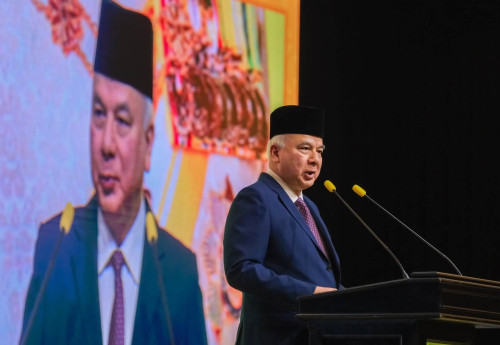
Speaking at the 22nd Shangri-La Dialogue, a premier Asia-Pacific security summit, Anwar argued that economic openness serves not only as a driver of growth but also as “a stabilising force in international relations”.
“It is a source of equilibrium, both between nations and within them, to address pressing issues such as poverty, social inequities, or even the digital divide,” he said. “Open markets create the kind of mutual exposure between nations that encourages caution, not confrontation.”
Anwar cautioned against the rising threat of unilateral actions and retaliatory tariffs, highlighting concerns among ASEAN leaders about global economic fragmentation. ASEAN’s commitment to a rules-based trading system, he stressed, is “not out of convenience, but because it is existential”.
“Currency volatility and investor flight do not respect borders. And disruptions in energy, food or critical minerals cascade quickly through societies,” he added.
Noting that Malaysia, like its regional counterparts, is highly dependent on open and export-driven markets, Anwar said fragmented trade regimes risk increasing costs, reducing resilience, and depressing investment.
Bilateral Engagements to Bolster Defence and Industry Ties
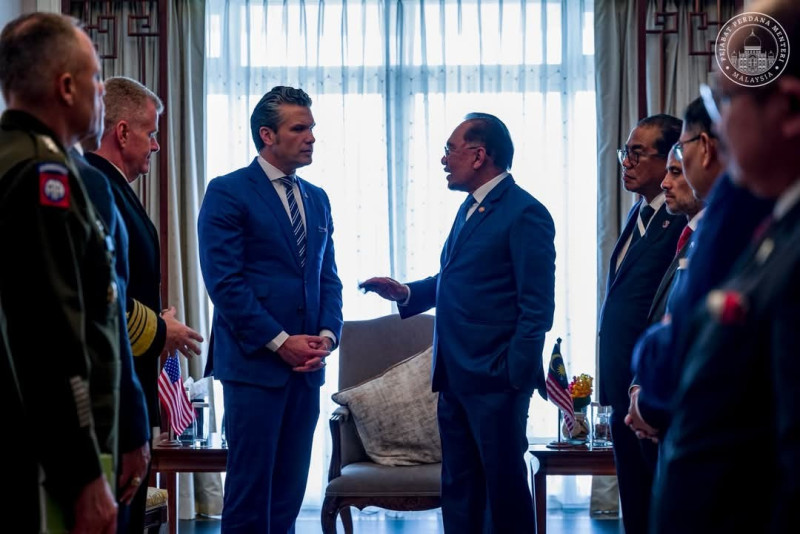
On the sidelines of the dialogue, the Malaysian Prime Minister met with United States Secretary of Defence Pete Hegseth and Boeing Global President Brendan Nelson.
In separate meetings, Anwar discussed enhancing defence and maritime security cooperation, as well as investment in education, asset modernisation, and the development of Malaysia’s Maintenance, Repair and Overhaul (MRO) ecosystem.
“These meetings reflect Malaysia’s growing relevance in the regional and global defence landscape,” Anwar posted on Facebook.
Defending ASEAN Centrality and Strategic Autonomy
In his Shangri-La address, Anwar also reaffirmed Malaysia’s commitment to defending ASEAN centrality and promoting active non-alignment as Chair of ASEAN 2025.
“Preserving our autonomy is not about resisting others. It is about strengthening ourselves. This, in essence, is what ASEAN Centrality is about,” he said.
Cautioning against “a new orthodoxy” that could fragment the region’s strategic architecture, Anwar emphasised the need for openness, transparency, and habit-forming cooperation instead of bloc politics.
“We do not object to like-minded partners talking amongst themselves. But coalitions that build walls instead of bridges, stoke arms competition, or undermine the legitimacy of multilateralism should give us pause,” he said.
He stressed that Southeast Asia must avoid becoming a battleground in a new Cold War, advocating instead for “an equilibrium that promotes cooperation without coercion and balance without bloc politics”.
South China Sea and Principled Diplomacy
On the South China Sea dispute, Anwar urged calm, dialogue, and consistent engagement, reaffirming Malaysia’s commitment to the United Nations Convention on the Law of the Sea (UNCLOS).
“We have no interest in seeing tensions spiral into confrontation, least of all in waters so critical to our own security and prosperity,” he said. “We will urge restraint, encourage dialogue, and work to preserve the stability on which this region depends.”
Rejecting the notion of spheres of influence, Anwar reiterated Malaysia’s active non-alignment policy and the need for all countries, regardless of size, to have a meaningful role in shaping the global order.
“True stability does not come from dividing the world into zones of control, but from creating space for all countries to participate meaningfully in shaping the global order,” he said.
While welcoming a continued US presence in the region, Anwar also stressed the importance of maintaining strong ties with China, and deepening engagement across Asia, Europe, and the Global South.
“For Malaysia, this is a deliberate and strategic posture: to help preserve an open region, to assert our sovereignty, and to make our own choices – on our own terms,” he said. - May 31, 2025