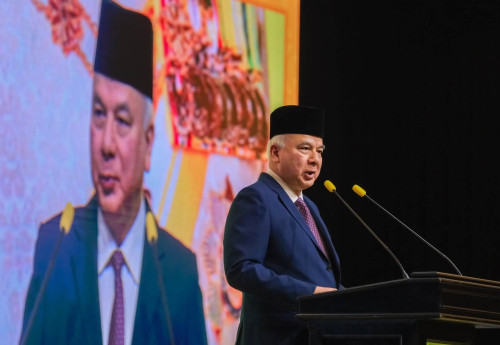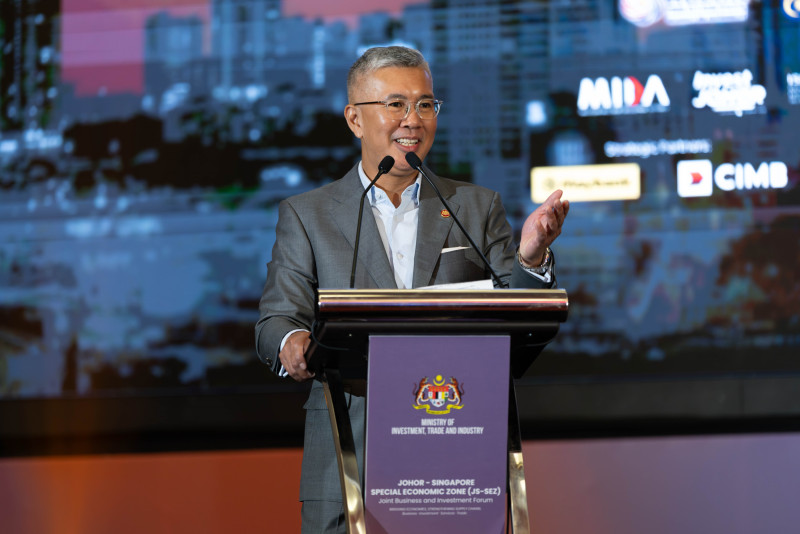
MALAYSIA is ready to take a leading role in healthcare innovation and regional economic strategy, Minister of Investment, Trade and Industry Tengku Zafrul Tengku Abdul Aziz declared at the official launch of International Healthcare Week (IHW) 2025.
Describing the event as more than an industry showcase, Tengku Zafrul said: “IHW 2025 is not just an event; it is a declaration that Malaysia is ready to lead, to collaborate, and to build a healthier, more resilient future not just for our nation, but also for the world.”
Held in Kuala Lumpur for the first time, IHW 2025 convenes global healthcare leaders, policymakers, investors and innovators under one roof, and sets the tone for Malaysia’s wider ambitions as ASEAN Chair this year.
Firm lines on sovereignty amid trade uncertainty
Turning to trade tensions triggered by reciprocal tariffs from the United States, Tengku Zafrul reaffirmed Malaysia’s commitment to protecting national interests while seeking constructive engagement.
“There are several red lines that the MADANI Government will not cross in trade negotiations. We will not sacrifice the country’s sovereignty, or sideline other trading partners in trying to close a trade deal. Our people’s rights, our country’s sovereignty and trust with our valued partners are not bargaining chips,” he said.
He stressed that any trade deal must serve Malaysia’s long-term reform agenda, warning against short-term gains that could compromise economic integrity. “Catchy, feel-good headlines last a few days, a week at the most. But poor deals will have long-term consequences on our people, industries and economy.”
Trade with the US remains robust
Despite recent tensions, bilateral trade with the US remains a key pillar. In 2024, Malaysia–US trade grew nearly 30 percent to RM324.9 billion (USD71.4 billion), with Malaysia supplying crucial exports such as semiconductors, E&E, rubber gloves, palm oil and machinery.
American firms have long maintained a strong presence in Malaysia, with 169 investment projects since 1980 amounting to RM77.5 billion. “These companies have benefited from cumulative incentives of RM4.1 billion,” said Tengku Zafrul, citing tax reliefs, automation allowances and research grants.
“We will continue to uphold the principles of positive reciprocity and fair competition while working alongside industry to innovate, diversify, and maintain our resilience in the global market,” he added.
Three-pronged strategy to strengthen Malaysia’s position
To navigate the shifting geopolitical and trade landscape, Tengku Zafrul outlined three strategic responses.
First, the government has established the National Geoeconomic Command Centre (NGCC) to coordinate inter-agency responses to external disruptions.
Second, Malaysia is pursuing impactful trade agreements such as the Malaysia–UAE CEPA and the Malaysia–EFTA agreement with Switzerland, Norway, Iceland and Liechtenstein.
Third, the country is accelerating its industrial reform agenda, with Q2 2025 results showing a RM3.8 billion increase in manufacturing GDP, 50,000 new jobs and a 4.5% rise in median wages.
Healthcare at the centre of Malaysia’s growth strategy
The global medical devices market is projected to grow from RM2.53 trillion in 2024 to RM4.13 trillion by 2032, and Malaysia is poised to benefit.
“Our healthcare industry is well-positioned to capture this growth,” said Tengku Zafrul, citing RM2.13 billion in healthcare investments in 2024 that created over 2,700 high-value jobs across manufacturing, R&D and regulatory sectors.
Malaysia currently hosts operations by eight of the world’s top 30 medical device manufacturers and is home to over 300 healthcare companies.
“From pharmaceuticals and medical devices to healthcare services and medical tourism, this sector is a catalyst for high-value job creation, innovation, and exports,” he said.
Pharmaceutical exports also rose 7.8% between January and May 2025, supported by the ongoing reforms in Malaysia’s industrial ecosystem.
ASEAN unity central to Malaysia’s leadership
In his role as Chair of the ASEAN Economic Pillar for 2025, Tengku Zafrul said Malaysia aims to strengthen regional cooperation and resilience.
“The US tariffs have thrown a spanner in our region’s growth trajectory. But as Chair of the Economic Pillar, Malaysia must chart the future of ASEAN’s economic community,” he said, adding that the chairmanship is an opportunity to drive deeper economic integration and ensure no member state is left behind.
A call for collective action
“IHW 2025 represents more than an exhibition — it is a call to action for us to strengthen collaboration, accelerate innovation and ensure that our healthcare systems remain inclusive, sustainable and future-ready,” he said in closing.
He thanked all partners, particularly MATRADE and Informa Markets, for delivering what he called a world-class event. “Let us work together to shape a healthier, more connected and innovative future for ASEAN and the world.” - July 15, 2025