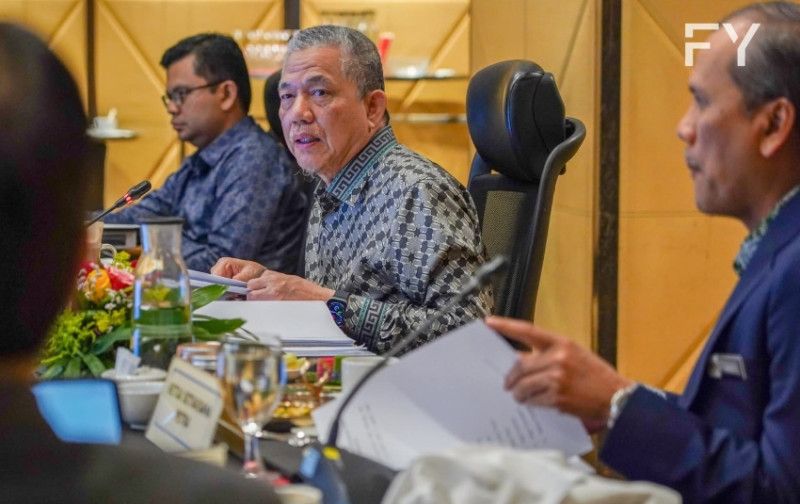
DEPUTY Prime Minister and Minister of Energy Transition and Water Transformation, Datuk Seri Fadillah Yusof, today chaired the second meeting of the Special Committee on Addressing the Deterioration of National River Water Quality (JKKAS) for 2025.
The committee, which plays a central role in overseeing river rehabilitation strategies, focuses on integrated management approaches involving the Federal Government, State Governments, local authorities and relevant stakeholders.
At the meeting, attention was given to the 2024 River Water Quality Status Report presented by the Department of Environment (DOE). Of the 672 major rivers monitored nationwide, 475 (71%) were classified as clean, 170 (25%) as slightly polluted and 27 (4%) as polluted.
Key pollutant parameters identified include Biochemical Oxygen Demand (BOD), Chemical Oxygen Demand (COD), Ammonia Nitrogen (AN), Total Suspended Solids (TSS) and Dissolved Oxygen (DO).
The committee also proposed new effluent discharge standards for both urban and rural wastewater, based on research by the National Hydraulic Research Institute of Malaysia (NAHRIM).
These standards, to be enforced by state authorities, will cover 11 core parameters, including pH, BOD, COD, suspended solids, oil and grease, nitrogen, mercury, colour and solid waste.
A technical workshop will be held to refine discharge standards for stormwater systems before they enter river channels.
This will be coordinated by the Ministry of Housing and Local Government (KPKT) in collaboration with other ministries and state governments.
State governments have also been encouraged to adopt local technologies developed by NAHRIM, such as suspended load extractors, IoT-based oil and grease traps, and the Intriguard system for river reserve mapping to prevent external contamination.
“These strategic measures are expected to significantly improve river water quality, protect environmental sustainability, safeguard public health and support national economic development in the face of climate change and global pollution challenges,” said Fadillah.
He reaffirmed the Federal Government’s commitment, in partnership with the states, to ensuring that Malaysian rivers remain clean, safe and sustainable for current and future generations, in line with the principles of Malaysia MADANI, which prioritise responsible stewardship of natural resources. - August 21, 2025