SOUTHEAST Asia’s top economic policymakers are set to converge in Malaysia next week for the 57th ASEAN Economic Ministers’ Meeting (AEM), a gathering seen as crucial in shaping the region’s trade and investment future amid mounting global protectionist pressures.
The meeting, chaired by Malaysia’s Minister of Investment, Trade and Industry, Tengku Zafrul Abdul Aziz, will focus on finalising key deliverables and proposals to be presented to regional leaders and dialogue partners at the 47th ASEAN Summit next month.
The goal: to deepen economic integration, liberalise intra- and extra-regional trade, and position ASEAN as a resilient hub for global commerce.
“This is a timely opportunity for ASEAN to consolidate its collective strength in the face of efforts to unravel the existing global trading order,” said Tengku Zafrul, highlighting the urgency of countering the economic impact of US tariffs that have hit many ASEAN economies since April.
Malaysia, in its role as ASEAN chair, has taken an active lead not only in steering trade initiatives but also in regional diplomacy, having received regional commendation for mediating recent tensions between Thailand and Cambodia.
As the Senior Economic Officials’ Meetings (SEOM) begin Monday, the spotlight will be on the progress of the 18 Priority Economic Deliverables (PEDs) endorsed informally in February in Desaru. These deliverables cover themes such as integration, inclusivity, sustainability, and digital trade.
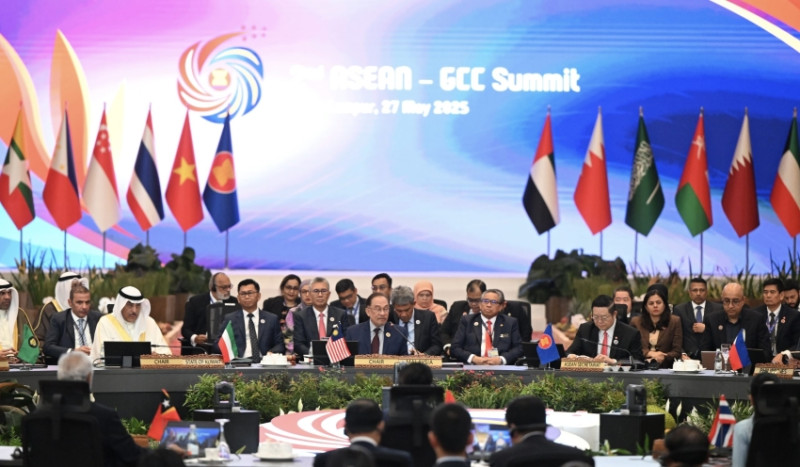
One key success to date is the joint ASEAN-Gulf Cooperation Council (GCC) declaration on economic cooperation, adopted on 27 May 2025. This milestone is seen as a springboard for greater economic ties with the GCC’s oil-rich economies and for diversifying both blocs’ supply chains.
While one PED has been fully completed, several others are in varying stages of implementation — from partially completed to ongoing — and will require renewed political and technical commitment to ensure their timely fulfilment.
Attention will also turn to the upcoming Regional Comprehensive Economic Partnership (RCEP) ministerial meeting. With its 15 member countries — including all ten ASEAN nations, China, Japan, South Korea, Australia, and New Zealand — RCEP remains the world’s largest trade bloc, covering 30 per cent of global GDP.
Speaking in August, Prime Minister Datuk Seri Anwar Ibrahim stressed that RCEP “must not remain a legal text on paper but must be renewed with political energy,” underscoring the urgency of advancing the pact’s implementation amid rising protectionism.
This follows the 2019 Bangkok RCEP Summit, where leaders agreed on the need to deepen regional trade links in the face of escalating US trade barriers.
On the sidelines of the AEM, ASEAN member states will also engage in consultations with the US Trade Representative, Jamieson Greer. These talks are expected to focus on the steep tariffs imposed under the US Liberation Day measures — which have affected key ASEAN industries such as semiconductors, commodities, and electronics.
Under these tariffs, Malaysia, Cambodia, the Philippines, Thailand, and Indonesia were hit with duties of up to 19 per cent. Vietnam faces 20 per cent, Brunei 25 per cent, while Singapore was relatively spared with a 10 per cent tariff. Laos and Myanmar were hit hardest, each with 40 per cent duties.
These developments have re-ignited debate within ASEAN on the need to fully unlock the bloc’s internal trade potential. Intra-ASEAN trade currently accounts for just 22 to 23 per cent of total trade, a figure experts say remains below potential.
As Malaysia leads the chairmanship, it is hoped that its stewardship will rally regional and external partners to push through bolder, high-impact trade initiatives. In doing so, ASEAN may yet redefine its role in a shifting global trade landscape and emerge as a formidable and attractive destination for international commerce. - September 21, 2025