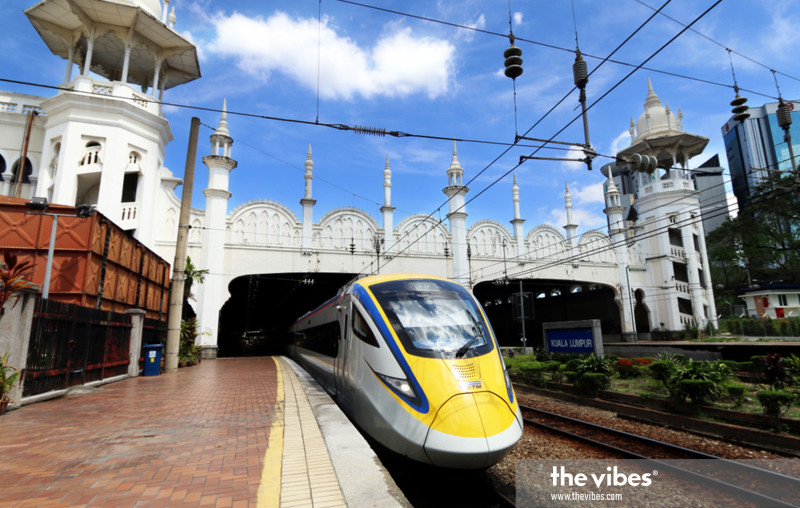
THE inaugural Electric Train Service (ETS) between Johor Bharu and Kuala Lumpur has sparked excitement among Malaysians and international travellers, marking a significant leap in the nation’s rail modernisation and offering a faster, smoother way to traverse the southern corridor.
For Nau Ay Choo and her two siblings from Johor Bahru, the maiden service on 12 December became the long-awaited family reunion they had been planning since Chinese New Year.
The family had intended to travel by locomotive to Kluang to meet their parents before continuing to the capital “the old-fashioned way”, but when the first direct ETS service from JB Sentral to KL Sentral went on sale, they secured their seats immediately.
“We don’t meet each other often, even though we live in JB… but finally, we planned this trip to experience the ETS, which gets everyone relaxed. We don’t have to drive, just sit peacefully and then meet my sister in KL,” The Straits Times reported the 57-year-old logistics executive saying today.
“I think with this new ETS, we’ll have reunions like this more often.”
At JB Sentral, hundreds of passengers arrived as early as 7.30am for the sold-out 8.40am departure.
The waiting area buzzed with excitement as travellers in matching train-themed T-shirts posed for photos, queued for commemorative merchandise and took pictures with wooden ticket replicas.
Cabin crew in bright yellow uniforms greeted passengers as they scanned their e-boarding passes at the gates.
Keretapi Tanah Melayu Bhd (KTMB) distributed goodie bags to commemorate the milestone launch. The service is the latest component of the Gemas–JB electrified double-track project, cutting travel time between Johor Bharu and Kuala Lumpur to around 4.5 hours, compared with the five- to seven-hour journey by road.
Among the earliest arrivals was business owner May Law, 54, who joined a group of fitness-class friends to experience the new service.
“We are going to take the train to Kluang and then come back to JB for a short day trip just to try out the new train,” she said.
Esnu Halim, 44, from Woodlands in Singapore, said the ETS will transform how he travels to Kuala Lumpur, where he owns a second home, and even how he returns to his family’s hometown in Kelantan.
“Our house in Singapore is just in Woodlands so it’s much easier to take the train,” he said, adding that he normally travels by motorcycle or flight.
KTM said that by 5am on 9 December, tickets for the first service were fully sold out except for a few seats reserved for passengers with disabilities.
A total of 409 passengers boarded, including 115 non-Malaysians. Fares begin at RM82 for standard seats and RM153 for business class. Tickets can be purchased via the KITS Style mobile app, KTM kiosks and the official website, with bookings open until May 2026.
While some passengers felt fares might be high for local travellers, many still saw value in the service. Homemaker Ida Marican, 47, said students stood to benefit most because of discounted fares.
“Two of my sons are studying in KL. One of them will be returning home to Johor on the first train out from KL Sentral,” she said.
For university student Bryan Chan, 22, the ETS offered a far cheaper option than flying.
“I was trying to get flight tickets and the price was RM300, RM700. And I still have to take the train from KLIA to the city or take a Grab,” he said from the business-class cabin.
Previously, journeys from JB required passengers to take a 4.5-hour diesel train to Gemas before transferring to an electric train, resulting in an overall trip of about seven hours.
With the Gemas–JB electrification complete, Malaysia’s west-coast rail backbone now runs entirely on double-track electric lines from Padang Besar in Perlis to Johor Bahru.
Operations on the first service were smooth, said KTM train quality inspector Muhammad Azam Mohd Saleh, 36, though some passengers were still adjusting to the new boarding procedures.
Johor’s executive councillor for trade and investment, Lee Ting Han, said the ETS would be a major boost for towns such as Kluang and Paloh.
“With these towns already along the rail corridor, improved ETS connectivity shortens travel time, expands access to jobs, education and services, and allows people to stay rooted in their hometowns while benefiting from national growth,” he said.
The 192-km Gemas–JB project began in 2017 and was initially scheduled for completion in 2021, but was delayed by the pandemic and land acquisition challenges.
Transport Minister Anthony Loke said on 11 December that with the line now complete, the journey from Padang Besar to Johor Bharutakes 10.5 hours.
The first JB–KL service arrived at KL Sentral at 1.10pm, while the maiden KL–JB trip, which departed at 7.45am, reached JB Sentral at 12.20pm.
Content creator Hassan Hussin, who travelled on the KL–JB journey, said the ETS would be a “game changer” for domestic tourism.
“I think for the next five to six months, people from up north will travel on the ETS just to experience the opportunities of travel down south,” said the founder of the train-travel platform Jom Naik Keretapi.
Among those testing the route’s convenience for onward travel to Singapore was Bangsar resident Mohamad Farid Yaacob, 37.
“From JB Sentral, it’s just a short bus ride to Singapore or in the future, the RTS,” he said.
“Travel to Singapore is going to be much easier as I don’t have to go through the jam on the highway, especially during weekends and holidays.” - December 12, 2025