


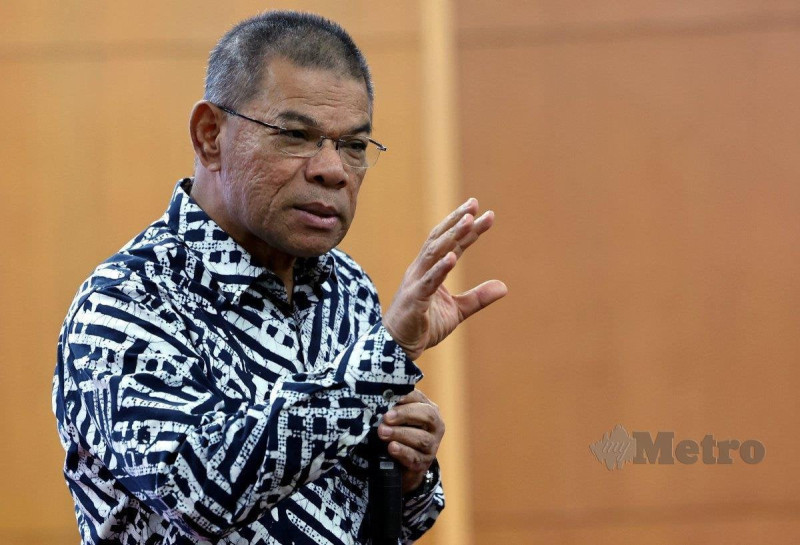
THE Home Minister has announced a series of measures addressing national security, religious extremism, and rehabilitation programmes as the country prepares for Visit Malaysia 2026.
Datuk Seri Saifuddin Nasution Ismail confirmed today that the Royal Malaysia Police’s Extremist and Social Threats Division (E2) will brief authorities this week on a South Korean cult operating in the country.
The minister emphasised that the government will rely solely on verified intelligence rather than speculation or unofficial sources.
“The primary duty of E2 is to detect all forms of deviant teachings or heretical practices, across all religions,” Saifuddin said during a press conference at the Dewan Seri Endon Puspanita in Putrajaya.
“We need to approach this matter carefully and responsibly, and E2 is the most accountable agency in this regard.”
He added that the Ministry is currently compiling comprehensive information on the group before taking further action, underscoring a cautious approach to managing potential extremist threats.
In parallel, Saifuddin announced plans to tighten security at national entry points without disrupting tourist flow.
Agencies under the ministry, particularly the Malaysian Border Control Agency (AKPS), will play a frontline role in balancing efficient visitor mobility with uncompromised national security.
“Visitor mobility should not be affected. Security cannot be compromised.
“And thirdly, we must improve revenue collection alongside the Royal Malaysian Customs Department, as this is also part of AKPS functions,” he said, noting that the government will expand autogate systems at key entry points, including KLIA Terminals 1 and 2, the Sultan Iskandar and Sultan Abu Bakar complexes, as well as locations in Penang, Kota Kinabalu, and Sarawak.
The upgrades are aimed at managing the expected increase in arrivals during Visit Malaysia 2026.
Saifuddin also highlighted a notable success in prison rehabilitation. He revealed that 35 inmates at Kajang Prison have successfully memorised the Qur’an and achieved huffaz status while serving sentences for serious crimes.
“Imagine an individual who has gone through the justice process and ended up in prison, and then the rehabilitation module transforms them into a huffaz.
“I believe that any rehabilitation module that enables prisoners to master and internalise these teachings contributes to the broader goal of personal transformation,” he said.
He instructed the Prison Department to expand this programme to other correctional facilities nationwide, noting that Malaysia has 41 prisons in total and a coordinated rollout could significantly enhance rehabilitation efforts.
The Minister also shared details of 22 halfway houses established to support former inmates who are not accepted back into their families or communities.
“There are cases where ex-prisoners remain rejected despite completing their sentences. These halfway houses provide a temporary solution, allowing them to work during the day and return at night until they are reintegrated into society,” Saifuddin explained.
These initiatives, spanning security, rehabilitation, and border management, illustrate Malaysia’s integrated approach to ensuring public safety, fostering social responsibility, and preparing the nation for an influx of visitors during Visit Malaysia 2026. - January 8, 2025







.jpeg)
