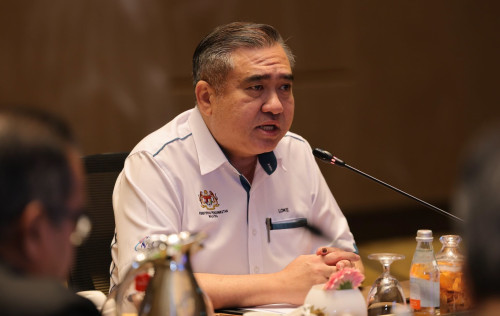
MALAYSIA’S status as a net oil exporter is helping shield the economy from the immediate impact of surging global energy prices triggered by escalating tensions in the Middle East, Finance Minister II Datuk Seri Amir Hamzah Azizan said on Monday.
Speaking to reporters after the 2nd ASEAN Banking and Finance Summit in Kuala Lumpur, Amir Hamzah said the government was closely monitoring developments in the region but remained confident that Malaysia’s economic fundamentals and energy position provided a buffer against global shocks.
“However, for Malaysia, the government is managing the situation and monitoring developments in the Middle East very closely.
“Malaysia's position as a net oil exporter places the country in a reasonable position despite oil prices surging above US$100 (RM396.90) per barrel today,” he said.
Global crude prices have climbed sharply following escalating geopolitical tensions in the region, with Brent crude rising to US$115.40 per barrel from around US$70 just a week earlier.
Amir said Malaysia entered 2026 from a position of relative strength after the economy expanded by 5.2 per cent in 2025, exceeding earlier projections.
“Malaysia’s economy grew 5.2% in 2025, exceeding our own forecasts. Domestic demand remains resilient and investment is surging, driven by multi-year infrastructure projects,” he said.
He added that fiscal indicators were also improving, with the government gradually narrowing the budget deficit towards the three per cent target set under the Fiscal Responsibility Act, while the ringgit had strengthened.
Despite the spike in oil prices, the government plans to maintain the subsidised retail price of RON95 petrol at RM1.99 per litre for the next two months.
“This is because we have the capacity to do that. However, for the open market, the current [global] price will reflect the price being transmitted through,” he said.
Asked whether higher petroleum revenues and potentially larger dividends from Petroliam Nasional Berhad could offset an increased subsidy bill, Amir said it was too early to determine the fiscal impact.
“This is still in the early days, but the key is for us to make sure that we secure a steady supply,” he said.
He added that Malaysia’s domestic oil supply remained stable and assured there would be no disruptions.
In his keynote address at the summit, Amir warned that escalating geopolitical tensions involving the United States, Israel and Iran had evolved into a broader regional conflict with global economic implications.
“Energy prices feed directly into inflation, borrowing costs and the credit risk calculations that banks make every day.
“Supply chain disruptions also affect the borrowers that banks finance,” he said.
He cautioned that geopolitical instability could also influence the investment appetite of multinational corporations that countries across Southeast Asia are seeking to attract.
“When energy routes are threatened and trade corridors become contested, every economy in Asean feels the impact,” he said.
Addressing bankers and financial leaders at the summit, Amir Hamzah also urged financial institutions to strengthen their resilience as global economic risks intensify.
“The theme of this summit calls for trust, technology, talent, and transformation. These are the right words. But let me add one more: resilience. We have moved from a world of efficiency-driven globalisation to one of security-driven geo-economics,” he said.
“In this new world, banks are no longer neutral intermediaries. They either absorb shocks or they transmit them.”
He added that financial institutions must focus on strengthening capital buffers, governance and talent development to withstand future economic disruptions.
“Long-term capital adequacy, deep domestic funding bases, and liquidity buffers matter more today than they have in a generation,” he said.
Drawing an analogy with the mangrove forests of Matang in Perak, which have protected Malaysia’s coastline for more than a century, the minister said economic resilience depended on strong interconnected systems.
“The banking and finance ecosystem is that forest. No single institution, no single country, can anchor the system alone,” he said.
“We cannot navigate this geo-economic era by ourselves. But together, we become something greater than the sum of our parts.” - March 9, 2026