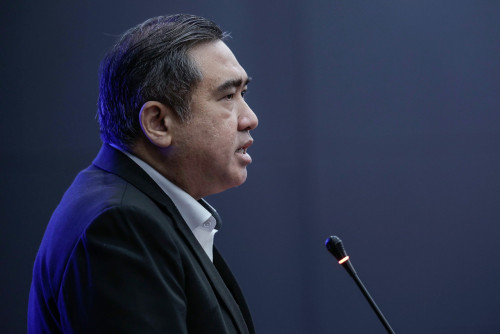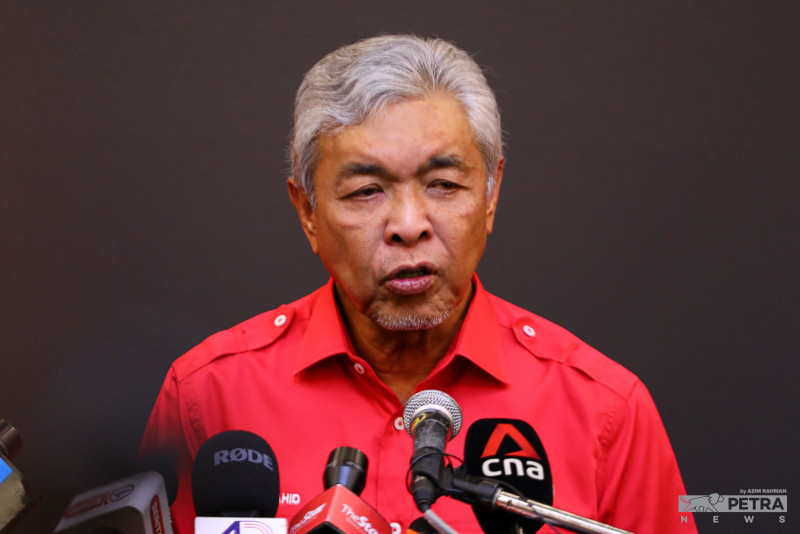
DEPUTY Prime Minister Datuk Seri Dr Ahmad Zahid Hamidi has called for a return to reasoned and strategic Malay politics, warning that prolonged divisions, emotional rivalries and political resentment risk eroding the community’s influence and weakening its ability to shape Malaysia’s future.
Speaking at the National Deliberation forum themed Malay Community Concerns: What Are the Solutions?, Zahid said Malay politics must no longer revolve solely around electoral victories, but instead focus on preserving national stability, protecting key institutions and strengthening communal unity.
“Malay politics must return to reason, decorum and strategy, not merely to win elections, but to ensure this community continues to hold the power to determine its own future,” he said.
The Deputy Prime Minister said persistent political feuds and distrust within the Malay political sphere would only diminish the community’s standing in its own country.
“Malays cannot continue to cheer while the village is pawned away. That is why Malay politics must return to its original purpose of uniting strength, protecting the interests of the community, preserving Islam, defending national institutions and ensuring Malaysia remains stable and equitable.
“Politics is not merely about winning power; politics is a trust to determine the future of the nation,” he said.
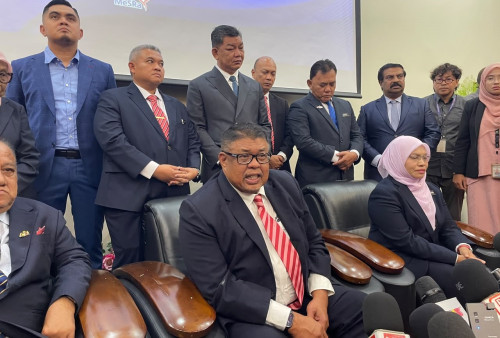
Also present at the event was National Deliberation chairman Tan Sri Abdul Ghani Othman.
Zahid, who is also chairman of Barisan Nasional and president of UMNO, said there was growing public perception that Malay political influence was no longer as strong as it once had been.
“Our voice weakens because of division. Our judgment is drowned by uncontrolled sentiment. Our strategy is often defeated by emotion. The consequence is that the voice of the community becomes weaker until our concerns are no longer acknowledged and are ignored,” he said.
He stressed that the National Deliberation platform should not merely become a venue for repeating anxieties, but instead function as a mechanism for developing solutions, rebuilding confidence and mobilising collective strength under what he described as “one national voice”.
The UMNO president also raised concerns over the growing marginalisation of the Malay language, warning that culture was increasingly confined to ceremonial displays while fading from daily values and identity.
“Young people are becoming increasingly detached from the roots of their community. Globalisation, digital technology and foreign culture are shaping the mindset of the younger generation, while manners, heritage and local values are becoming increasingly loose in everyday life,” he said.
He said public unease was also reflected in recurring disputes involving language, identity and national heritage, ranging from controversies surrounding heritage food to concerns that national promotional narratives no longer adequately reflected Malay-Islamic roots, as well as festivals perceived as lacking sensitivity towards local societal values.
At the same time, Zahid warned that national unity was being increasingly tested as social media became a platform for racial mockery and suspicion.
“Terms such as ‘Type M’, ‘Type C’ and ‘Type I’ may have begun as jokes, but they have ultimately become the language of hidden anger,” he said.
“This concern is not hatred towards other races. It is anxiety that the religious, cultural, linguistic and social sensitivities of the Malay-Muslim community are increasingly being taken lightly.”
He called for stronger legal frameworks and national unity guidelines to ensure public policies, programmes and events respected religious, cultural and linguistic sensitivities.
“The Malay language must be enforced, cultural literacy must be strengthened and unity must be preserved not merely through slogans, but through policy, decorum and law,” he said.
Zahid added that existing legislation, particularly laws dealing with insults against religion and the Malay rulers, should be reassessed and strengthened to address modern challenges more effectively.
“Freedom of speech must continue to be respected, but freedom cannot become a licence to insult religion, belittle the Malay Rulers institution or undermine the foundations of national harmony,” he said.
He argued that concerns within the Malay community had deepened following repeated incidents involving Islam and the monarchy.
“From the issue of the International Convention on the Elimination of All Forms of Racial Discrimination (ICERD), insults against the word Allah, the ‘ham and cheese’ joke belittling halal sensitivities, the issue involving the late firefighter Muhammad Adib, and objections to the azan call to prayer, all these matters have hurt feelings and raised major questions about respect for the foundations of the nation,” he said.
Zahid said recent incidents involving insults directed at the Malay rulers were particularly alarming, including an act in which the Sultan of Selangor’s image was allegedly compared with that of an animal.
“This is not merely an excessive joke, but an open insult to the Malay Rulers institution as the umbrella of the nation’s sovereignty. Such acts clearly exceed the boundaries of decorum, culture and respect that form the basis of social harmony,” he said.
“Islam is the religion of the Federation. The Malay Rulers are the umbrella of sovereignty. When these two pillars are disturbed, public concern cannot be considered trivial. It must be handled firmly, fairly and wisely so that the dignity of religion, national institutions and national harmony can continue to be preserved.”
On education, Zahid said Malaysia’s future education system must move beyond simply producing academic qualifications and instead focus on building capability, creativity and confidence among young Malays.
“Malay youths must be equipped with knowledge, skills, innovation and confidence to compete in the new economy,” he said.
He highlighted a growing mismatch between higher education outcomes and labour market demands, noting that approximately 35.8 per cent, or 1.96 million, higher education graduates were employed in semi-skilled or low-skilled jobs unrelated to their qualifications.
“This shows that the issue in education is no longer merely access to universities, but the compatibility between knowledge, skills and industry needs,” he said.
The Deputy Prime Minister also expressed concern over the weakening role of national schools as institutions for nation-building, while debates surrounding the Unified Examination Certificate (UEC) continued to dominate discussions over Malaysia’s education system.
However, he said Technical and Vocational Education and Training (TVET) should emerge as a key pathway for Malay social mobility and economic advancement.
“TVET must emerge as a new pathway for Malay social mobility, not as a second choice, but as the main route to produce skilled workers, technologists, entrepreneurs and creators of new national value,” he said. - May 10, 2026