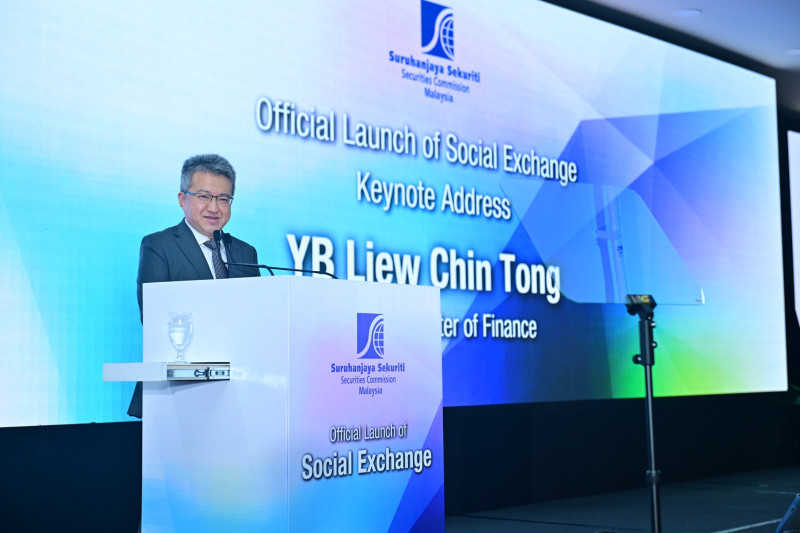
SECURITIES Commission Malaysia (SC) has launched its first regulated Social Exchange platform in a move aimed at transforming charitable fundraising and mobilising private capital towards social impact, sustainability and community development initiatives.
Deputy Finance Minister Liew Chin Tong said the initiative by SC signalled a broader shift in how the country viewed capital markets, positioning them not merely as instruments for profit generation but as vehicles for social progress.
“The Social Exchange is a great initiative by the Securities Commission Malaysia (SC). It is not just an initiative, but a statement that we are not just thinking about the capital market just for money, but capital market for a purpose,” he said at the launch ceremony on Monday.
Liew said Malaysia faced deep structural challenges including youth employment concerns, social mobility, ageing demographics and climate change, all of which required sustained and coordinated financing solutions rather than short-term policy responses.
“The broad challenges that we face, I would say, are how to ensure that the Gen Z won’t feel the need to protest, thus we must deal with what they care about most: jobs, wages, and upward social mobility,” he said.
He added that the country also needed to address the pressures of an ageing society while strengthening the middle class and expanding social protection systems.
“We need to create a strong middle class with adequate social safety nets so that our people get rich before we get old, and further, we need to be prepared for the impact of climate change,” he said.
The launch marks a significant expansion of Malaysia’s social finance ecosystem, with the platform designed to create a transparent and regulated avenue for charitable contributions, social impact projects and community-focused financing initiatives.
Liew said global philanthropy trends showed strong potential for growth, noting that 64 per cent of the world’s population donated to charitable causes in 2024, while the expanding global middle class represented a major untapped source of impact funding.
“Even a small shift such as allocating just 0.5% of this spending towards charitable and social causes could increase annual donations by an additional US$319 billion,” he said.
He said digital technology was also reshaping philanthropic activity by improving transparency, accountability and public trust.
“By enabling contributions to be channelled effectively via the Social Exchange towards projects that make a difference, it is an opportunity to turn goodwill into measurable outcomes. It also demonstrates the capital market's ability to be a force for social growth,” he added.
The Deputy Finance Minister also linked the initiative to the Government’s broader Ekonomi MADANI agenda, which prioritises inclusivity, sustainability and equitable growth.
He suggested Malaysia could pioneer hybrid social-economic models, particularly in sectors such as healthcare, where social objectives and market mechanisms could operate simultaneously.
“This ‘middle’ domain can be moderately profitable but is transversely regulated by the society, by the market and by some government regulations. It can be social in orientation but market in mechanism,” he said.
Liew stressed that stronger governance and regulation would be essential to build confidence in the so-called “third sector” comprising voluntary and community organisations.
“One of its key strengths of the Social Exchange lies in its robust regulatory and governance framework, developed by the Securities Commission Malaysia (SC). This is critical to strengthen trust and confidence in the third sector comprising voluntary and community organisations,” he said.
Under the 2026 Federal Budget, the Government has allocated RM2 million in grants to help reduce participation costs for non-profit organisations joining the platform, while tax incentives will also be extended to eligible organisations and donors.
“These measures are intended to reduce barriers to entry and support the development of a more vibrant and inclusive domestic social impact financing ecosystem,” he said.
Liew said the long-term ambition was for the platform to evolve beyond charitable donations into a broader ecosystem supporting social enterprises, environmental conservation, climate resilience and community development financing.
“As the ecosystem matures, the Government hopes to see a wider range of activities and stakeholders involved,” he said.
He also called on corporations, philanthropic groups, Islamic institutions and members of the public to support the initiative. - May 25, 2026