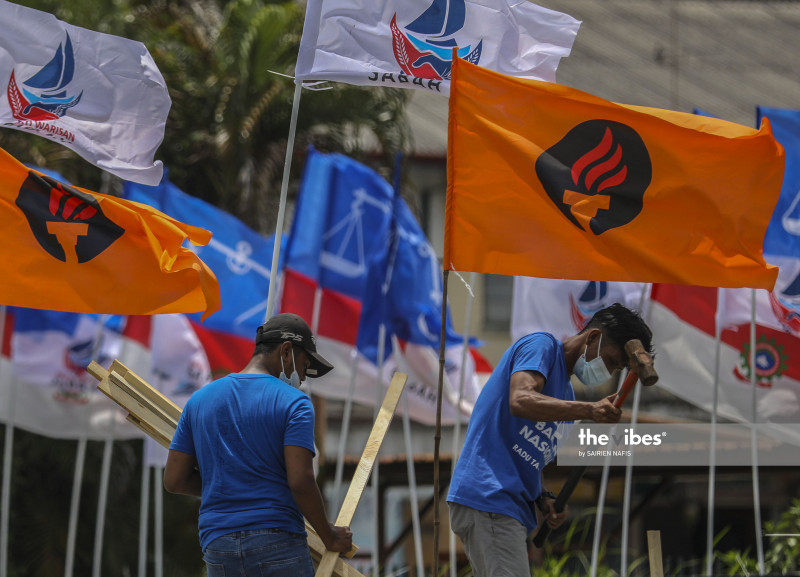

KOTA KINABALU - Despite a noticeable shift in political allegiance from Barisan Nasional (BN) to Perikatan Nasional (PN) among Sabahans, Society Empowerment and Economic Development of Sabah (SEEDS) sees no clear winner in the state election scheduled tomorrow.
The think tank has unveiled the results of its second survey as part of its Sabah Electoral Project 2020.
“In BN’s marginal seats it lost its voter inclination share substantially by more than 10%, whereas PN gained 13%,” said its chairman Arnold Puyok.
“Overall, there is still no clear winner in sight. The second survey shows Gabungan Rakyat Sabah (GRS) comprising PN, BN and PBS leading, with Warisan Plus trailing behind,” he said.
Involving 1,138 respondents, the survey shows that Warisan Plus and the “third force” contenders have not moved much in terms of popularity when factoring in any marginal error, he added.
The first survey was conducted from Aug 24 to Aug 31 Aug. It involved 2,350 respondents across Sabah’s 25 parliamentary constituencies.
Puyok said PN has benefited greatly from campaigning, even in far-flung rural areas
Still, the clashes between BN, PN and Parti Bersatu Sabah (PBS) in 17 constituencies will heavily split the votes and provide an advantage to rival parties, he said.
“In Warisan’s marginal seats, BN lost its voter inclination share substantially by more than 20%, whereas PN gained more than 10%.
“However, Warisan Plus has managed to capture the larger share of the voter inclination by 15%,” he said.
Puyok listed the three top issues that may influence voters’ decisions as infrastructure development, performance of the state government and that of the federal government.
Issues like party hopping and the Philippine claim to Sabah are less salient in this election, while PN is viewed more favourably than Warisan in handling the Covid-19 crisis.
However, concerns about illegal immigrants, Malaysia Agreement 1963 (MA63) and government aid are salient in influencing voters’ decision-making. A majority of respondents also identified oil royalty as the most salient issue under MA63.
Of the respondents, 51% said they would vote for the party rather than the individual. However, among youths, the individual is preferred more than the party.
Puyok also said that the inclination to support local parties increased to 15.9% from the 7.8% found in the first survey. - The Vibes, September 25, 2020.