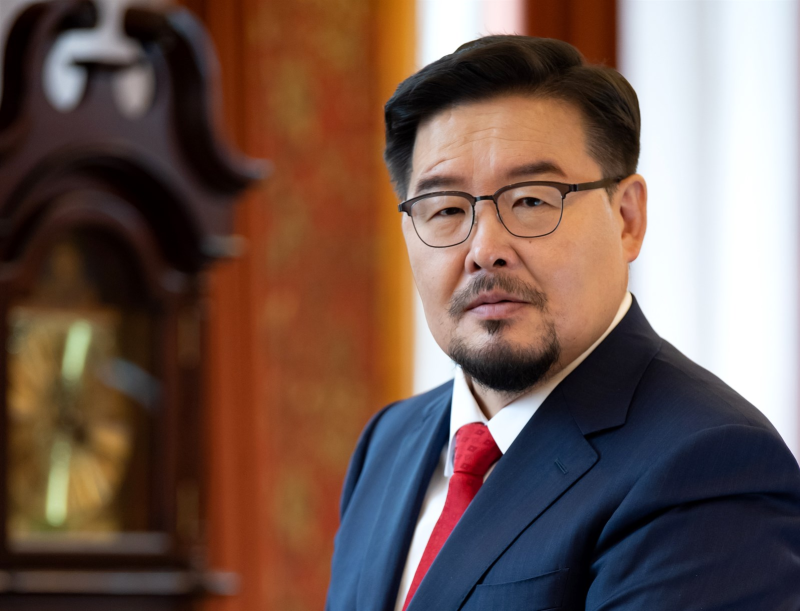
MONGOLIA has moved to formalise its support for Altantuya Shaariibuu’s family, establishing a government-level working group as her father continues his decades-long search for answers through Malaysia’s legal system, former Mongolian prime minister Gombojav Zandanshatar said.
In an exclusive interview, Zandanshatar said the move reflected the state’s responsibility towards its citizens, regardless of where they become victims.
He said a government should not abandon its people when they encounter difficult circumstances abroad, particularly when families are forced to navigate lengthy legal processes in foreign jurisdictions.
“I have always believed that a passport is a promise. When a state issues one, it tells its citizens: wherever you travel, you remain under the care and concern of your country.”
“That responsibility does not disappear when a case becomes difficult, sensitive or prolonged,” he told The Vibes.
Zandanshatar said the Mongolian government established its first dedicated government-level working group in March 2026 to coordinate legal, diplomatic and institutional support for the family after he met Altantuya’s father, Shaariibuu Setev.
The development comes as the family continues its legal efforts in Malaysia, almost 20 years after Altantuya was murdered in 2006.
A state’s responsibility to its citizens
Zandanshatar said his meeting with Shaariibuu reinforced the importance of ensuring that families facing prolonged legal battles abroad do not have to carry the burden alone.
He said the government’s role was not to interfere in another country’s judicial process, but to ensure its citizens received appropriate support.
“A public promise must lead to action, and a grieving father should not have to navigate foreign systems alone.”
The former leader said Mongolia’s involvement was based on concern for one of its citizens and should not be viewed as a challenge to Malaysia’s sovereignty.
He stressed that Mongolia respected Malaysia’s courts and legal institutions.
“Mongolia and Malaysia are friends. Friendship between nations is not weakened by facing a difficult truth.”
“It is strengthened when both countries act with respect, candour and fidelity to the rule of law.”
From diplomatic concern to institutional support
Altantuya’s murder in 2006 triggered widespread grief and public attention in Mongolia, where her death became a symbol of the concerns faced by citizens seeking justice overseas.
Zandanshatar said the case had remained above political divisions in Mongolia because it involved the protection of a citizen rather than partisan interests.
“Concern for the family has crossed political lines because this is not a partisan matter, and it is not a dispute with the Malaysian people.”
“It is a call for truth and justice through Malaysia’s own institutions.”
Zandanshatar said Altantuya’s case demonstrated why governments must remain committed to their citizens, particularly those who are unable to speak for themselves.
“When a citizen can no longer speak for herself, the responsibility to seek answers becomes even greater.”
Supporting justice while respecting Malaysia’s process
The family’s civil action is currently at another stage of legal proceedings, with the Federal Court set to hear its application for leave to appeal against aspects of the Court of Appeal’s decision.
Zandanshatar said Mongolia’s support for the family was not an attempt to influence the outcome of Malaysia’s courts.
Instead, he said the government’s role was to ensure that the family’s pursuit of justice was not faced alone.
“Respect for Malaysia’s sovereignty and a call for full transparency are not contradictory. Both express respect for the rule of law.”
He said Mongolia would continue to pay attention to the case as the family sought what it believed was a complete account of what happened to Altantuya.
“I will continue to pay attention to this case as long as the family is still seeking justice.” - July 14, 2026