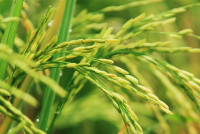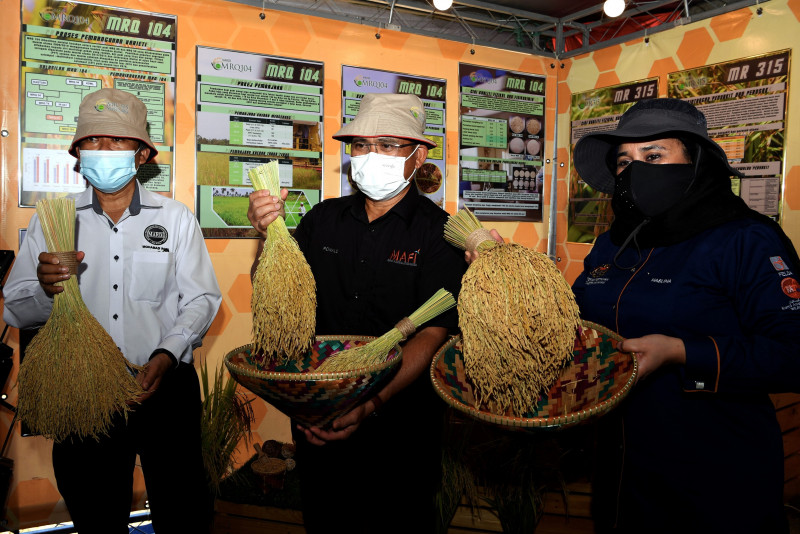

KEPALA BATAS – The Agriculture and Food Industries Ministry today announced two new varieties of padi seeds – MR315 and MRQ104 – expected to increase the country’s food supply.
Its minister, Datuk Seri Ronald Kiandee, said the new seeds have undergone research for up to 12 years and are expected to give a return of up to nine tonnes per hectare.
“We named these two padi seeds as Sri Waja (MR315) and Kembang Sari (MRQ104). They will be used in the next rice planting season, which is expected to be in the middle of this year.
“These two are more resistant to disease, and will increase the yield and income of farmers,” he said at a press conference at the Malaysian Agricultural Research and Development Institute (Mardi) in Seberang Prai today.
He said the maturity rate for the new seeds was also shorter, which is only around 105 to 109 days, compared with other rice varieties, which take up to 120 days.
“The ministry is committed to continue to develop the rice industry so that our rice is not too dependent on foreign countries, such as Thailand.”
Commenting on the issue of padi seed monopoly, Kiandee said his ministry is taking note of farmers’ grievances and will make improvements from time to time.
He added that the ministry is ready to offer positions to legal padi seed agents as panel sellers under the National Farmers’ Organisation.
“This is a new thing for us, and we have implemented this so that the price of padi seeds is controlled and not monopolised by any party.”
In early February, The Vibes reported that the cost of cultivating rice is expected to go up after the federal government directed farmers to purchase seeds from only their respective area’s farmers’ association, instead of the open market.
About 1,000 rice farmers in Seberang Prai Utara are protesting the decision to grant monopoly power to the association to sell seeds of essential crops this year, especially in the midst of a pandemic.
The association is a management agency under the National Farmers’ Organisation.
The decision will likely have an impact on padi production in the coming season, as the seeds will be sold at a higher price to farmers than in stores and distributors. – The Vibes, February 27, 2021