
GEORGE TOWN – Malaysians can have premium vegetables, but are they willing to pay for it?
The fact that not many are willing to pay a higher price has resulted in the country exporting premium vegetables and importing non-premium produce for local consumption, Federation of Vegetable Farmers Associations Malaysia secretary-general Chay Ee Mong told The Vibes.
“If we have premium-grade tomatoes, we can only sell it at RM2 in Malaysia. If we sell it in Singapore, we can fetch S$1 (RM3.08) for it.
If Singapore cannot absorb the total produce, then the balance will be sold within the country. Grade A will also be sold here – but we cannot sell it at the same price as Singapore, because Malaysians cannot afford to pay that price,” he said.
Chay added that the industry is such where farmers, exporters, and traders will sell to whoever offers a better price. “If you have a Musang King durian farm and you can sell it at RM120 per kg to other countries compared to RM30 or RM40 per kg in the Malaysian market – of course, you will want to export it.”
Yesterday, The Vibes reported that higher grade crops in Malaysia are exported and locals are left with third-grade leftovers.
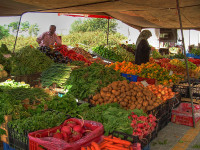
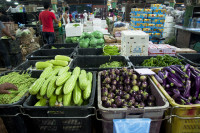
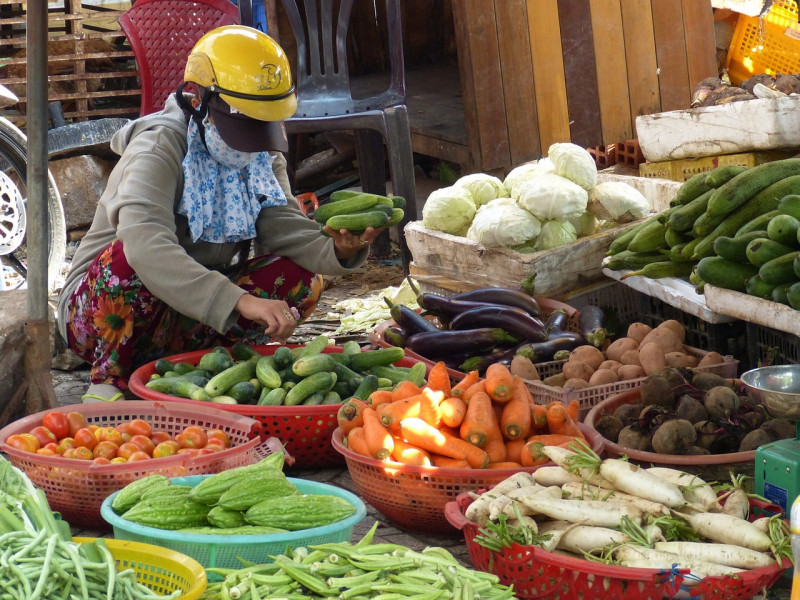
Vegetable supplier David Mariadass told The Vibes that, though Malaysia produces high-quality fresh produce, such as tomatoes, carrots, cabbages, and turnips from Cameron Highlands, more than often than not, it is never consumed by Malaysians, but sent to Singapore where it is repackaged and exported to Europe instead.
Chay said, however, that although Malaysians preferred to purchase non-premium vegetables, this does not mean they are consuming low-grade vegetables.
“We import from countries like Thailand and China – and the produce are of good quality, even though they may be less fresh due to the duration of transportation.
“It takes too long for the veggies to arrive on our shores because they are coming in by containers, not air-flown – meaning that it takes between five and seven days for the produce to arrive.”
He said that the vegetables are imported because a better price can be obtained from the currency exchange. Additionally, the country continues to import vegetables in order to achieve what is known as the self-sufficiency level (SSL).
“We can only produce about one million metric tonnes of vegetables, both highland and lowland types – but our consumption is three million metric tonnes. This means we have to import another two million metric tonnes of vegetables – either fresh, dried, or preserved – so we can feed 22 million locals, foreigners, and visitors.”
All of this means that to balance the import and export of fresh produce, an estimated 23% to 25% of vegetables from Peninsular Malaysia are exported to Singapore, as it only takes 12 hours from farm to market, with the rest being used for local consumption.
No help to increase yield
On whether increasing the yield can reduce Malaysia’s heavy reliance on imported vegetables, Chay said the country does not have enough land to produce the amount of vegetables required to achieve SSL.
“If the government is willing to give land, that will be better – but they are closing down illegal farms now. And if we acquire more land for development with no designated projects to grow edibles, how are we going to increase our yield?”
The NGO federation representative said that currently, the government is not giving out land – and at the same time, most of the land status is regarded as illegal or temporary, even after applying for the land for years. “If there is no approval, how is anybody going to invest? Don’t forget, with this land, you cannot get a loan or financial aid – and some farmers are forced to cultivate on ex-mining land.”
He said that this state of affairs does not benefit individual small farmers and growers, whereas entrepreneurs with more capital can get 2,000 acres of good land easily. “If Malaysia is looking to achieve the SSL, that balance is nowhere in sight as more produce is still being imported.”
More greenbacks for fewer greens
Chay predicts that imported vegetables will become more expensive because of two factors: currency exchange, and transportation.
“Container charges today are very expensive, and there is lower supply because of the Covid-19 pandemic. It doesn’t help that the price mechanism in the market and at the farms is fluctuating fast.
“In March, before the rainy season, 1kg of sawi (mustard greens) from the farm was RM1; that has now increased to between RM3 and RM5 per kg. When it goes to the retail market, the price goes up to between RM8 and RM9 per kg.”
And what choice does the consumer have in this instance? “If sawi is expensive, you can always choose other alternatives like bayam (spinach) or kangkung (water spinach),” he said. – The Vibes, April 14, 2021