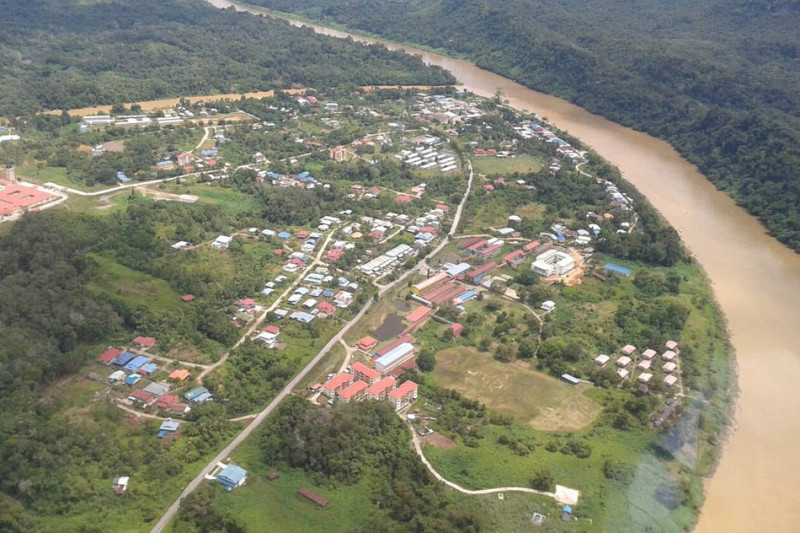

MIRI – Sarawak’s porous border with Kalimantan has raised fears of foreign workers bringing in more Covid-19 infections into the state via Belaga district.
The workers from Indonesia are believed to be making their way into Sarawak via rat trails to work in the many oil palm plantations during the current harvest and planting season.
Social and environmental activist in Belaga Harry Wing today told The Vibes there are concerns that the undocumented Indonesians are spreading the virus in remote parts of the district.
“I heard there are more cases of Indonesians found positive with Covid-19 in the remote parts of Belaga district. There are also claims that some of them who wound up dead are being carried back into Kalimantan via illegal routes.
“Belaga district has turned into a Covid-19 red zone, but there isn’t even a hospital here. The nearest one is Kapit Hospital which is five hours away by boat.
“We only have an isolation and treatment centre at the Belaga community hall for low-risk Covid-19 patients. The locals are very worried about the current situation, especially potential Covid-19 carriers among the undocumented Indonesians.”
Wing said it is worrying news that Sarawak health teams when conducting screenings at an outbreak zone in the RM8 billion Baleh hydroelectric dam project site in central Sarawak (Putai cluster) found dozens of undocumented workers.
“The project site has been placed under enhanced movement control order following the outbreak, as announced three days ago by the state Disaster Management Committee (DMC).
“Actions will be taken against contractors or sub-contractors found hiring the undocumented workers.”
The Baleh dam project that is currently under construction is owned by Sarawak Energy Bhd.
The main contractor is from China, handling the building of the 190m high dam across the Baleh River located deep in Belaga district.
On March 5, a local social-community organisation in the state had expressed alarm over the move by the Sarawak government to re-open its borders to foreign workers.
Baram People’s Action Committee (BPAC) had said re-opening the state’s border to foreign workers at this time of Covid-19 pandemic was akin to asking for more coronavirus infections from across the border to come into Sarawak.
BPAC chairman Philip Jau had told The Vibes that Sarawak government leaders seemed to have forgotten that neighbouring countries like Indonesia and the Philippines were still plagued by Covid-19, just like Sarawak.
“Sarawak gets its major portion of foreign workers from Indonesia and Philippines. This can be seen in the plantation, logging, housing construction and road construction and other industrial construction sectors throughout Sarawak where the biggest number of migrant workers are from these neighbouring countries.
“The latest move to allow up to 27,000 of such foreign workers to come into Sarawak again is like asking for more trouble in view of the fact that Covid-19 is still a serious threat in Sarawak and our neighbouring countries.
“Will Sarawak be able to thoroughly screen these 27,000 new foreign workers and make sure they do not carry any infections into our state? Already we have at least 200,000 foreign workers throughout Sarawak who have not even undergone Covid-19 screening and test,” he said.
Sarawak DMC chairman Datuk Douglas Uggah Embas on March 3 said the state government made the decision to re-hire foreign workers due to the heavy demands from many private companies.
He had said that despite the ongoing serious infections, the state reopened its borders to foreign workers because: “we, the state government, have received many applications from companies in Sarawak for foreign workers to be allowed in”.
“There are applications for 27,000 foreign workers needed by the plantation sectors, construction and heavy industrial sectors, services sectors, and the food sectors like restaurants.
“We are allowing these foreign workers back in starting March 1, but they must follow all standard operating procedures strictly.”
The Covid-19 death toll in Sarawak stands at 173, with about 30,000 infections so far. – The Vibes, April 30, 2021