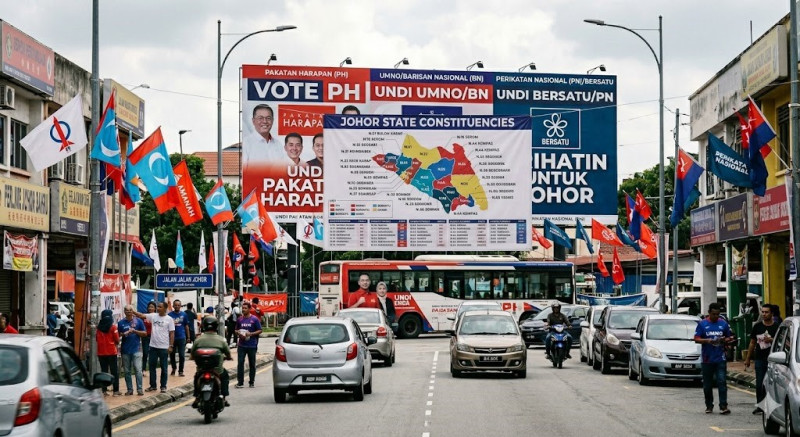
THE upcoming Johor state election, scheduled for 11 July, is expected to be defined by tightly contested “hotseat” constituencies and intensifying intra- and inter-coalition rivalries, with at least ten seats identified as highly vulnerable due to slim majorities and ongoing political realignments.
Seven of the constituencies classified as marginal were previously decided by fewer than 1,000 votes, underscoring the volatility of voter sentiment in closely fought areas.
Berita Harian reported today that the narrowest victory was recorded in Bukit Batu, where PKR’s Arthur Chiong Sen Sern secured a majority of just 137 votes, followed by Bukit Pasir, where Barisan Nasional–UMNO’s Mohamad Fazli Mohamad Salleh won by 198 votes.
Other highly marginal seats include Parit Yaani, held by BN–UMNO’s Datuk Najib Samuri with a 294-vote majority, Tangkak where PH–DAP’s Ee Chin Li prevailed by 372 votes, Serom, won by BN–UMNO’s Khairin-Nisa Ismail with 699 votes, Bukit Kepong, taken by PN–Bersatu’s Datuk Dr Sahruddin Jamal with a 710-vote margin, and Jementah secured by PH’s Ng Kor Sim with a 714-vote majority.
Beyond these closely contested constituencies, three additional seats — Tiram, Endau and Puteri Wangsa — are being shaped by internal disputes, defections and competing claims over party rights to field candidates.
In Tiram, a DAP-related internal realignment has emerged following the unexpected political retirement of former Skudai assemblyman Marina Ibrahim, raising questions over candidate placement and whether PKR will contest the seat, which was previously won by Barisan Nasional–UMNO with a majority of 5,281 votes in 2022.
In Endau, political tensions escalated after incumbent Alwiyah Talib defected from Bersatu back to UMNO on 4 June, fuelling speculation that she may be re-nominated under Barisan Nasional despite previously defending the seat for Perikatan Nasional, where she won by a 3,041-vote majority.
Meanwhile, Puteri Wangsa — currently held by MUDA president Amira Aisya Abdul Aziz — has become a focal point of inter-party contestation, with Johor AMANAH vice-chairman Dr Zuhan Zain arguing that the seat was only temporarily allocated to MUDA, a claim rejected by Johor PKR Youth chief Faezuddin Puad, who maintained that no constituency can be treated as permanently owned by any single party.
MUDA, for its part, has insisted it will defend its sole state assembly seat.
Political analyst Associate Professor Dr Mazlan Ali of Universiti Teknologi Malaysia told Berita Harian the election is expected to be significantly more competitive due to shifting alliances, the emergence of new political entities, and increasing voter focus on local issues and candidate performance.
“If five or six-cornered contests occur, that situation can cause votes to split into several political blocks, subsequently making it difficult for any single party to secure a victory with a large majority,” he said.
“To me, it is not impossible that no single party will be truly dominant after the election. If that situation happens, the formation of the government may require cooperation between several political parties,” he added, noting that the dissolution of the PAS–Bersatu alliance and the emergence of new political movements such as Bersama and Gerakan RESET could further fragment the electoral landscape. - June 13, 2026