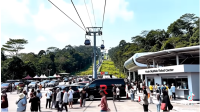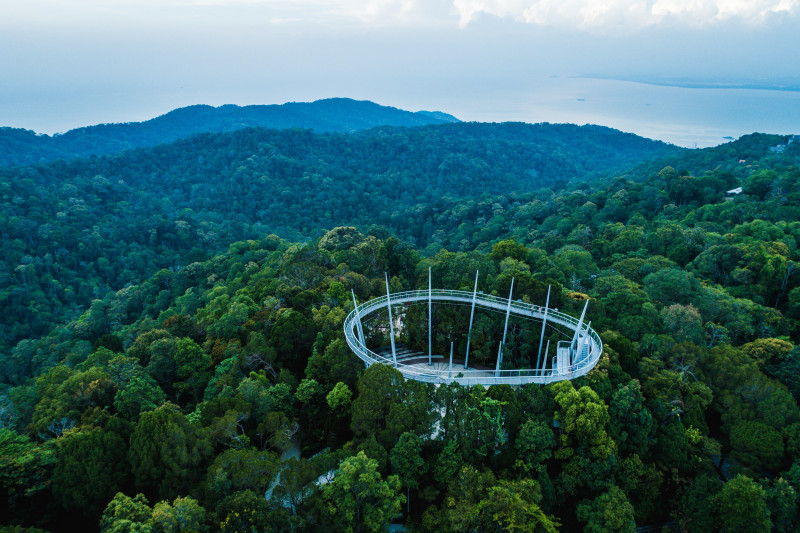

GEORGE TOWN – Will the controversial cable car project still go on now that Penang Hill has been designated a biosphere reserve by the UN Educational, Scientific and Cultural Organisation (Unesco)?
That is the question that has been swirling in the minds of civil society groups ever since the announcement was made on September 15.
The state government was quick to reply, saying that the proposed project does not affect the new recognition under Unesco’s Man and the Biosphere (MAB) programme, and is hence still in the works.
Civil society groups have spoken out against the mega transportation project.
Meenakshi Raman, president of Sahabat Alam Malaysia (SAM), questioned the methodology used in the cable car pre-feasibility study, which the Penang Hill Special Area Plan (SAP) 2020 is based on.
She believes that it is biased in favour of the project.
“The number that was proposed in the cable car pre-feasibility study is 6,463 people at any one time,” she said, referring to the official carrying capacity of the hill.
However, in the 2016 SAP, it was stated that the hill can take 4,800 people at any one time.
“If we stick to the 2016 SAP, there is no need for a cable car,” Meenakshi told The Vibes.
“The overarching objective is to limit numbers going up the hill, not escalate the numbers.”
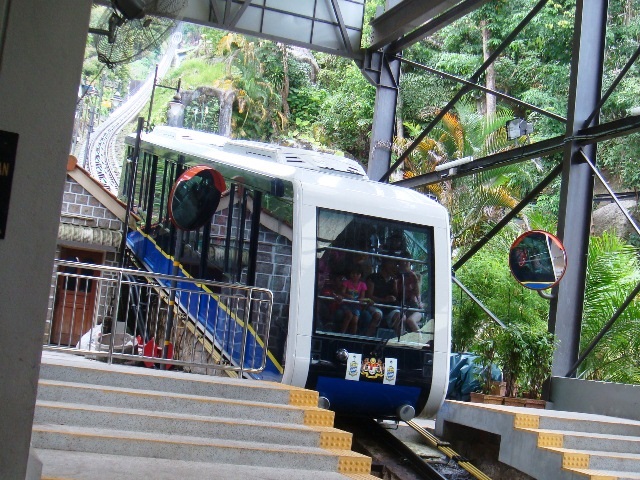
If more people are brought up to the hill, Meenakshi said, there will be a subsequent push for other tourism and commercial products to be introduced to the hill to make the cable car economically viable.
This will inevitably lead to more development on the hill.
“Even if we take the argument by Jagdeep that it will be built in the transition zone, the point is to not increase the (volume of) people up the hill,” she said, referring to state exco Jagdeep Singh Deo.
“What will happen if more people head up there? There will be more pressure for more and more tourism products on the hill.”
She also rubbished claims that a cable car is environmentally friendly, pointing out that the bottom station will take up space whether it is at the Youth Park or the Botanic Gardens.
“It is a fallacy to say that it has a small environmental footprint,” she said.
Meanwhile, Penang Hill Watch (PHW), a subgroup of the Penang Forum coalition of NGOs, called on authorities to be more sensitive to the risks of over-tourism or mass tourism and any form of infrastructure development on the hill that may not be in harmony with the objective of the Unesco listing.
It would be prudent for the state government to reconsider its proposal for building the cable car and instead redirect its resources to enhancing the natural attributes and facilities of Penang Hill, it said.
It added that this would be preferred by “new normal” tourists, in particular, outdoor-oriented and culture-based activities that make the best of the natural and historical heritage of Penang Hill without compromising its fragile ecological integrity.
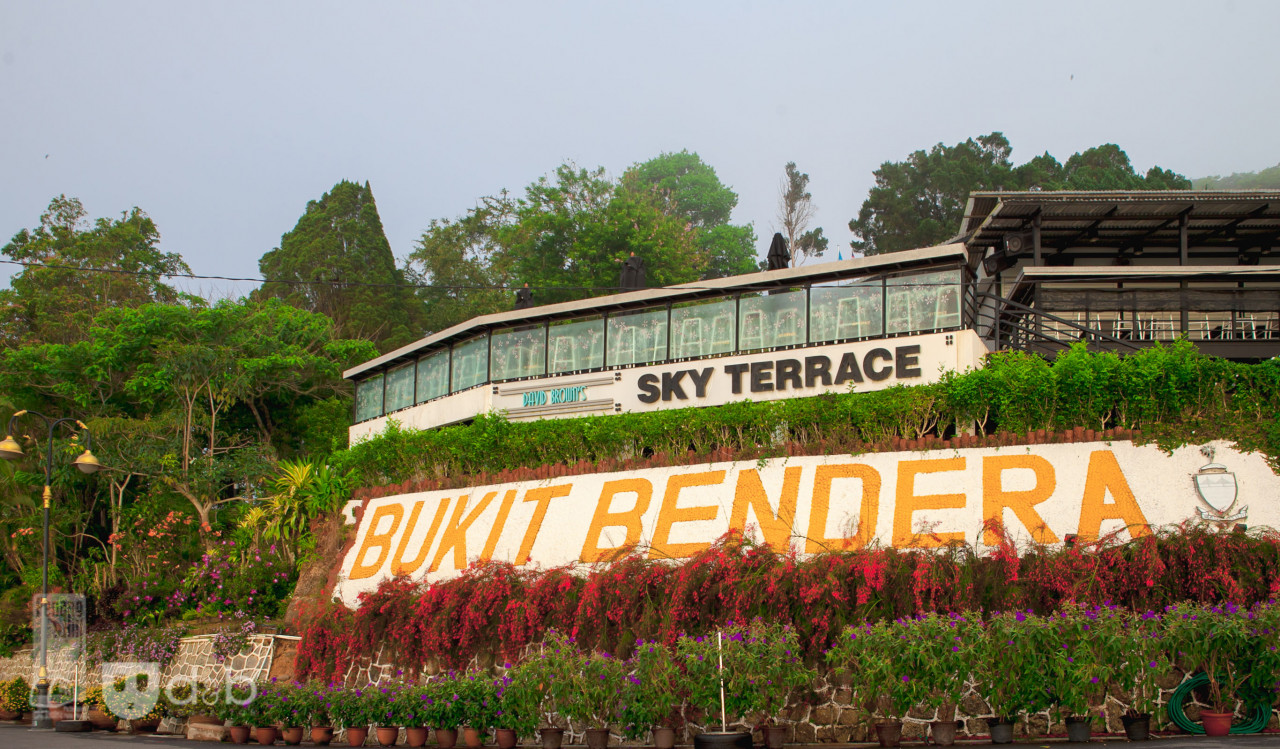
“With this listing, we are hopeful that these risks, some of which are already present within the boundaries of the Penang Hill Biosphere Reserve (PHBR), are managed and mitigated effectively,” PHW said in a statement.
“With its listing as a Unesco MAB site and in the wake of the Covid-19 pandemic as well as in the face of the looming climate change crisis, there is yet time and opportunity to rethink the development strategy of Penang Hill as set out in the 2020 Special Area Plan draft.”
Management unit must have enforcement powers
PHW also welcomed the state government’s decision to set up a management unit dedicated to managing the PHBR.
However, it stressed that the unit should not function only as a monitoring unit, but have enforcement powers as well as clout to garner the cooperation and resources of relevant government agencies to ensure effective management of the PHBR.
This is in the interest of biodiversity conservation as well as its long-term environmental sustainability, it added.
Yesterday, Jagdeep, who chairs the state’s Local Government, Housing, Town and Planning Committee portfolio, explained that the proposed cable car project would be located in the transition zone of the PHBR, and hence is allowed.
“We will ensure the (Unesco) status is maintained under this Penang government’s watch,” he said.
“The Unesco listing of the Penang Hill Biosphere Reserve is another feather in our cap. To all the naysayers out there, that is not easy for us to achieve.
“We want to allay your fears; we are doing this for the betterment of Penang.” – The Vibes, September 22, 2021
.jpeg)
.jpeg)