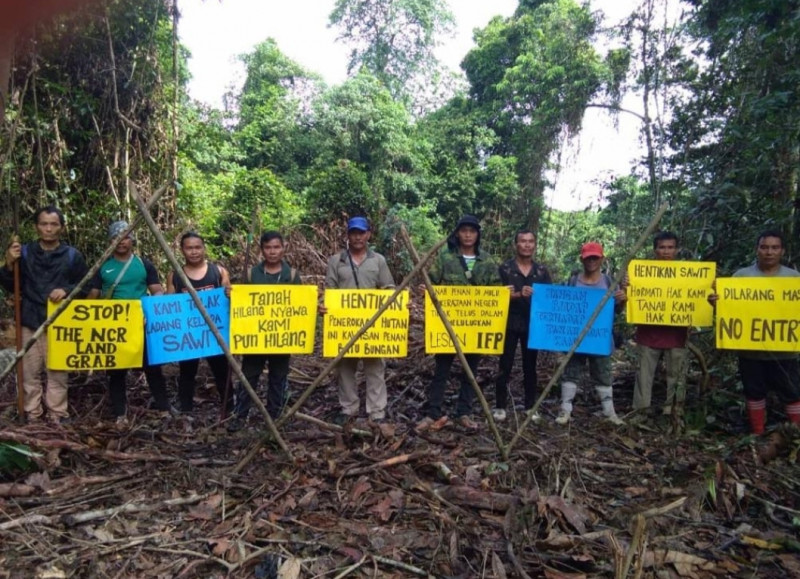

MIRI – A huge oil palm plantation project measuring 4,400 ha proposed by the state government adjacent to the Mulu National Park, which is a Unesco world heritage site, has been aborted following prolonged blockades by protesting natives.
Penan rights group Keruan Sarawak and Mulu social activist Willie Kajan confirmed separately that the project has been halted.
Kajan told The Vibes today that the massive project has been abandoned and that all clearing works at the site have stopped.
Keruan chairman Komeok Joe, meanwhile, also said that the state has stopped the operations and that there are now no more workers at the site.
“There were a lot of land clearings and felling of forests at the Mulu border region since 2018 but now all the works have stopped,” he said in a statement today.
“The workers have left and all the machinery, tractors and bulldozers have been taken away by the project developer. The workers said they were told to halt all work at the site,” he added.
Kajan said that the protests by the Mulu natives against the forest clearing had started way back in 2018 when the bulldozers started raking up the land and ploughing down the trees.
“We natives had set up a series of human blockades against the clearing of the Mulu fringes,” he said.
“It must be due to these protests that the state government has now stopped the plantation project.”
Komeok said that the Penan people are glad that the state authorities have listened to their calls.
Assessment of forest degradation needed
In a related matter, he told The Vibes that since Mulu is a world heritage site, it needs urgent ecological-climatic changes impact assessment by independent environmental experts as there are clear signs of worrying degradation with regards to temperature rise and flood frequency.
Komeok called on local and foreign non-governmental bodies to carry out a comprehensive assessment of the ground situation in the national park.
He said the park is seeing detrimental ecological changes as there is too much forest clearing around the edge of its zone.
“Extensive clearing of big tracts in the forests along the Mulu National Park border boundary for logging and then for plantations are causing serious impacts inside the national park as well.
“These human development projects have been getting more intense over the past years.
“There must be a thorough ecological impact study inside Mulu to determine the extent of changes to the weather pattern and flora and fauna,” Komeok said.
“As far as we Indigenous communities living in Mulu can see, the number of times serious floods have occurred inside the national park is a clear sign of impact.
“The impact on wildlife and water quality resources is also a worry. The temperature inside the park is getting hotter too,” he added.
“It will be good if there are outside experts willing to help our communities compile accurate findings on such ecological and climatic changes in Mulu, which is Sarawak’s biggest national park and only world heritage site,” he said.
Mulu is located about 200km inland from Miri city and is adjacent to Baram district.
Kajan is a native of Long Terawan settlement near the world-famous Mulu Caves and is a local tour leader with vast knowledge of the area, travelling regularly into the park and beyond.
He functions as a guide leading domestic and foreign tourists.
The Sarawak branch of national environment group Sahabat Alam Malaysia (SAM) is already carrying out a ground survey to determine the ecological damage extent caused by decades of massive logging and plantation operations in the vast Baram district in northern Sarawak where researchers had found rare and threatened species of trees, plants and animals.
SAM Sarawak coordinator Jok Jau Evong said his group had already visited specific locations in Baram whose size is as big as the state of Pahang.
He recently told The Vibes that he and his team are meeting with the numerous Indigenous communities to carry out surveys in and around their settlements and the surrounding sites where forests had been cleared for large-scale logging and plantation projects.
Jok said SAM intends to document and compile the information gathered into a comprehensive report, adding that there have been at least seven severe flash floods in Baram this year.
Last month, it was announced that the Penan and Orang Ulu natives in Baram district, with the help of local and American researchers, had completed a massive ecological and community heritage survey in the forest of Baram in the interior of northern Sarawak. – The Vibes, October 5, 2022