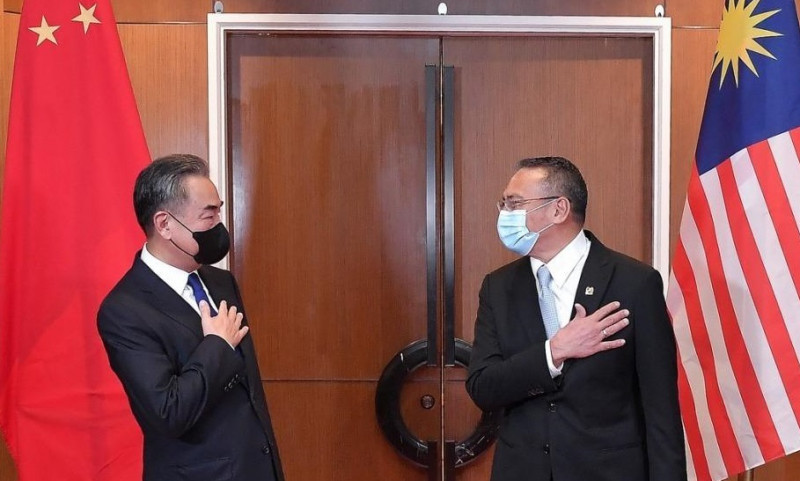
I JUST couldn’t believe I was reading it right: Foreign Minister Datuk Seri Hishammuddin Hussein calling China “big brother” in a televised press conference. Never in all my 36 years in the Foreign Ministry have I seen a Malaysian foreign minister grovelling before a foreign power this way.
In the face of criticism over his remarks, Hishammuddin could only quibble with words, claiming that he was not referring to relations between the two countries but merely showing respect to his counterpart, a senior Chinese statesman. It is a facile argument though.
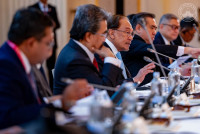
In the first place, it is quite clear from the video of the joint press conference that he was talking about Malaysia-China relations, not his personal relationship with State Councillor and Foreign Minister Wang Yi. In any case, he ought to know that when the foreign minister sits down to talk with his counterpart in another country, he speaks on behalf of his nation, never in a personal capacity. And, he always sits as an equal, as the official representative of a sovereign nation dealing with another sovereign representative. That is a bedrock principle in diplomacy.
Hishammuddin also couldn’t have been unaware of the meaning of “big brother” in the general sense of the term. The Cambridge dictionary defines it as “a way of referring to a government, ruler, or person in authority that has complete power and tries to control people’s behaviour and thoughts and limit their freedom”.
To refer either to China or to the Chinese foreign minister as “big brother” is, therefore, highly inappropriate. It is an admission of vassalage. It was so unprofessional and incongruous that even the Chinese foreign minister appeared embarrassed by it. He was, however, astute enough to quickly emphasise that both countries were on equal footing as “brothers”.
Although China has increasingly behaved like a regional hegemon, the last thing it wants to be accused of is acting like a “big brother” to its smaller and less powerful neighbours. Hishammuddin seemed blissfully unaware of the nuances and implications of his words.
By contrast, the statements by the Indonesian and Singaporean foreign ministers following their respective meetings with the Chinese foreign minister were professional, business-like and focused on their respective national priorities. There was none of the mushy fawning that was evident in Hishammuddin’s remarks; they have too much national self-respect and pride for that.
To refer either to China or to the Chinese foreign minister as “big brother” is, therefore, highly inappropriate. It is an admission of vassalage. It was so unprofessional and incongruous that even the Chinese foreign minister appeared embarrassed by it.
The context of Hishammuddin’s meeting – at a time when the rivalry between China and the US is intensifying – is also important. Both big powers are exerting immense pressure on Asean countries to take sides. Given the enormous strategic and economic interests that Asean enjoys with both countries, Asean (at least those that still remain outside the China orbit) has understandably avoided taking sides, calling for cooperation instead of competition. This has also been a pillar of Malaysia’s foreign policy going back to the days of Tun Abdul Razak.
By declaring China the “big brother”, Hishammuddin, intentionally or otherwise, appeared to signal that Malaysia is now leaning towards China. While Beijing will no doubt be quietly ecstatic, Washington will be miffed; there will be consequences. Though he has since insisted that Malaysia remains “independent, principled and pragmatic”, Hishammuddin’s intemperate remarks have undermined confidence in the direction of Malaysia’s foreign policy.
Faced with growing international isolation over the 1Malaysia Development Bhd affair, Datuk Seri Najib Razak hinted, during his November 2016 visit to China, that some sort of agreement under which China would protect and defend Malaysia’s sovereignty was under consideration. It alarmed our neighbours, raised concerns in Washington and other capitals, and threatened to undermine our sacrosanct policy of remaining non-aligned. Upon coming to office, prime minister Tun Dr Mahathir Mohamad quickly reaffirmed our traditional policy of equidistance between the big powers. Under yet another unpopular government, are we now drifting back into an informal alliance with China?
Hishammuddin’s behaviour, however, shouldn’t come as too much of a surprise. When he was defence minister, he went out of his way to appease China, continuously downplaying the dozens of Chinese incursions into our waters. When the then chief minister of Sarawak complained that Malaysian fishermen were being driven out of their traditional fishing grounds by Chinese naval vessels, Hishammuddin blithely offered to arrange for the chief minister to have tea with the Chinese ambassador.
Of course, no one wants to see hostile relations with China but, surely, burying our heads in the sand in the face of aggressive moves by China to challenge our territorial integrity requires more of a response than an invitation to tea. What agenda is the minister pursuing vis-à-vis China?
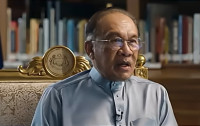
Kudos to Datuk Seri Anwar Ibrahim, the leader of the opposition, for rightly taking Hishammuddin to task over his “tasteless” statement. “This is not the language or style that should be used in global diplomacy and international relations,” he had said, adding that “it makes it look as if Malaysia is a foreign puppet”. Former foreign minister Datuk Seri Anifah Aman, too, criticised what he called Hishammuddin’s “faux pas”.
But, where are all the leaders who not so long ago worked themselves into a frenzy over the loss of their dignity? Where’s the “maruah” in being so submissive to a foreign power? – The Vibes, April 5, 2021
Datuk Dennis Ignatius is a former ambassador