
DEAR readers, let’s try an exercise: try to think of the thing you are most ashamed of. That one thing you dare not bring up in casual conversation, the one thing you know would only be met with disapproval, criticism, judgment, scorn, disdain and contempt.
Got it? Didn’t take that long, right?
Now, let’s try something else: try to think of the last time you made someone else feel ashamed. It could have been an off-hand comment that you didn’t realise would be taken badly, or maybe it was something you said on purpose and with clear intent to try to change someone’s mind.
Maybe your sincere opinion was sought, and you were simply being honest. Maybe you were just pissed off and it really didn’t matter who was at the sharp end of your words.
Finding the second part a little difficult? That’s not particularly surprising.
Shame has an effect on people unlike almost any other emotion. Sure, like guilt, it stems from feelings of wrongdoing, but with guilt you tend to feel bad about a specific action, or inaction, a particular choice you made. With guilt, your focus is primarily on the feelings of others.
But with shame, you turn inwards. And that feeling isn’t confined to a certain deed. With shame, your entire being is wrong; you are an inherently terrible person, a bad friend, an insolent daughter, an overbearing boss, an undependable worker.
Shame sticks with us because it blankets what we perceive to be our most profound weaknesses, and bears the risk of opening the door through which all our family, friends and colleagues will walk out of should they find out how flawed we are, how we simply aren’t good enough.
With shame comes the distinct and overpowering belief that you have violated the unwritten rules of society, that you have transgressed or fallen short of what is expected of you, that there is part of you in need of repair – or a good place to hide.
Which is why shame is such a powerful weapon.
And it’s not even nuclear-level weaponry, mind you. It’s there in the conversations between parent and child – “Shame on you for not studying as hard as your friends and getting poor marks”. It’s there between you and your boss – “Shame on you for making the same mistakes over and over, and ruining my Saturday”. It’s even there between you and your friends – “Shame on you for complaining about being lonely even though you didn’t take my advice to join Tinder”.
It’s the killing of confidence by a thousand little cuts.
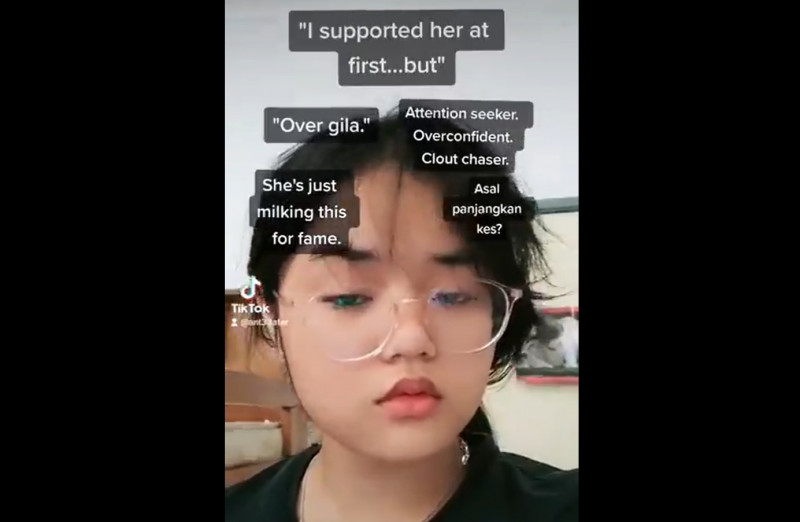
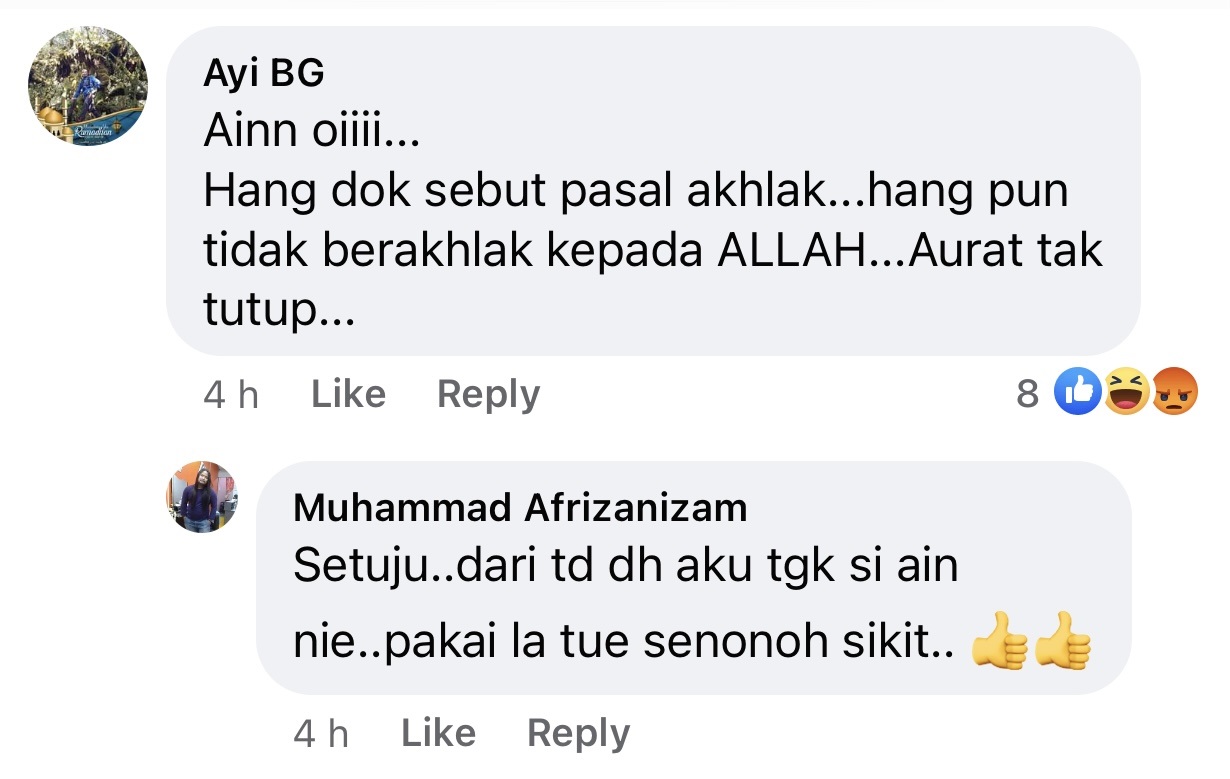
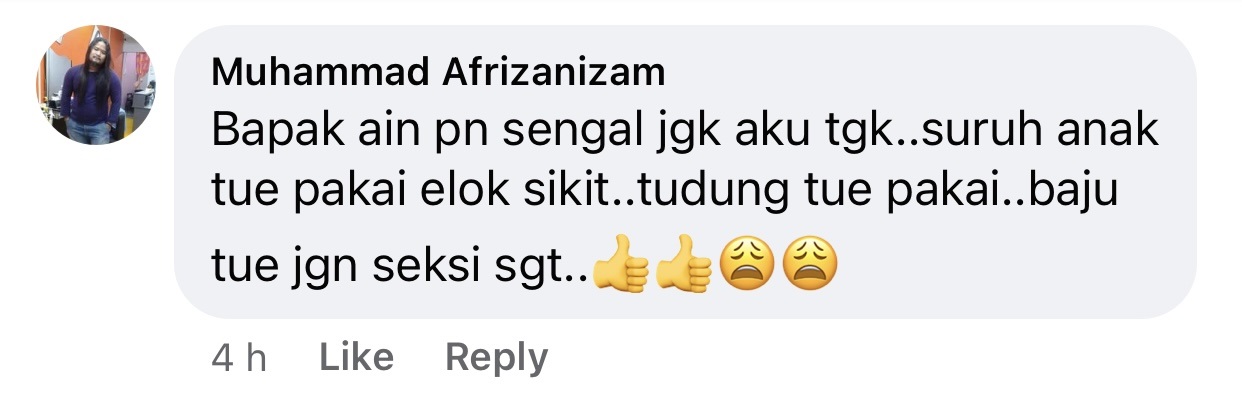
Or, in Ain Husniza Saiful Nizam’s case, a thousand Facebook comments.
After enduring criticism and even a rape threat after speaking up about a teacher’s rape “joke” in class, the flood of abuse, slurs and smears against Ain Husniza has yet to stop. Even her school principal seemed to have joined the fray, allegedly calling her “anak setan” on Facebook.
What, you may ask, is the motivation behind this? Are these people really spurred by pure intentions to “fix” Ain Husniza’s “inappropriate” behaviour because they are so invested in her welfare? Have they always been full of good advice with no one to direct it to until now? Are they really, truly, vehemently, afraid for her soul and want a better afterlife for her? Or does it feel really good riding that high horse and trampling over the young and defenceless?
Threat response to shaming
Redirect, your honour: perhaps the question should be, does shame alter behaviour? And if it does, is it worth employing?
Let’s ask the myriad politicians and elected officials facing trial right now. Has the shame of accusations (and, ahem, convictions) of graft, money laundering, bribery, lying and stealing left them feeling so humiliated to the point of giving up their office or being unable to face their constituents again? Is the sting of being caught in flagrante delicto enough to keep them from leading their political parties, asking voters for donations or showing their faces in the hallowed halls of Parliament? Or does the Malaysian populace simply have an uncanny ability to vote into office members of the citizenry with the highest tolerance for shame? If so, we better get Merdeka Centre on that survey ASAP.
I can count on about zero hands the zero number of times a politician has stepped down from office due to allegations of wrongdoing and the shame that (should) come with it in recent years. But maybe that speaks to the computation of shame itself: does it only work if we care about the opinions of those doling out the humiliation? Does the element of power matter when it comes to the effectiveness and extent of the shame to adjust your conduct? Does it matter how many people tell you you are wrong before you start to believe it?
If so, what does that tell us about those who remain in political power and are able to drown out the critical voices of the masses, the people they are supposed to serve?
While studies don’t discount the possibility that shame can alter behaviour, the “threat response many people experience during shame is a big part of why it’s so counterproductive” and could result in “efforts to hide unacceptable behaviours driving one to secrecy, deception... all to escape detection”.
So, the pain of shame doesn’t work for everybody, and even if it does, employing it as a means of control is dicey business indeed.
For your average teen, who is more sensitive to and feels shame more deeply, using embarrassment and humiliation (especially if you are a faceless nobody running your mouth on social media) to keep them “in line” is not only counterproductive, but destructive, hurtful and toxic, and could affect them for years to come, even into adulthood.
So, forget about making just our schools a safe place; all of Malaysia, in the virtual and physical plane, must be safe places for all our children. Forget about trying to nail down dirty politicians on a case-by-case basis; fix the system and close the loopholes that allow corruption to fester.
If we can sit by and watch fully grown adults disparage our children beyond reproach, if we can allow teachers who joke about rape to continue walking school corridors while students who speak their minds are threatened with expulsion, if we can watch men and women continue to pilfer taxpayer money and line their pockets with their filthy lucre, then – and I hate to end it this way – shame on us. – The Vibes, May 17, 2021
Fuzeani Fauzi is assistant chief sub-editor at The Vibes who fears getting her fight-or-flight instinct permanently stuck on fight