
.png)
ON Tuesday, new Covid-19 infections in Malaysia numbered 7,654, the first time the daily tally crossed the 7,000 mark in a month. The Klang Valley contributed more than 60 of each 100 cases that day.
Selangor logged 3,260 cases, while Kuala Lumpur had 1,550, bringing the total in these two areas to 4,819, or 63% of the Tuesday caseload.
But, the population of Selangor and KL stands at 8.3 million – 26%, or slightly over a quarter, of the Malaysian population. That works out to this: the area’s contribution to the national Covid-19 rate is some 2½ times its population share. Why?
We need to know the answer to that if we are to deal with the latest coronavirus problem. The two tables below show the cases for Malaysia on July 5 and 6.
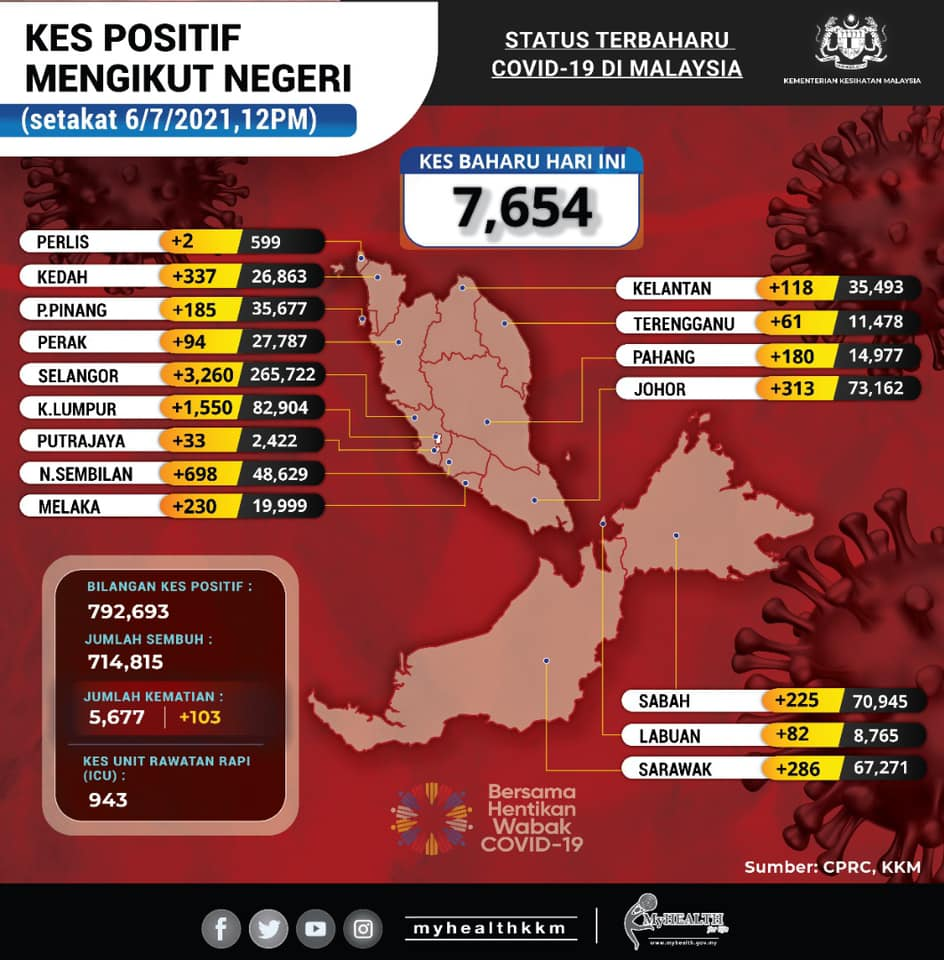
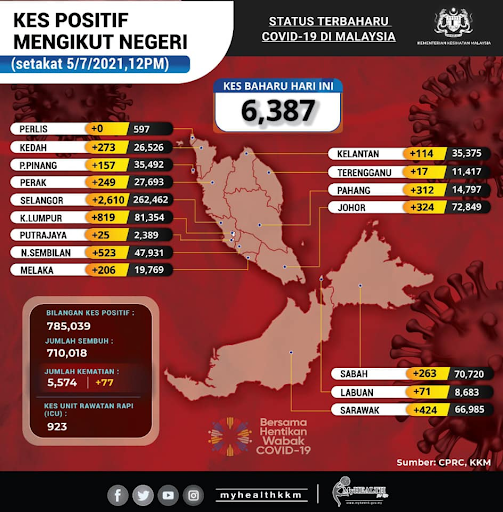
From these tables, we have constructed a comparison table of new cases for the two days, and will attempt to draw some conclusions. This is hampered by the availability of good data, but is still a useful exercise.
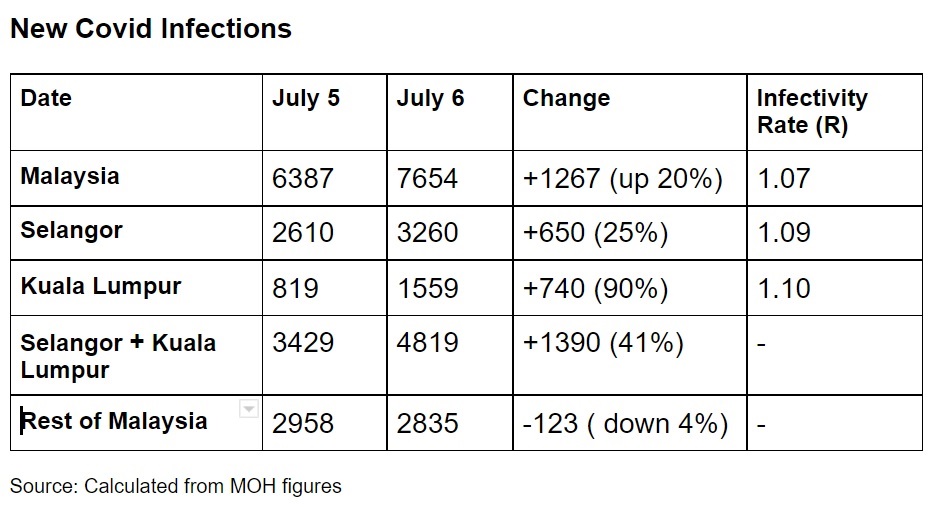
From the table, it can be seen that fresh infections in Malaysia rose 20% on July 6 from the previous day. An infectivity rate (R) of 1.07 indicates that 100 people will infect 107 others, showing that the numbers will trend up further out.
That’s a concern because only 8.6% of Malaysians have been fully vaccinated, which means if Covid-19 hits hard and wide, many of us can become seriously ill, and the load on the health system, which is already seriously high, can result in an increase in deaths and patients in serious condition. We cannot yet afford that; perhaps towards year-end, when we vaccinate 70% to 80% of Malaysians.
The other thing to note is that most of Malaysia’s Covid-19 cases now come from Selangor and KL. Between July 5 and 6, Selangor’s cases went up 25% to 3,260, while KL saw an upsetting 90% increase to 1,550. Together, they accounted for 4,819 cases – 63% of infections nationwide.
The bright spot is that the rest of Malaysia, accounting for nearly three-quarters of the population, saw a 4% decline in cases to 2,835, which indicates a drop in infections. But that’s not very encouraging. Many states have an R of over 1, indicating that cases are set to increase.
It raises the question of why daily cases in Selangor and KL are much higher. Could it be due to factories? Perhaps.
A new term has been introduced into the Covid-19 lexicon: sporadic infections. These are infections that cannot be traced to any cluster, and are in the community.
In mid-May, Health Director-General Tan Sri Dr Noor Hisham Abdullah said 80% of recently reported infections then did not belong to any cluster, meaning they were sporadic.
The full movement control order (FMCO) imposed on June 1 should have controlled that by limiting movement within the community, and it did, initially. But then, it did not any more, leading to the enhanced MCO (EMCO) in many places in Selangor and KL.
Malaysia – infectivity rate v daily cases
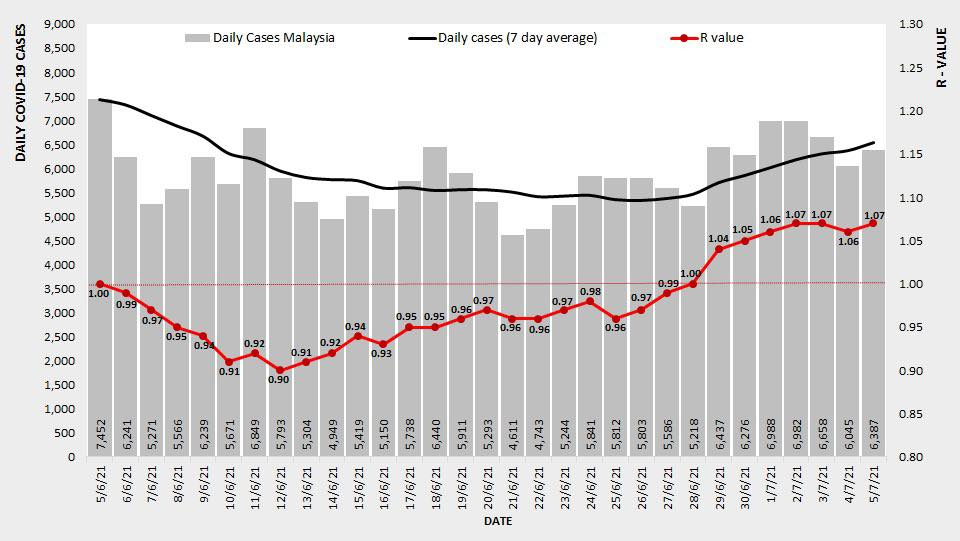
The chart showing R versus daily cases does indicate that in the early stages of the FMCO, the numbers and infectivity rate did come down, with R at 0.9 on June 12. But, this may have been due to reduced testing. Since then, it has been going up, reaching 1.07 despite the imposition of the EMCO on large swathes of KL and Selangor.
The tragedy is that despite the FMCO and EMCO, the daily infection numbers and R are seeing a steady uptrend. This is worrisome, and it is imperative that the root causes of the sharp deterioration in Selangor and KL’s situation are identified.
Considering that movement within the community has been severely curtailed, the obvious thing would be workplace infections. The International Trade and Industry Ministry may be a bit too easy with granting approvals to operate, for instance.
Minister Datuk Seri Mohamed Azmin Ali was quoted as saying on June 28 that only 10% of Covid-19 cases are from the manufacturing sector, with just 25% from various clusters stemming from the workplace.
But, that analysis may be wrong. Sporadic cases may have their origins in workplace infections. This may be the reason why despite the FMCO and EMCO, they continue to persist.
The answer may be a form of targeted MCO at factories and other places with Covid-19 cases because of conditions that make for easy transmission, instead of a blanket MCO imposed on entire districts. We need data to establish this. If we can do this confidently, it may mean greater economic activity and less hardship all around.
It is blasé to forget the numbers now; it is too early for them not to matter. We have some way to go before we reach a good vaccination level. In the meantime, we still have work to do in terms of keeping the numbers down.
Otherwise, we might face a disaster such as we have never known before. – The Vibes, July 8, 2021
P. Gunasegaram says Covid-19 is too serious to fool around and experiment with; better to err on the side of caution. He is chief executive of research and advocacy organisation Sekhar Institute and editorial consultant of The Vibes










.JPG)