-WIKIPEDIA.jpg)
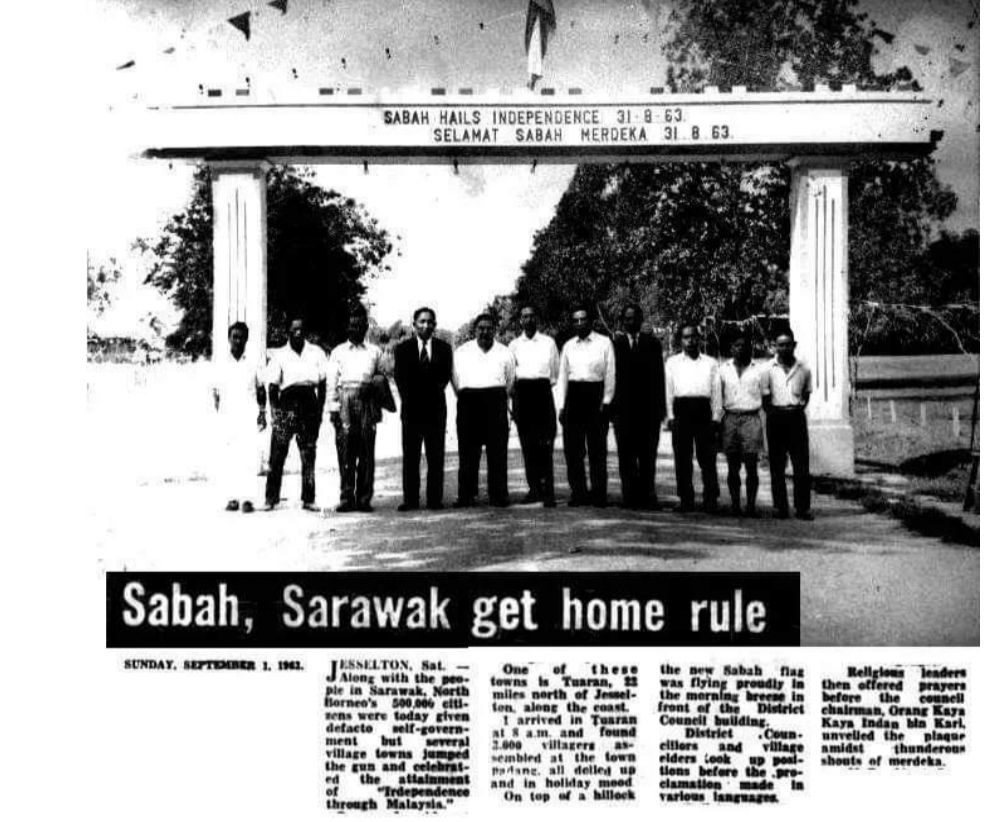
KOTA KINABALU – This time each year, a picture on an arch bearing the words “Sabah hails Merdeka” will make its rounds on social media.
And every year on August 31, it triggers a debate on whether Sabah attained independence or otherwise.
For those in Peninsular Malaysia, it is undoubtedly the day when the federated states of Malaya proclaimed independence on August 31, 1957.
But no, not the case in Sabah.
On August 31, 1963, the newspapers read that Sabah had attained self-goverment, but there was no proclamation of independence.
Unlike Sarawak, a proclamation of Merdeka was done by then chief minister Stephen Kalong Ningkan, with the final words of the proclamation reading: “Sarawak has on this day attained independence as a state of Malaysia.”
Not to be misconstrued by the meaning of state as “negeri”, as it means something else for the people in that era.
Note that the British Crown Colony had identified North Borneo as a “state” during its reign in Sabah.
Sabah, on the other hand, had then chief minister Tun Fuad Stephens read the Proclamation of Malaysia on September 16, 1963.
Local history buffs argue that, although Fuad did not read or come out with the state’s own proclamation on Sabah 16 days earlier, Sabah did attain independence by means of definition.
Firstly, the creation of a de facto government led by Fuad and secondly, the ceremonious lowering of the Union Jack and raising of the Sabah flag on August 31, 1963.
But that government only lasted for 16 days as it became the de jure government after merging with the federation of Malaya, to which the federal government has become the de facto government.
The story bears resemblance to the current government of Malaysia, which is a de jure government.
A de jure government is the legal, legitimate government of a state and is so recognised by other states.
In contrast, a de facto government is in actual possession of authority and control of the state or for some, a government elected by the will of the people.
The absence of a proclamation in Sabah has been touted as the reason behind why the state does not have the legal means to declare a “Sabah Day”.
True enough, the ruling party Sabah Progressive Party is now demanding that the state legalise “Sabah Day” as a public holiday for the state.
This is also probably why August 31 is recognised as North Borneo self-government day.
Such a call started in 2018.
On the contrary, Sarawak has a Sarawak Day, celebrated annually on July 22. It is also branded as Sarawak Independence Day.
The reality for Sabah is that self-government is only legislation churned out by the British, but it did not provide for independence prior to the formation of Malaysia.
But the cause of such confusion led to the politically correct term “National Day”.
Yet, for many Sabahans, August 31, 1963, is still an important date, as it was the start of a true and only Sabah government with self-rule.
Sadly, that government only existed for 16 days before the people in this part of Malaysia ushered in the birth of the country. – The Vibes, August 31, 2021
Jason Santos is The Vibes’ Sabah bureau head