

AS a result of an extended MCO, I’ve been distracted this entire week with two key thoughts. The first was, “Oh good, more time to plan ahead and prepare content for work”, and the second was, “Oh no, when will all this blow over?”
As someone who identifies herself as an introvert, I can do without social interaction for a few days but even one who keeps herself company with a to-do list knows that it’s unhealthy to live in isolation for an extended period of time.
We all need physical connection, and the frustration of not being able to connect with family and friends since Christmas has finally set in.
Awareness is the ability to perceive a given situation and feel the need for change. Without it, I would be happily moseying around my introverted cave and humming like a Smurfette, completely unaware of my impending isolation.
Awareness also helps in facilitating movement by connecting our mind to our body. It’s one of the ten principles in Contrology (now known as the Pilates method) along with control, concentration and other principles I’ll share in the coming weeks.
Why is mind-body awareness important?
It’s the reason we’re able to feel a change in our bodies after waking up from an awkward sleeping position or the ‘aha’ moment when you consciously activate your obliques instead of just your neck muscles.
Mind-body awareness is often overlooked as a health priority because there is no tangible, external evidence of its growth, unlike booty gains or abdominal definition. Without it, we wouldn’t know if we’re firing the right muscles or progressing in our workouts.
Only when you’re aware, can action be taken.
Have you ever chatted happily with a friend only to return home to your bathroom mirror and discover that you had a smidge of spinach stuck between your teeth the whole time you were talking ─ one can’t help but imagine how distracting that must have been for my friend!
That’s precisely the case with Pilates: the first few times might not feel like anything, but one day, while you’re performing your one-hundredth exercise, something suddenly clicks in your body. Your brain forms a connection to the movement and you finally understand what your instructor meant by core control.
As your mind-body connection strengthens, with a deeper understanding and increased awareness, you gain better control of your body with familiar movements or even with new ones that have shared similarities.
Ways to Build Mind-Body Connection
1. Ask an expert for feedback: Consulting your Pilates instructor or personal trainer will help you understand the “why” behind movement mechanics, along with things you might not be aware of. For example, you may know how to activate your glutes in a squat but not realise that if you position your hips too far forward, it can apply undue stress to your lower back.
2. Use a mirror: Your mind may be quick to understand concepts, but your body could be in a different ‘zone’ altogether. Since the mind-body connection takes time, you can quicken the process and keep track of your movements by using a mirror or a video recording to obtain immediate feedback. Applying these small changes will help you progress in your workouts.
3. Practice, practice, pause, and repeat: Our body is changing every day: yesterday’s teaser may have been a breeze but today, you can barely find your balance. Be patient and keep practising. At times, you’ll be better off taking a break from a particular exercise and revisiting it on another day.
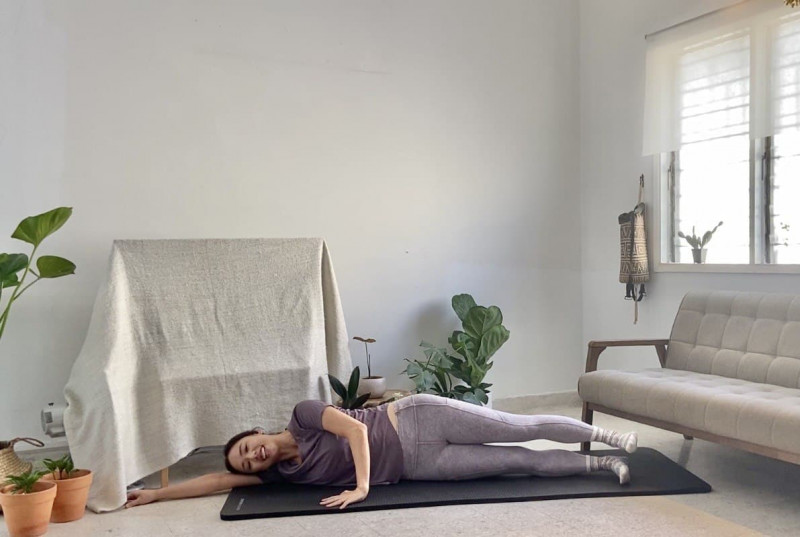
Let’s all move into action with the video below. Today, our awareness is on the glutes. For my kindred anatomy nerds, we’re going to focus specifically on the gluteus medius, gluteus minimus and the hamstrings.
Get ready to fire up that derrière for today’s Pilates workout. ─ The Vibes, 10 February, 2021