

LAST week, I talked about how movement efficiency and developing minor muscle groups in Pilates can strengthen larger muscle groups. Today, we’re taking it up a notch and building upon the foundational movements of the Pelvic Tilt, Leg Lifts & Leg Changes, which I’d shared in my previous article. If you haven’t read it or need a quick recap, you can access it here.
As fitness and movement studios in the Klang Valley were recently allowed to open ─ provided they adhere to current MCO protocols ─ I was excited to get back into The Flow Studio ─ where I teach group reformer Pilates ─ and engage with the Pilates community as nothing beats moving together in the same room and feeling each other’s energy.
Returning to in-person teaching reminded me of ‘collective joy’, a term coined by Kelly Mcgonigal, a health psychologist and lecturer at Stanford University.
What is Collective Joy?
As you know, endorphins are feel-good neurotransmitters that kick in during a workout, but have you ever wondered why working out on your own is different from working out in a group, or why we tend to enjoy watching events ‘live’ as opposed to watching them on TV?
The answer is because neurochemical hormones, such as endocannabinoids, dopamine, and oxytocin, tend to increase in your body when you move. The result of these hormones makes it easier to bond and connect with others.
Movement brings connection
Mcgonigal refers to this as collective joy. “When you move with others at the same time, your brain starts to perceive me not as separate from you but almost like a superorganism that you and I are both a part of," says Mcgonigal.
In these moments of collective movement, we are reminded that we are all a part of something bigger, beyond ourselves. The author, Brené Brown, also talks about this in her work and how collective joy (and collective pain) is a sacred experience.
At times, when we need that extra boost of motivation to challenge ourselves, we can glance around the room and know that we aren’t alone. Moving alongside others in synchronicity reminds us that we need one another.
Movement guides you to self-discovery
The benefit of moving collectively doesn’t stop at establishing a connection, it also helps us to centre ourselves. It helps you to define who you are and what you can become.
For instance, when you step into a Pilates reformer class, your strength and balance will be challenged. You may have moments where you reach your threshold for stress and feel like giving up. When you forge those mind-body connection patterns, you’re not just physically stronger, you become more resilient to what life throws at you. What you experience in your movement sessions will translate to other areas in life.
Movement creates meaning
As creative humans, we look for meaning and purpose in what we do. There’s an exercise in Pilates performed on the reformer called the Long Stretch. You’re in a front support or plank position and you’re having to balance the muscle tension between the front and back of your body. There are no stops or holding shapes.
It’s a continuous flow and balance between propelling forward and creating length despite the discomfort ─ a metaphor for when you are literally being stretched beyond comfort but choose to propel forward.
Can collective joy be experienced virtually? I believe it can. It’s how you show up in a room, physical or virtual, and shine your light for the benefit of others.
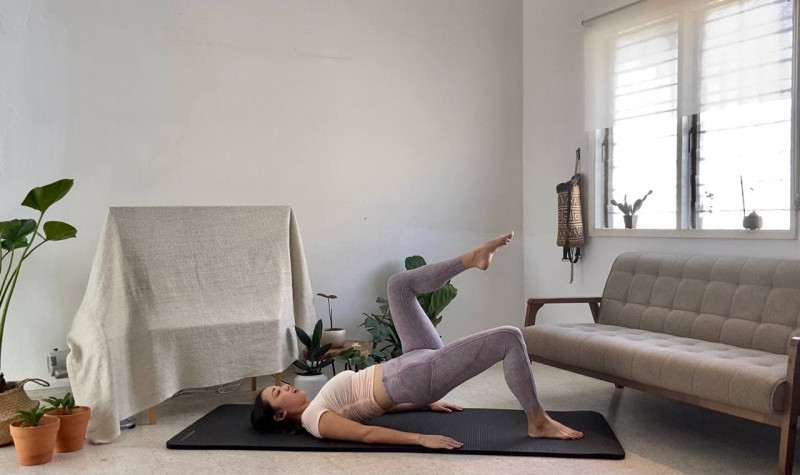
Are you ready for a collective joy moment with me? This week’s workout focuses on the Pilates principle of Control. As you move through the dynamic movement sequence, focus on being in control of your body versus letting momentum power your movement.
Enjoy moving! ─ The Vibes, 3 March, 2021