GOLF has been a thing for the men in my family. My koong koong, my husband and his dad, and my dad are all recreational golfers. Growing up, I moved between a few countries, and wherever we went, so did dad’s clubs. I wish I could say I inherited his talent in the sport but I don’t. The closest I’ve gotten to it was playing a round of putt-putt or the one time dad let me be the caddy. Needless to say, that was the first and last time in the role. Let’s just say driving a golf cart is not my forte!
Recreational sportsmen and women should be celebrated more. A dedication to a sport for over 4 decades says something about both the person and the movement method. It’s becoming an uncommon bond rarely seen today in our fast-paced climate where fitness trends change as rapidly as an upward swipe of the finger. I wonder what the magic spark is that keeps my dad going. Perhaps it’s a triad of physical challenge meets scenic fairway and a community of friends with no rush to be somewhere. Ultimately, we all should find a physical activity that motivates us to be consistent and rise above challenges.
Like any sport, consistency and upkeep of one’s body are key. It’s important for golfers to keep their mobility, especially if they want longevity in playing their sport. Spinal mobility is important for a golfer’s stroke and swing. Quality over quantity is the key to this game, thus, it is essential to have good thoracic mobility. However, a mobile upper-body swing without a strong lower-body base to support one’s swing is ineffective. Building a golfer’s mind-body connection while strengthening the abdominals and back muscles will unlock freedom of movement.
Top Exercises for Golfers
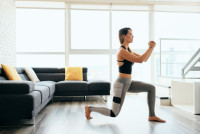
Exercises that stabilise the lower-body while involving spinal rotation will give golfers power in their swing. The Kneeling Lunge or Standing Lunge is a reformer pilates exercise that can be modified for home practice on the mat. One foot is in front while the back leg is either kneeling or standing. The objective is to stabilise the torso with one dominant leg. Once this is achieved, the added component of thoracic rotation can be worked on. As golfers are inclined to having one dominant leg and side that they rotate towards, it’s important to also work on the secondary side to promote balance and avoid back pain or other common golf injuries.
The Pelvic Curl (also known as the Glute Bridge) is important for golfers as it strengthens the largest muscle of the body, the gluteus maximus, which is also part of the core muscles. Start lying down with feet on the floor, the hips and spine are elevated by contracting the hamstrings and glutes, while the abdominals and back muscles stabilise the hips. Common mistakes seen when performing it are hyperextending the back to elevate the hips or letting the knees abduct, losing connection between knees, ankles,and feet. This exercise is great for all ages and it can also be progressed to the Shoulder Bridge, where one leg is off the floor, or by adding a resistance band. Put these exercises to practice as I guide you through them in the video below. - The Vibes. April 28, 2021