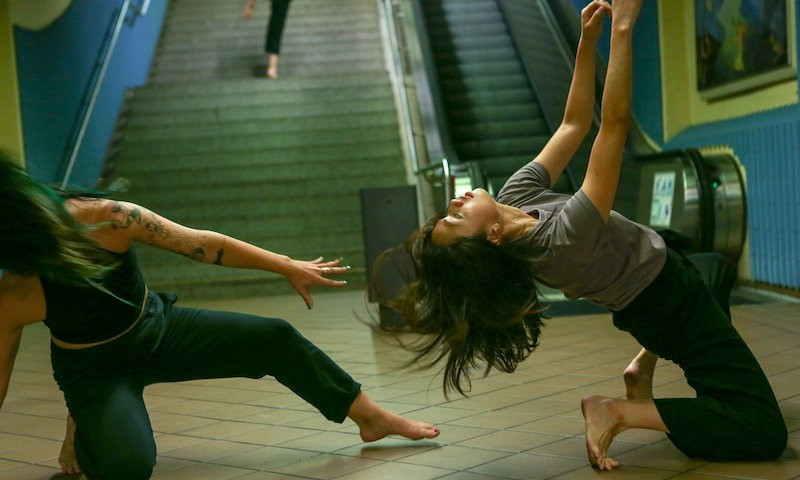

I timidly entered my first class on movement improvisation in the Fall of ‘09 in Jackson, Mississippi. That class pried me open like an oyster who’s sand granules unearthed the capacity to hold value within them. Improvisation taught me that my voice as a 20-year-old mattered and the thoughts embodied through movement were valid. Society tends to make fun of movement improvisation by referring to it as interpretive dance.
Oftentimes when I tell people I’m a dance-artist educator by profession, I’ve seen strangers turn into musical box figurines while balletically raising their arms above their head. Or others enjoin me, “show us a dance!” To give them the benefit of the doubt, they might not have met many people who make the Arts their lifelong career. The limited amount of discourse and lack of vocabulary is a larger echo of society as a whole and its perspective of performing artists.
However, the Arts teaches us more. It teaches us that we need to reflect and interpret the world around us for ourselves. It’s more than just an audience’s form of escape or an entertain-me-mindset. It’s a catalyst that develops lifelong creators who have the ability to access limitless creativity.
Movement improvisation shows up in my everyday life. Learning to move in any space has taught me to create no matter where I am. It has broadened my perspective. I see the world around me differently. Places that are usually seen as mundane are reimagined into a mental playground.
Below are some key lessons I’ve learned (along with personal views from my wonderful students) that will spark your curiosity, cultivate your creativity, and hopefully, encourage you to move in a new way.
1. Dance like no one’s watching
“It doesn’t matter who’s watching. It’s about feeling and expressing.” Nicholas Augustin
Remember that scene from Napoleon Dynamite where he starts dancing to Jamiroquai in front of the entire high school? That iconic dance number was entirely freestyle i.e. improvised by Jon Heder’s character most associated with dance improvisation. What I love about that scene is the complete surrender to the music and the feeling of sheer abandonment conveyed through the screen.
2. Embrace the unexpected
“It opened up more possibilities..to explore more ways to move.” - Jamie Tan
Bobby McFerrin defined improvisation as a “means of coming to the situation without rigid expectations or preconceptions.” The American vocalist known for his improvisational vocal percussion and his song “Don’t Worry, Be Happy”, reminds us that ultimately, it begins with what we allow ourselves to do or not to do. Choose to make the first move.
3. Learn to let go
“Go with the flow..and react” - Madelyn Leaw
Another former student of mine, Tan Wei Ling, said “I had to allow myself to react without overthinking.” Whether it be reacting to fellow movers in the studio or to music, she came to the point where she chose to step out of her comfort zone and into, as she coins it, a “don’t think, just do” situation. It’s truly in those moments of letting go that you’re able to express yourself as you are and with freedom. As McFerrin says, “The key to improvisation is motion -- you keep going forward, fearful or not, living from moment to moment. That’s how life is.”
Now, it’s your turn. Check out the video below to explore a movement improvisation task. You won’t know until you’ve tried!


.jpg)