THE countdown is on for 2024, which is shaping up as the year of moon landings.
As many as 12 missions could fly by or land on the moon in the next 12 months, the most in one year.
Three missions are expected in January alone.
Japan’s SLIM mission is targeting January 19 for its first lunar landing. If successful, it will be only the fifth country to successfully reach the lunar surface after Russia, the United States, China, and India (which landed there in 2023).
Two companies are racing to achieve the first commercial landing on a celestial body. Intuitive Machines and Astrobotic are part of Nasa’s Commercial Lunar Payload Services (CLPS) programme and represent the growing ambitions of the US commercial space sector.
There are three primary overlapping reasons for such intense interest in the Moon.
First, the cost of space access continues to decline as the price of launch vehicles and spacecraft systems fall.
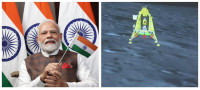
This opens the market to new participants as lunar missions can cost less US$100 million (RM465.5 million), as demonstrated by India’s 2023 Chandrayaan-3.
The development of commercial capability, like Intuitive Machines and Astrobotic, is especially exciting as it can allow purely commercial missions or delivery of payloads from nations without their own lunar landing capabilities.
Indeed, Astrobotic’s mission is carrying small rovers developed by Mexico for that nation’s first lunar mission.
Mining and competition
Second, there is intense scientific and economic interest in lunar exploration and resources.
The moon likely has minable water resources, which can be used for in-space refuelling and to support astronauts. Many of 2024’s missions are either directly or indirectly focused on the search for water.
Third, the re-emergence of geopolitical competition has led to significant support for civil space programmes.
Competing visions of international cooperation in space, like the US-led Artemis Accords and the China-led International Lunar Research Station, are rapidly being adopted by many firstcomers to space exploration.
Underscoring this competition, both China and the US have planned flagship missions in 2024.
In May, China plans to launch the Chang’e 6 mission to return the first scientific samples from the lunar far side.
Following the successful sample return from the Chang’e 5 mission, Chang’e 6 will further demonstrate China’s ability to operate across all parts of the lunar surface.
A successful mission will keep the country on track for its goal to land taikonauts by 2030. Notably, the lander will also host instruments from Pakistan, Italy, France and Sweden.
Return of humans to moon
In November, the US plans to launch the Artemis II mission to fly by the moon carrying a human crew.
Artemis II’s four astronauts, including one Canadian, will be the first to leave Earth orbit since the 1970s.
This mission will lay the groundwork for a crewed return to the lunar surface in 2026 or 2027, with an expectation for continual missions by the end of the decade and establishment of a lunar surface base in the early 2030s.
Beyond these larger missions, several smaller flybys, orbiters, and landers are planned. China is sending a relay satellite that can support future missions to the south pole.
A Japanese mission is planning a flyby on the way to an asteroid while the private company ispace is attempting to land again after 2023’s near miss.
Perhaps the most exciting of the other missions is Nasa’s Viper rover, which is heading to the lunar south pole.
The moon’s south pole is home to permanently shadowed regions, areas that never receive sunlight and are expected to contain substantial deposits of volatiles like water.
The rover is designed to search for these volatiles, crossing into the shadowed regions to take samples. Viper is solar powered, however, and so will only be able to briefly operate and explore those areas.
Nevertheless, it is possible that it could confirm that there are sufficient quantities of ice to support mining operations, unlocking the potential for lunar development this decade.
Irreversible momentum
Not all of these missions will be successful. Even landing on the moon is a technological challenge, as illustrated by the loss of Russia’s Luna 25 lander in 2023.
Landing is the first major hurdle to securing lunar surface access. With so many commercial and national landing attempts in 2024, the success of even two or three would mark a major technological feat.
Successful landings, and even lessons learned from failures, will prove that newcomer countries and private industry can reach the moon.
The culmination of so many missions this year represents the last five years of renewed focus on the moon.
Even with these high-profile missions, the most important developments for lunar development in 2024 are likely to be on Earth.
After years of development, multiple launch vehicles capable of lunar delivery are expected to see their maiden flights.
Astrobotic’s January mission will be launched on ULA’s Vulcan, Europe’s Ariane 6 is expected to fly mid-year, and Blue Origin’s New Glenn could even reach orbit. All three will expand lunar access.
The most high-profile, however, is SpaceX’s Starship, which reached space in November 2023. An orbital launch attempt is almost certain in 2024.
Starship is Nasa’s human lander for Artemis III, so Starship’s success in 2024 will determine whether human landing is on track for the 2020s.
Next year is also likely to see continued geopolitical progress.
India joined the Artemis Accords in 2023, marking a major shift in lunar geopolitics and a success in US diplomacy.
More countries are likely to join either the Artemis Accords or the International Lunar Research Station in 2024.
Ultimately, the next 12 months could signal that lunar exploration has irreversible momentum. If multiple landers are successful, 2024 will mark the beginning of the modern lunar era. – 360info, December 24, 2023
Alex Gilbert is a fellow at the Payne Institute for Public Policy at the Colorado School of Mines and is a PhD student in its Space Resources programme.
Published under Creative Commons and in partnership with 360info.org